

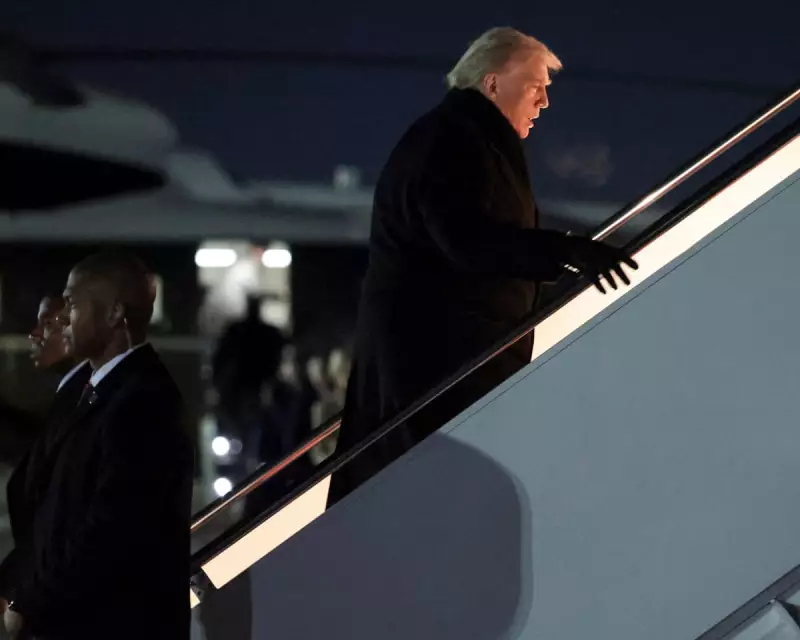
President Donald Trump's journey to the World Economic Forum in Davos, Switzerland, encountered an unexpected disruption when his official aircraft, Air Force One, was forced to return to Washington DC shortly after departure. The decision was made following the detection of what officials described as a "minor electrical issue" onboard.
Unplanned Turnaround Due to Electrical Fault
The incident occurred on Tuesday evening as Air Force One took off from Joint Base Andrews. According to White House Press Secretary Karoline Leavitt, the crew identified the fault shortly after becoming airborne, prompting a cautious return to base. A pool reporter travelling with the president noted that lights in the press cabin flickered off briefly during the flight, though no immediate explanation was provided at that moment.
Leavitt emphasised that the turnaround was executed "out of an abundance of caution" to ensure the safety of all onboard. This unscheduled return was expected to delay President Trump's arrival in Davos, where he is scheduled to participate in high-level discussions at the international forum.

Trump Continues Journey on Backup Aircraft
Undeterred by the technical setback, President Trump promptly boarded an alternative aircraft to continue his trip to Switzerland. He transferred to an Air Force C-32, a modified Boeing 757 typically utilised for domestic travel to smaller airports. The departure occurred shortly after midnight, allowing the presidential delegation to proceed with their itinerary.
Ageing Presidential Fleet Under Scrutiny
The two Boeing 747 jets that currently serve as Air Force One have been in operational service for nearly four decades, raising questions about their reliability and maintenance requirements. Boeing's efforts to deliver replacement aircraft have faced repeated delays, complicating fleet modernisation plans.
Controversy previously emerged in 2025 when Qatar's ruling family presented President Trump with a luxury Boeing 747-8 intended for inclusion in the presidential fleet. This gesture attracted intense scrutiny and the aircraft is presently undergoing refitting to meet stringent US security standards. Speaking to reporters onboard after the electrical issue, Leavitt remarked that the Qatari jet was sounding like a "much better" option at that particular moment.
Broader Context of Transportation Incidents
This incident follows other recent technical problems affecting US government aircraft. In February 2025, a military plane carrying Secretary of State Marco Rubio to Germany had to return to Washington due to a mechanical issue. Furthermore, in October of the same year, an aircraft transporting Defence Secretary Pete Hegseth made an emergency landing in Britain after developing a crack in its windshield.
Technical malfunctions on the presidential jet remain relatively rare owing to meticulous maintenance protocols. A notable precedent occurred in 2006 when the primary Air Force One experienced a mechanical malfunction while stationed in Ho Chi Minh City, Vietnam. This incident forced President George W. Bush to utilise the backup aircraft, a Boeing 757, for his subsequent flight to Indonesia.
Davos Agenda Overshadowed by Political Tensions
President Trump's participation in the World Economic Forum occurs against a backdrop of significant geopolitical tensions. His administration has threatened to impose tariffs on European countries concerning the ongoing dispute over Greenland, which the president has repeatedly expressed determination to acquire.
Speaking to reporters before his original departure, Trump hinted at a dramatic forum, stating: "Let's put it this way: it's going to be a very interesting Davos." Earlier, during a press briefing marking his first anniversary in office, he remained cryptic about his intentions regarding Greenland, telling journalists: "You'll find out."
The presidential delegation travelling to Davos includes several key figures: Secretary of State Marco Rubio, White House Chief of Staff Susie Wiles, Deputy Chief of Staff Stephen Miller, and National Economic Council Director Kevin Hassett. Their discussions at the forum are anticipated to address critical economic and diplomatic issues amidst current international uncertainties.






