

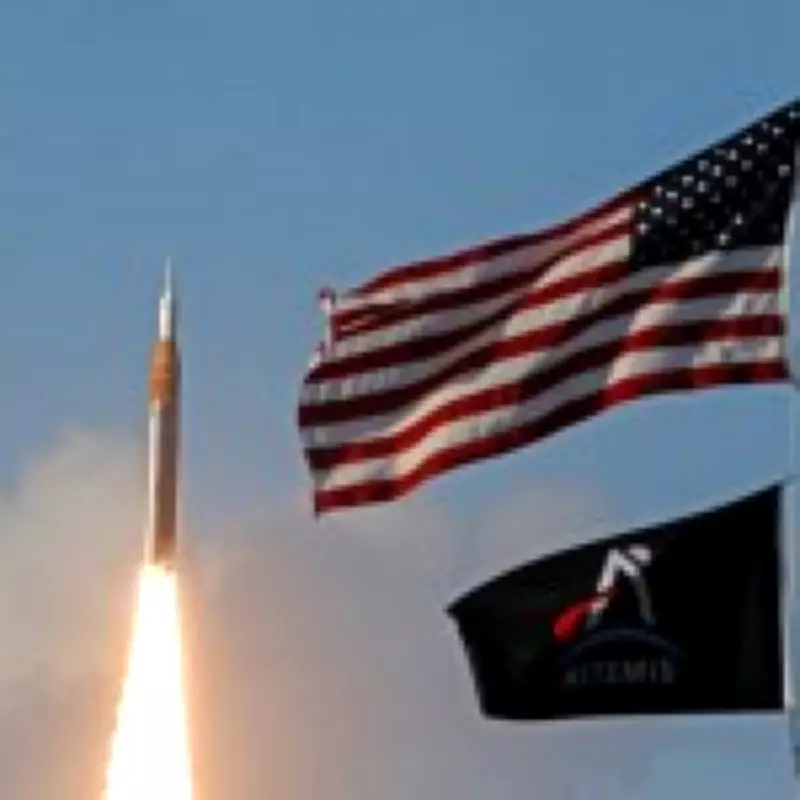
NASA's Artemis II mission has embarked on its historic journey to the moon, with four astronauts experiencing a rare view of Earth from space. The launch occurred on Wednesday, propelling Reid Wiseman, Victor Glover, Christina Koch, and Jeremy Hansen toward our lunar neighbor. This mission marks a significant step in human space exploration, following the separation of the Orion capsule from the rocket after a trans-lunar injection maneuver.
Tracking the Artemis II Mission in Real-Time
To monitor the progress of Artemis II, NASA has developed the Artemis Real-time Orbit Website (AROW), a specialized tracker also accessible via the space agency's mobile app. This tool provides live updates on the Orion capsule's location and speed. Currently, the spacecraft is traveling at approximately 5,000 miles per hour, with over 81,000 miles covered and 174,000 miles remaining to reach the moon. The app even allows users to visualize Orion's position relative to Earth by holding up their phones.
Record-Breaking Distance and Lunar Exploration
As Artemis II passes behind the moon, it will set a new record for the farthest distance humans have traveled from Earth, reaching 252,799 miles. This milestone enables the crew to observe the far side of the moon, a hemisphere perpetually hidden from Earth's view. Dr. Alfredo Carpineti, an astrophysicist and author, expressed excitement about this opportunity, noting that the astronauts will see regions never directly viewed by humans before.

The moon's tidally locked nature means one side always faces Earth, while the other, often called the 'dark side,' remains less studied. Unlike the crater-marked near side, this area could offer insights into the early solar system. According to NASA's itinerary, the lunar flyby is scheduled for April 6, lasting about two days. During this time, the moon will appear to the astronauts as the size of a basketball held at arm's length, with April 7 dedicated primarily to photography and video documentation.
Return Trajectory and Mission Safety
Following the lunar encounter, Artemis II will enter a 'free return' trajectory, utilizing the moon's gravity to swing the capsule back toward Earth. This design ensures that Orion could return safely even in the event of propulsion system failure. NASA maintains constant communication with the spacecraft, receiving data at the Mission Control Center in Houston to track its position accurately.
If the mission proceeds as planned, Orion will splash down in the Pacific Ocean near San Diego. This journey not only advances scientific knowledge but also paves the way for future lunar explorations. The Artemis II mission underscores NASA's commitment to pushing the boundaries of space travel and discovery.






