

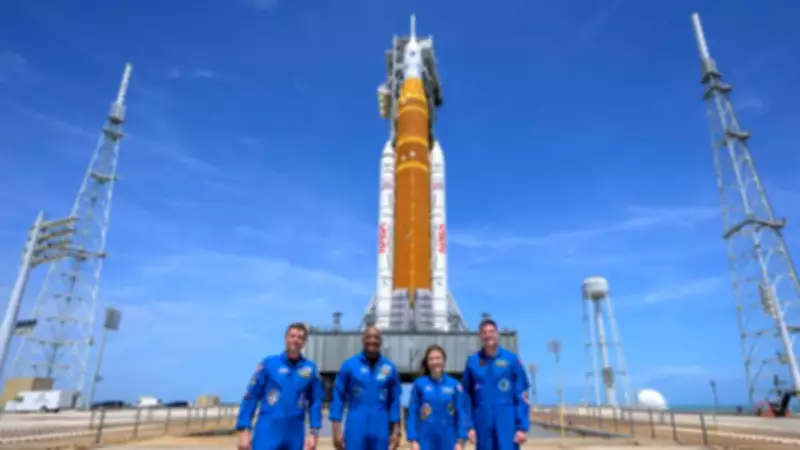
NASA's Artemis II mission is on the brink of a historic launch, heralding the first manned journey around the moon in more than five decades. The countdown has officially commenced, with the 32-storey Space Launch System (SLS) rocket scheduled to blast off from the Kennedy Space Centre in Florida on Wednesday. This monumental event will send four astronauts on a 10-day flight that will culminate in a splashdown in the Pacific Ocean, reigniting humanity's lunar ambitions.
Preparations and Readiness for the Launch
At a briefing held on Monday, Emily Nelson, NASA's chief flight director, expressed unwavering confidence in the mission's preparedness. She stated that teams in mission control and the crew members are "ready to go", underscoring the extensive training and meticulous planning that have gone into this endeavor. This launch follows the successful Artemis I mission in November 2022, which orbited the moon without astronauts on board, setting the stage for this crewed follow-up.
Overcoming Challenges and Delays
The path to launch has not been without obstacles. In February, a liquid hydrogen leak during a practice launch forced NASA to delay the operation until Wednesday. Standing at an impressive 98 meters tall, roughly the height of Parliament's Elizabeth Tower housing Big Ben, the SLS rocket represents a pinnacle of modern aerospace engineering. This mission marks a significant step forward, as Artemis II will carry astronauts but not land on the moon; that milestone is reserved for the subsequent Artemis III mission.

The Astronauts and International Collaboration
The crew for this groundbreaking flight includes NASA astronauts Reid Wiseman, Victor Glover, and Christina Koch, alongside Jeremy Hansen from the Canadian Space Agency. Their selection highlights the international nature of space exploration today. British astronaut Major Tim Peake has emphasized Europe's substantial involvement in the Artemis programme, noting contributions such as the European service module that powers the Orion spacecraft, providing essential electrical power, life support systems, and propellant.
Future Ambitions and Lunar Base Camp
NASA envisions the Artemis missions as a foundation for establishing a base camp on the moon's surface, with long-term goals that include using this outpost as a stepping stone for human missions to Mars. The agency has a launch window from the first six days of April, after which it will stand down until the end of the month if necessary. This mission not only revives the legacy of Apollo 17 in 1972, the last human moon landing, but also paves the way for a new era of space exploration, fostering global cooperation and technological advancement.






