

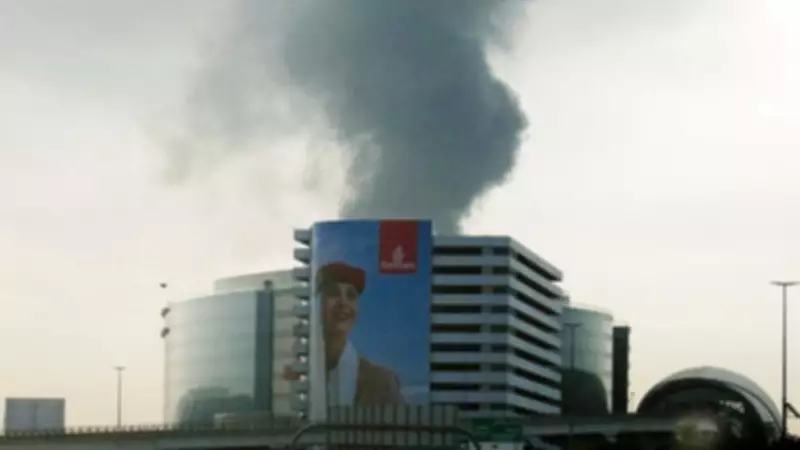
Dubai Airport Grinds to a Halt After Drone Attack on Fuel Tank
In a major aviation crisis, Dubai International Airport suspended all operations early Monday morning after a drone strike hit a nearby fuel storage facility, causing widespread disruption for thousands of UK passengers. The airport announced the shutdown at 1.36am GMT, leading to immediate flight cancellations and diversions across the region.
UK Flights Forced to Turn Back Mid-Journey
Five flights departing from UK airports were compelled to return to their origins due to the sudden closure. Most notably, an Emirates flight from Edinburgh had advanced as far as Egyptian airspace before being ordered to reverse course and land back in Scotland. An Emirates spokesperson confirmed, "We can confirm the flight [EK24] returned to Edinburgh due to operational disruption."
Other travelers faced similar upheaval, with a flight from London Stansted being diverted to Vienna, Austria, just short of its Dubai destination. The incident has exacerbated travel woes for many stranded in the Middle East since the onset of US-Israeli military operations against Iran in late February.

Gradual Resumption Amid Ongoing Challenges
By Monday morning, Dubai International Airport indicated that flights were gradually resuming to selected destinations, though the impact is expected to linger. All seven Emirates flights from Dubai to London Heathrow were cancelled for the day, highlighting the severity of the disruption. Airports in Dubai, Doha, and Abu Dhabi, which collectively handle around half a million passengers daily, serve as critical hubs for travel between Europe, Asia, and Australia.
In a related development, Ireland's Minister for Foreign Affairs, Helen McEntee, announced on social media that Qatar Airlines will resume flights from Doha to Dublin starting Friday, 20 March 2026, with four direct weekly services. This partial recovery offers a glimmer of hope amid the broader aviation chaos.
The drone strike not only caused immediate flight halts but also damaged infrastructure, as seen in images of workers inspecting affected areas. This event underscores the vulnerability of key transport hubs to geopolitical tensions and security threats, with ripple effects felt by travelers worldwide.






