

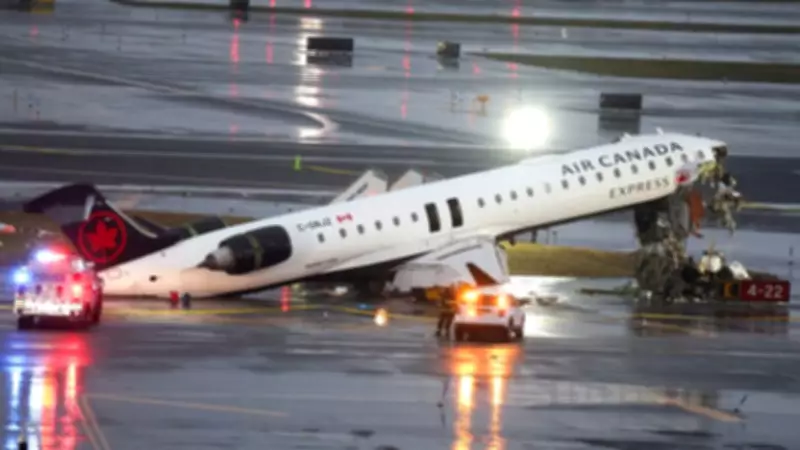
LaGuardia Airport Crash: Controller's Desperate 'Stop' Commands Revealed in Audio
Air traffic control recordings have revealed a series of increasingly urgent commands for a fire engine to stop moments before it collided with an Air Canada regional jet at New York's LaGuardia Airport. The tragic incident resulted in the deaths of both pilots and left dozens injured, casting a spotlight on runway safety protocols at one of America's busiest airports.
The Fatal Sequence of Events
According to released audio recordings, the air traffic controller initially provided clearance for the emergency vehicle to cross runway four, instructing "truck one and company" to "cross four, Delta." However, the situation rapidly escalated as the controller's tone shifted dramatically. The subsequent transmission changed to "stop there, please," before escalating into a panicked plea of "stop, stop, stop, truck one, stop."
For reasons that remain under investigation, these warnings went unheeded. The Bombardier CRJ-900, which had just arrived from Montreal carrying approximately 70 passengers and four crew members, plowed into the fire engine with its nose. The impact was catastrophic, completely disintegrating the aircraft's front section and rolling the emergency vehicle onto its side.

Casualties and Immediate Aftermath
The collision proved fatal for both the pilot and co-pilot of the Air Canada flight. In a particularly harrowing detail, sources revealed to Sky News' US partner network NBC News that a flight attendant was found outside the aircraft still strapped into her seat. Meanwhile, two individuals in the fire engine sustained injuries, though authorities confirmed these were not life-threatening.
Forty-one passengers were transported to local hospitals, some with serious injuries. Passenger Rebecca Liquori described the terrifying moment of impact to News12 Long Island, stating, "Everybody just jolted out of their seats. People hit their heads. People were bleeding."
Airport Operations and Official Responses
The crash caused massive disruption at LaGuardia, with more than 600 flights cancelled by midday according to FlightAware.com. Although the airport has since reopened, Transport Secretary Sean Duffy announced it would operate at reduced capacity for "some time" during a press conference addressing the incident.
President Donald Trump characterized the situation as "terrible" during remarks to reporters, acknowledging that a "mistake" had occurred. Meanwhile, audio from approximately twenty minutes after the crash captured the air traffic controller expressing personal responsibility, stating, "We were dealing with an emergency earlier. I messed up."
Broader Context and Safety Systems
The incident raises questions about runway safety despite LaGuardia being one of thirty-five US airports equipped with an advanced surface surveillance system designed to track aircraft and ground vehicles. Former Federal Aviation Administration air traffic control chief Mike McCormick told Associated Press that while the US faces a well-documented shortage of air traffic controllers, LaGuardia does not typically experience "perennial staffing problems."
The fire engine had been responding to reports of a strange odor on another aircraft when the collision occurred. Jazz Aviation was operating the service on behalf of Air Canada, with the Montreal-to-New York flight normally taking about ninety minutes. The investigation continues as authorities work to determine the exact sequence of failures that led to this tragic runway incident.






