

London Couple's 22-Hour Dubai Airport Ordeal Amid Middle East Conflict
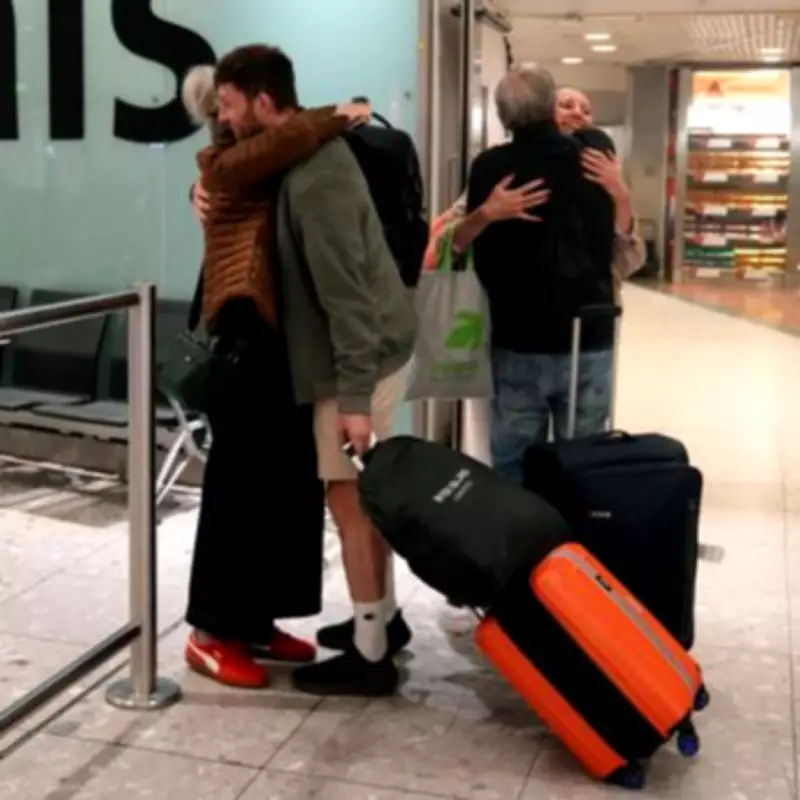
A London couple has recounted their harrowing experience of being stranded for 22 hours at Dubai International Airport, describing chaotic scenes as they waited for a flight home amid escalating Middle East tensions. Lee Smart, 36, and his partner Nina Luminati, 35, from Thornton Heath in south London, finally arrived at Heathrow Terminal 3 on Wednesday afternoon after spending the night sleeping on airport chairs.
Wedding Trip Turns Into Travel Nightmare
The couple was returning from a wedding celebration in India when their travel plans were abruptly disrupted last Saturday. While waiting for their connecting flight to the United Kingdom in the United Arab Emirates, they found themselves among thousands of stranded passengers as airspace restrictions took effect following US and Israeli military actions against Iran.
"We were advised by our hotel to get to the airport yesterday morning and then it was just a bit of carnage," Mr. Smart told reporters in the Heathrow arrivals hall. "I think many hotels told people the same thing. Maybe they were trying to get people out."

Chaotic Scenes and Repatriation Efforts
The couple had been placed on multiple waiting lists for flights home but struggled to secure seats until they finally boarded Emirates flight EK001, which departed Dubai at 7:45 AM on Wednesday. They acknowledged that while they missed the initial repatriation flights due to their position in lengthy queues, the situation in Dubai itself remained relatively calm despite the surrounding conflict.
"It was pretty calm in the city, despite everything that was going on," Mr. Smart noted. "I think the UAE government did an amazing job to be honest."
Family Reunion and Emotional Relief
Upon their arrival in London, the exhausted travelers were greeted by Nina's parents, Sue and Terry Luminati from Teddington in southwest London. Sue Luminati described how her daughter and partner had "scrambled" to reach Dubai airport once they realized the severity of the travel disruption.
"Once they got there it was an absolute nightmare," she explained. "There were obviously thousands of people all in the same position. It's very difficult to give advice in this situation because it is so unprecedented."
She detailed the impossible decisions facing stranded travelers: "Do you get on? Do you stay there and hold your ground? Do you get on a plane, or do you go back, try and get a hotel and relax and wait for it to calm down. They stayed there, and that's why they're on this flight today. Because they were there at the right time to be able to get a seat."
Widespread Flight Cancellations and Alternative Routes
The couple's ordeal reflects a broader travel crisis affecting the region. Aviation analytics company Cirium reported that 23 out of 33 scheduled flights from the UAE to the UK on Wednesday were cancelled. All 17 flights from Qatar to the UK were axed, along with all three from Bahrain and both from Kuwait.
British Airways announced it remains unable to operate scheduled flights from Abu Dhabi, Amman, Bahrain, Doha, Dubai, and Tel Aviv. However, the airline has arranged additional flights between Muscat, Oman and London Heathrow, with two more scheduled for Friday and Saturday. All these flights are reportedly fully booked.
Government Response and Evacuation Efforts
Prime Minister Sir Keir Starmer informed Parliament that more than 1,000 British nationals returned to the UK on commercial flights from the UAE on Tuesday alone. Eight additional UK flights were scheduled to depart from the UAE on Wednesday, with two further government-chartered flights planned from Oman in coming days.
Muscat has emerged as a crucial evacuation hub, as the Foreign Office has not issued travel advisories against visiting Oman's capital region, unlike its warnings for Dubai, Abu Dhabi, and Doha airports. The approximately 300-mile road journey from Dubai to Muscat has become a viable alternative for those seeking to leave the region.

Long-Term Travel Disruption Expected
Flight-tracking service Flightradar24 noted that Muscat has "become a popular alternative for flying out of the region" but warned that "almost all scheduled flights from Muscat are fully booked." The service also reported increased private jet charters for those who can afford alternative evacuation options.
With approximately half a million passengers typically using Dubai, Doha, and Abu Dhabi airports daily as vital hubs connecting Europe with Asia and Australia, aviation experts predict it could take weeks to clear the passenger backlog created by the current conflict-related disruptions.
The Foreign Office continues to advise British nationals in the region: "There are a limited number of commercial options available, including by air from UAE and from Oman. If your presence in UAE is not essential, you may wish to consider departing – if you judge you can access these options safely."





