

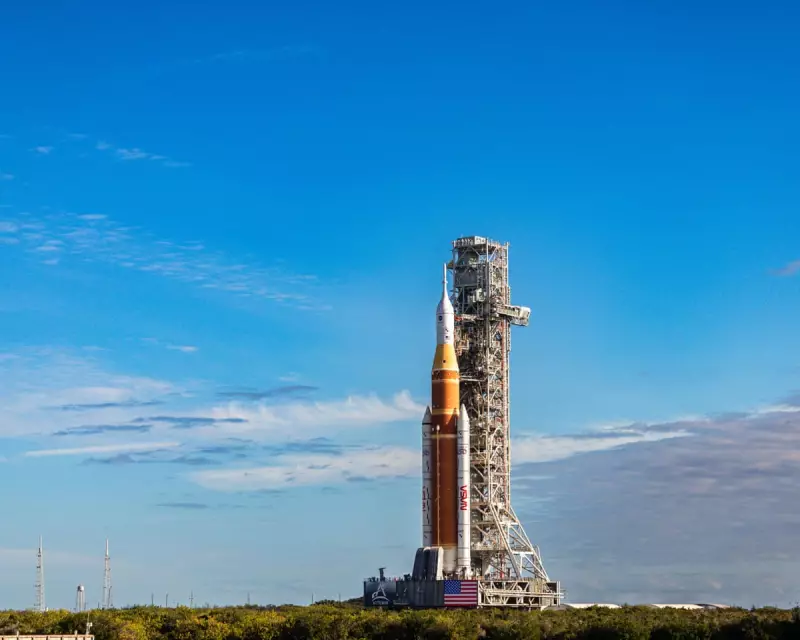
In a monumental step towards returning humans to deep space, Nasa's towering new moon rocket has completed a painstaking journey to its launch pad in Florida. The move sets the stage for the first crewed flight to the moon in over half a century, a mission that could blast off as soon as February.
A Dawn Rollout for a New Era
The 98-metre (322ft) Space Launch System (SLS) rocket, topped with the Orion crew capsule, began its slow procession from the iconic Vehicle Assembly Building at Nasa's Kennedy Space Center at daybreak. Weighing a staggering 5 million kilograms, the combined structure crept along at just 1 mph (1.6 km/h) aboard a massive, upgraded transporter from the Apollo era.
The 4-mile trek took until nightfall to complete. Thousands of space centre employees and their families gathered in the pre-dawn chill to witness the historic event, which had been delayed for years. The crowd was led by Nasa's new administrator and the four astronauts assigned to the pioneering Artemis II mission.

"What a great day to be here," said mission commander Reid Wiseman. "It is awe-inspiring."
Overcoming Hurdles for a Crewed Voyage
This rollout feels distinctly different from the first SLS launch in November 2022, which sent an uncrewed Orion capsule around the moon. "This one feels a lot different, putting crew on the rocket and taking the crew around the moon," noted Nasa's John Honeycutt.
The path to this moment was not without challenges. The initial test flight revealed issues, including heat shield damage, that required extensive analysis and testing. These hurdles pushed back the timeline for this first crewed moonshot.
The 10-day Artemis II mission will not involve a lunar landing or orbit. Instead, the crew will perform a fly-around of the moon, a critical test before future landing attempts. The mission's commander, Reid Wiseman, will be joined by pilot Victor Glover, mission specialist Christina Koch, and Canadian astronaut Jeremy Hansen, a former fighter pilot on his first spaceflight.
A Bridge from Apollo to Artemis
This flight marks a profound moment in space exploration history. The crew will become the first people to travel to the moon since Apollo 17's Gene Cernan and Harrison Schmitt concluded the lunar programme in 1972. Only four of the twelve Apollo moonwalkers are still alive today.
"They are so fired up that we are headed back to the moon," Wiseman said of the surviving Apollo astronauts. "They just want to see humans as far away from Earth as possible discovering the unknown."
Nasa's immediate next step is a crucial fuelling test on the pad in early February. The space agency has a narrow five-day launch window in the first half of February before the next opportunity arises in March. Success would see humanity take a giant leap back towards the lunar surface, paving the way for sustained exploration under the Artemis programme.






