

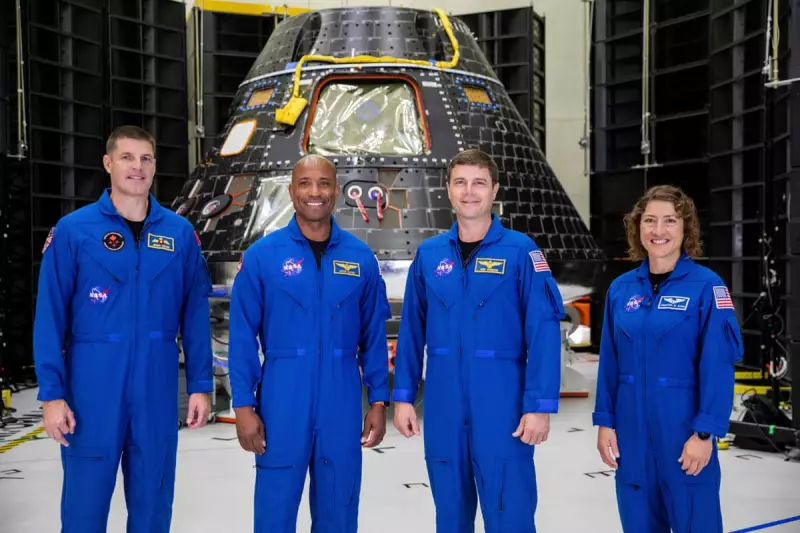
Nasa is on the brink of a monumental spaceflight milestone, readying its most powerful rocket ever built for a mission that will send a crew of astronauts on a journey around the Moon for the first time in more than half a century.
The Mission and Its Historic Crew
The Artemis II mission is scheduled to launch from Kennedy Space Center in Florida, with a potential launch window opening on 6 February. The four astronauts will embark on an epic 685,000-mile round trip, splashing down in the Pacific Ocean approximately ten days later. This flight represents only the second test of Nasa's colossal Space Launch System (SLS) rocket and, critically, the first with a human crew aboard.
The crew comprises Nasa astronauts Reid Wiseman, Victor Glover, and Christina Koch, alongside Canadian Space Agency astronaut Jeremy Hansen. For three of them, it will be a return to space, but for Hansen, it marks a thrilling first. The mission will see Koch become the first woman and Glover the first person of colour to travel beyond low Earth orbit, venturing into deep space.

While the crew will not land on the lunar surface or enter orbit around it, they will be the first humans to travel to the vicinity of the Moon since the Apollo 17 mission in 1972. They will live and work inside the Orion capsule, rigorously testing its life support and communication systems while practising vital manoeuvres for future missions.
Engineering Marvels and Precise Preparations
The combined SLS rocket and Orion capsule stand nearly 100 metres tall. The rocket carries a staggering volume of liquid propellant—more than enough to fill an Olympic-sized swimming pool—generating the thrust needed to reach speeds of up to 24,500mph on its path to the Moon.
The journey to the launchpad is an event in itself. Using the enormous Crawler-Transporter 2, Nasa will soon begin the slow, four-mile roll of the 5,000-tonne vehicle from the assembly building to the pad, a process that can take up to 12 hours. Following this, engineers will work through a meticulous preflight checklist, culminating in a 'wet dress rehearsal'. This involves loading over 700,000 gallons of propellant, conducting a practice countdown, and demonstrating safe fuel removal.
Any significant technical issues would necessitate a rollback for repairs. Teams have recently addressed a bent cable in the flight termination system, a faulty valve on the Orion capsule, and leaks in oxygen pumping equipment. John Honeycutt, chair of the Artemis II mission management team, emphasised that crew safety is the absolute priority, stating, "We're going to fly when we are ready." If a 6 February launch isn't feasible, Nasa has identified 14 alternative dates through to mid-April.
A Path to the Future and a New Space Era
Artemis II is a critical stepping stone. It follows the successful uncrewed Artemis I test flight in 2022 and paves the way for Artemis III, which aims to land astronauts near the lunar south pole as early as next year. The mission's importance was underscored by Nasa Administrator Bill Nelson, who hailed it as one of the most significant human spaceflight endeavours in decades.
David Parker, former head of the UK Space Agency, noted the broader vision: "It is a step towards what we in the space world always dreamed of: the sustained human and robotic exploration of the moon and, one day, on to Mars." Some frame this return as a new space race, with the US conscious of China's ambition to land its astronauts on the Moon by 2030.
Once launched, the crew will perform two Earth orbits before the Orion capsule separates. They will then manually pilot the spacecraft in a docking rehearsal, providing invaluable data for future Artemis missions. A final push from Orion's European-built service module will send them on a figure-of-eight trajectory around the Moon, travelling over 230,000 miles from Earth. Throughout the voyage, they will test emergency procedures and a radiation shelter designed for protection against solar flares.

As the world watches, the mix of excitement and nervous anticipation is palpable. "Every rocket launch is a nail-biter," admitted David Parker. "We're putting astronauts on a rocket, and it's flown only once before... But I'm confident Nasa will only launch when they are ready." The countdown to a new chapter in lunar exploration has truly begun.





