

Inside the Orion: The Cosmic 'Minivan' for Artemis II's 10-Day Lunar Journey
If the Orion spacecraft were listed on Airbnb, "cosy" might be the most fitting description. This compact capsule, currently housing four astronauts after the successful launch of Artemis II from Florida, serves as their home for a 10-day mission around the moon. Commander Reid Wiseman, pilot Victor Glover, and mission specialists Christina Koch and Jeremy Hansen will live within its 330-cubic-foot confines before splashing down in the Pacific Ocean near San Diego.
What Is the Orion Spacecraft?
The Orion capsule, built by US defence and aerospace manufacturer Lockheed Martin and christened Integrity by the crew, represents humanity's home away from Earth. While it lacks interior space, it offers unparalleled access to outer space. Perched atop the rocket, it separates after launch, propelling toward the moon before looping back. Libby Jackson, head of space at the Science Museum in London and former Mission Control worker for the International Space Station, notes, "The Orion is about the size of a small minivan, with four people stuck inside for 10 days, making it very cramped. Future missions might include a lander for more space, but this crew faces a confined environment."
The spacecraft, capable of sustaining passengers for up to 21 days, consists of two main sections: the crew module and the service module. During this mission, the astronauts will remain in the crew module. After launch, Koch and Hansen will set up essentials like a water dispenser, food warmer, and a five-cubic-foot toilet located under the floor near the main hatch, with a curtain available for privacy—especially useful for Hansen, who stands at 6'2", towering by astronaut standards. In case of toilet malfunctions, the crew relies on urine collection bags and a waste chute to dispose of materials into space.

Amenities and Daily Life in Space
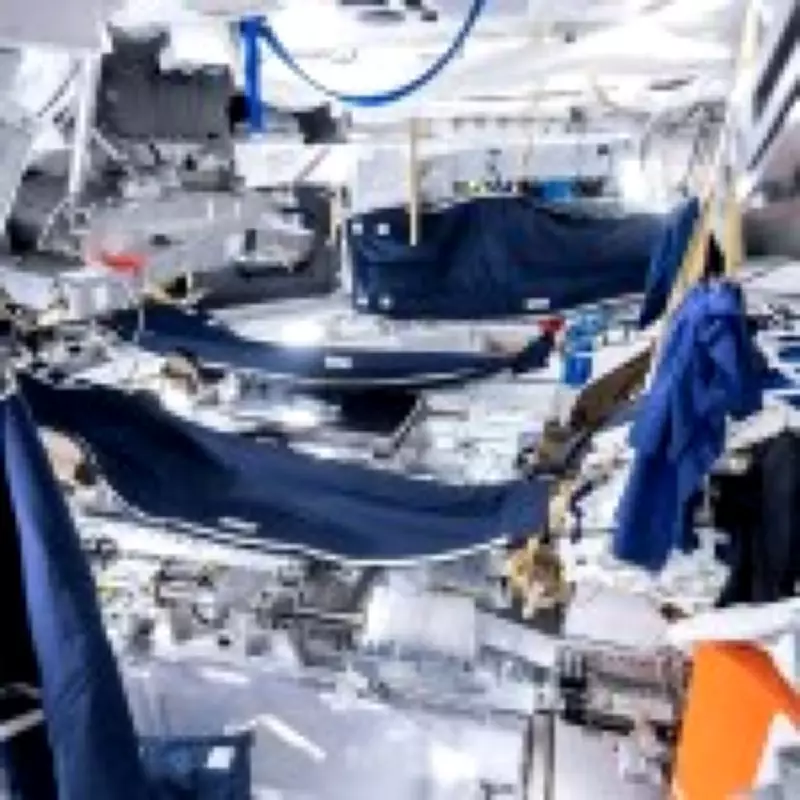
Orion features some unique amenities, such as bags strapped to the walls for sleeping in zero gravity. The crew will rehydrate vacuum-packed meals like shrimp, macaroni and cheese, and tortillas using water from the lower service module. For exercise, a flywheel near the hatch serves as a personal gym, allowing rowing, squatting, and deadlifting. Jackson emphasizes the importance of physical activity: "In space, your body adapts instantly—fluids shift, bones and muscles weaken, and you might feel sick initially due to fluid imbalance. However, on a 10-day mission, balance and muscle strength won't degrade significantly, so astronauts return strong."
Potential Risks: Radiation and Safety Systems
A major hazard in space is radiation, as astronauts leave Earth's protective magnetic field. Jackson explains, "Our magnetic field, which makes compasses point north, shields us from solar radiation. Leaving for the moon exposes crews to dangerous radiation." In the event of a solar flare, astronauts can take shelter in storage lockers under the seats.
The service module, provided by the European Space Agency, houses propulsion, power, and life-support systems, which are critical for testing during Artemis II. According to NASA, the life-support system manages air, pressure, water, and waste, with a regenerable air system that removes carbon dioxide and humidity efficiently. It continuously monitors temperature, humidity, and pressure to detect unsafe conditions. Additionally, Orion includes a launch abort system with solid rocket motors that use propellants like helium to quickly move the capsule away from dangers.
NASA's mobile app and a dedicated website allow the public to track the capsule as it journeys toward the moon. This mission marks a significant step in lunar exploration, testing systems for future deep-space endeavors.






