

The Fragile Frontier: How a Satellite Collision Chain Reaction Could Trap Humanity on Earth
For millennia, Earth's orbit remained a pristine and empty expanse, untouched by human activity on the planet's surface. However, this changed dramatically in 1957 when Soviet scientists launched Sputnik, a metal ball with radio antennae, into orbit. This historic event marked the dawn of the space age, initiating a rapid transformation of the orbital environment.
The Exponential Growth of Orbital Objects
By the end of the 1950s, only a handful of objects circled Earth. As the space race intensified between the United States and the Soviet Union, satellite launches surged. The 1970s concluded with over 14,000 tracked objects launched, approximately 7,000 of which remained in orbit. The 1990s saw further expansion, with around 20,000 objects being tracked by the turn of the millennium.
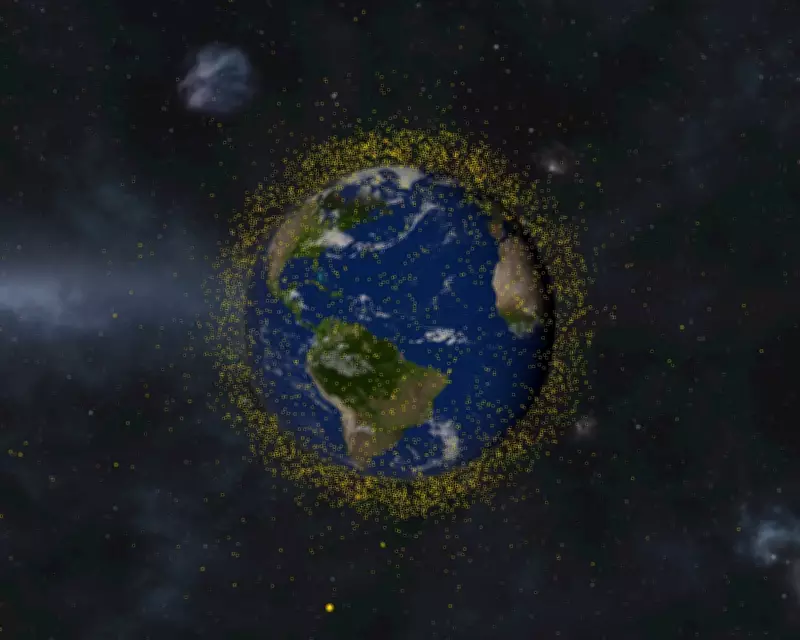
In the 21st century, private companies began launching satellites at unprecedented rates. Today, Earth's orbit is densely packed with thousands of satellites and fragments, totaling about 32,000 objects, all traveling at immense speeds. This count accounts for many satellites that have already decayed and reentered the atmosphere. Projections suggest that by the end of this decade, there could be more than 60,000 active satellites in space.

The Shift to Private Mega-Constellations
The focus of space exploration has shifted from government-led missions to a private era dominated by companies like SpaceX and Amazon. SpaceX launched its first Starlink satellites in 2019, heralding the mega-constellation era. These ventures deploy thousands of smaller, mass-produced spacecraft to provide global high-speed internet, fundamentally altering how Earth's orbit is accessed and utilized.
This surge in orbital activity includes not only functional satellites but also space debris, such as discarded rocket stages, defunct satellites, and collision fragments. The United States and Russia, including former Soviet launches, are responsible for the largest number of orbital objects. China and France have each launched over 1,000 objects, with other countries contributing smaller numbers.
The Looming Threat of a Chain Reaction
The rapid increase in orbital objects has created a significant collision risk. A 2009 incident, where a US satellite collided with a defunct Russian military satellite, produced tens of thousands of high-velocity metal fragments. The primary concern is that future collisions could trigger a domino effect, known as the Kessler syndrome, where Earth's orbit becomes cluttered with debris. This could form a near-impenetrable layer, making space launches so hazardous that humanity might be effectively trapped on Earth.
Jonathan McDowell, a former astrophysicist at the Harvard-Smithsonian Center for Astrophysics, has spent decades tracking orbital objects. He warns of a genuine threat from a chain reaction of satellite collisions. "I think the cascade potential is real but it would happen over decades," McDowell stated. "The current danger level is sort of tolerable," he added with a nervous laugh.
The Fragility of Orbital Cooperation
The current system relies on constant cooperation among satellite operators, who maneuver their craft daily to avoid collisions. McDowell emphasizes that if this cooperation falters, the situation could spiral out of control within days or weeks. "This feels fragile," he says. "All you need is for two players to screw up on the same day."
To mitigate risks, space agencies are testing methods to deorbit large defunct satellites, such as using nets, robotic arms, or high-powered lasers. However, the challenge remains immense as orbital congestion continues to grow.
Methodology and Data Sources
This analysis is based on data from Space-Track.org, which sources information from the US Space Surveillance Network, along with contributions from TS Kelso's CelesTrak and Jonathan McDowell's research. These sources provide a comprehensive, though not exhaustive, picture of orbital objects, with limitations for classified or military satellites. Visualizations represent satellites in orbit at specific times, using orbit speed and height metrics that may reflect later stages of a satellite's lifecycle.






