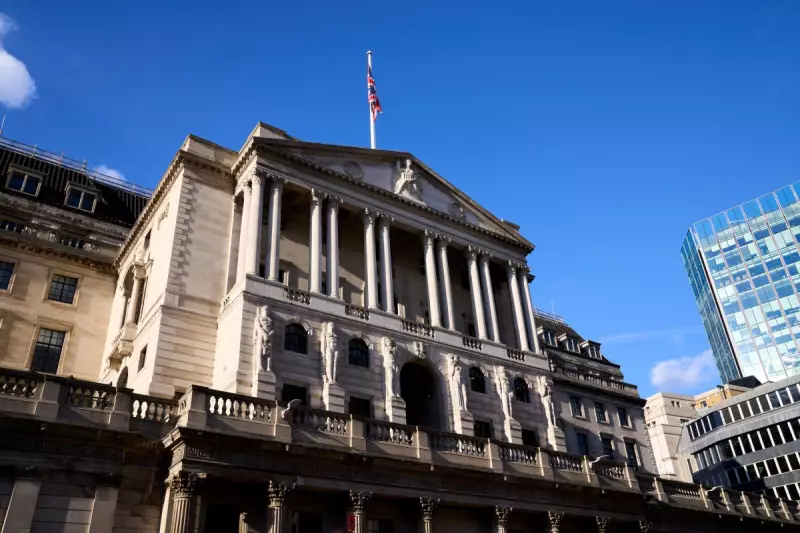
City Banks Revise Interest Rate Cut Timelines Amid Inflation Surprise
Leading financial institutions in the City of London have significantly adjusted their expectations for the Bank of England's next interest rate reduction, creating a forecasting divide as inflation data complicates the monetary policy outlook. The central bank is now widely anticipated to maintain the current rate at its forthcoming decision, reflecting heightened caution among policymakers.
UBS and Morgan Stanley Shift Predictions Following Inflation Data
UBS Investment Bank economist Anna Titareva has notably pushed back her forecast for the Bank's next rate cut from February to March 2026. This revision follows the Office for National Statistics reporting that price growth accelerated to 3.4 per cent in the year to December 2025, exceeding many analysts' projections.
Titareva, who maintains that interest rates will decline from 3.75 per cent to 3.25 per cent throughout 2026, had previously anticipated the Monetary Policy Committee might support a reduction as early as next week. She emphasised that the February vote will likely be closely contested, with Governor Andrew Bailey potentially casting the deciding vote for the third consecutive meeting.

"In December, we highlighted the MPC's cautious tone, particularly noting that despite voting for a cut, Governor Bailey and Deputy Governors Breeden and Ramsden referenced the strength of forward-looking wage growth indicators as an inflation risk factor," Titareva explained. "Our updated forecast assumes that after pausing next week, the Bank will implement a 25 basis point cut to 3.5 per cent on 19 March, by which time the MPC will have January inflation figures that we expect to show the first substantial decline in inflation."
Analysts at American banking giant Morgan Stanley have similarly revised their predictions, moving their expected rate cut from February to March following the inflation overshoot.
Forecasting Divide Emerges on 2026 Rate Cut Trajectory
The forecasting community remains deeply divided regarding the number of interest rate reductions anticipated for 2026, as economists grapple with assessing the potential impact of Chancellor Rachel Reeves' Budget measures on price growth and public expectations.
Both the Bank of England and the Office for Budget Responsibility have indicated that Budget initiatives to remove energy subsidies from household bills could potentially reduce inflation by as much as 0.5 percentage points. However, researchers at Barclays argue that the short-term effects of these policy measures would prove "insufficient" to persuade MPC members, who analyse the UK economy's future on an extended timeframe, to endorse additional interest rate cuts.
Barclays joins NatWest, Nomura, and Pantheon Macroeconomics in projecting just a single interest rate reduction throughout 2026. Conversely, economists at Berenberg, HSBC, and Capital Economics have outlined three potential rate cuts this year as inflation gradually approaches the target 2 per cent rate.
"We believe the effects of the weakening labour market will maintain inflation at 2 per cent or below moving forward," stated Paul Dales, chief UK economist at Capital Economics. "Therefore, although we no longer anticipate the Bank cutting rates on 5th February, we don't believe it will be excessively long before rates are reduced again – potentially in April."
Monetary Policy Uncertainty Intensifies
The conflicting forecasts underscore the substantial uncertainty surrounding the Bank of England's monetary policy direction in 2026. With inflation proving more persistent than some analysts predicted and Budget measures introducing additional variables into economic calculations, the MPC faces complex decisions balancing price stability with economic growth concerns.
This forecasting clash reflects broader tensions within economic analysis as institutions weigh short-term data surprises against longer-term structural factors, creating divergent narratives about the appropriate pace of monetary policy normalisation in the coming months.