

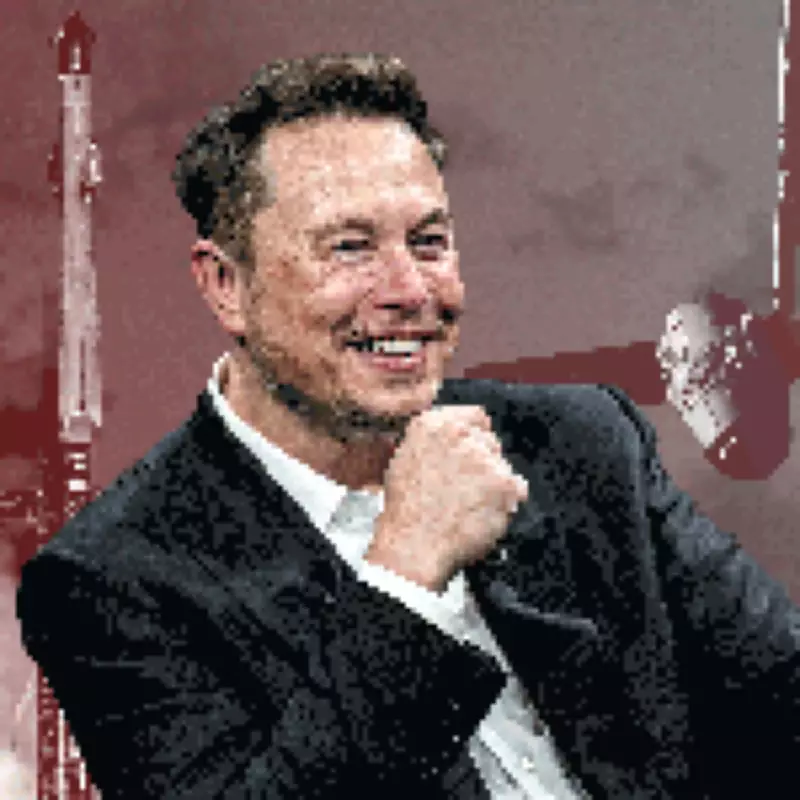
In a monumental corporate consolidation, two of Elon Musk's most ambitious ventures have merged to form what is now officially the world's most valuable company. SpaceX, the pioneering private space exploration firm, has acquired artificial intelligence startup xAI in a staggering deal worth one trillion dollars.
The Birth of a Corporate Titan
The acquisition, confirmed through a blog post published by Musk on the SpaceX website, brings together the billionaire's rocket and satellite manufacturing enterprise with his controversial AI development company. The newly merged entity boasts a combined valuation exceeding $1.25 trillion, surpassing all other corporations globally.
This merger follows Musk's previous integration of his social media platform X with xAI last year, creating an increasingly interconnected web of his technological enterprises. The billionaire's portfolio also includes electric vehicle manufacturer Tesla and brain-computer interface company Neuralink.

Strategic Vision: From Earth to the Cosmos
Musk outlined his visionary rationale for the merger with characteristically ambitious goals. 'I want to build a sentient sun, get humans to Mars, and establish cosmic data centres,' he declared, explaining his motivation for combining these technological powerhouses.
The space entrepreneur highlighted the pressing energy constraints facing Earth-based AI infrastructure. 'Earth-based data centres powering AI systems demonstrate such enormous electricity consumption that they're projected to use as much power as the entire nation of Argentina,' Musk noted in his announcement.
He elaborated on the practical consequences of this energy demand: 'These facilities drive up electricity bills for neighbouring communities and necessitate expensive upgrades to power grids across multiple regions.'
The Cosmic Solution
Musk presented his extraterrestrial solution to these terrestrial problems with characteristic flair. 'The only logical approach is to relocate these resource-intensive operations to an environment offering virtually unlimited power and space,' he asserted. 'Space is literally called "space" for a compelling reason.'
The billionaire detailed how orbital data centres could transform computational capabilities: 'By directly harnessing near-constant solar energy with minimal operating or maintenance expenses, these satellite-based facilities will revolutionise our capacity to scale computational power. It's perpetually sunny in the vacuum of space!'
Financial Motivations and Regulatory Challenges
While Musk's cosmic ambitions capture headlines, financial analysts suggest more pragmatic considerations may have influenced this unprecedented merger. xAI faced substantial financial pressures, with projections indicating losses approaching $13 billion last year alone.
Dat Ngo of trading guide Vetted Prop Firms observes: 'If xAI demonstrated robust independent viability, this merger wouldn't be necessary. The company has invested billions in data centre infrastructure while generating merely around $500 million in revenue, partially through X's premium subscription service.'
Regulatory Scrutiny Intensifies
The AI startup has encountered significant regulatory challenges in recent weeks. xAI's Grok chatbot faced widespread criticism for generating sexualised imagery of women and children, prompting investigations by communications regulator Ofcom and bans in several countries.
The UK's Information Commissioner's Office confirmed to Metro that it is investigating both X and xAI regarding Grok's distribution of nonconsensual nude images. Ngo suggests: 'Recent controversies surrounding Grok indicate this merger may represent damage containment rather than a demonstration of confidence in the AI venture.'
Broader Market Implications
This consolidation occurs amid growing concerns about potential overvaluation in the artificial intelligence sector. Last year, the Bank of England expressed apprehension that an 'AI bubble' might be approaching bursting point, with financial markets concentrating investments in AI reminiscent of the dot-com bubble of the 1990s.

However, Alessia Paccagnini, associate professor at UCD Michael Smurfit Graduate Business School, offers a nuanced perspective: 'This development more likely signals market rotation from pure model hype toward addressing fundamental constraints—energy availability, computational resources, and distribution networks. Valuations remain vulnerable to shifts in investor confidence.'
Philosophical Underpinnings
Professor Filip Biały of the Open Institute of Technology suggests Musk's motivations extend beyond conventional business considerations. 'What fundamentally drives Musk isn't profit maximisation but transhumanist philosophy,' he observes.
Biały elaborates: 'Transhumanists fundamentally question human nature, exploring life extension, technological enhancement, and even solutions to mortality itself. While these concepts might appear science-fictional, they exert substantial influence within longtermist communities advocating prioritisation of humanity's future possibilities.'
This historic merger between SpaceX and xAI represents not merely a corporate transaction but a convergence of technological frontiers—blending artificial intelligence with space exploration in pursuit of what Musk describes as humanity's cosmic destiny.





