

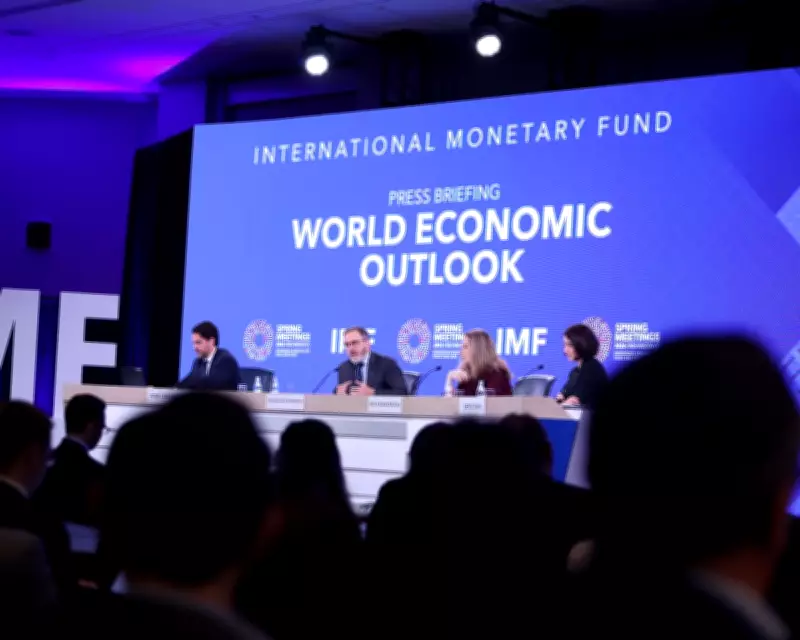
IMF's Economic Outlook Darkens as Global Tensions Escalate
The International Monetary Fund has dramatically shifted its global economic assessment from cautious optimism to outright pessimism in its latest World Economic Outlook. Where January's report carried the hopeful title "Steady amid Divergent Forces," the current document bears the ominous heading "Global Economy in the Shadow of War." This stark reversal acknowledges the profound impact of Middle East conflicts that erupted in late February 2026, fundamentally altering global economic prospects.
The Persistent Blind Spot: Profit-Driven Inflation
Despite this sobering reassessment, the IMF continues to demonstrate a troubling analytical gap. While the organization extensively discusses wage pressures and inflation expectations, it largely ignores the substantial role of corporate profits in driving price increases. This oversight persists despite the IMF's own 2023 research revealing that rising corporate profits accounted for nearly half of Europe's inflation surge over the previous two years.
The IMF maintains its traditional focus on wage-price spirals as the primary inflation concern, even as evidence mounts that profit-driven price increases represent a significant component of current inflationary pressures. This analytical blind spot has profound implications for policy recommendations, particularly regarding interest rate decisions.

Three Dire Scenarios for Global Growth
The IMF outlines three increasingly pessimistic scenarios for global economic development. The "bad scenario" assumes relatively swift resolution of current conflicts, resulting in only moderate growth slowdown. The "adverse scenario" projects continued tensions through year-end with oil prices stabilizing around $100 per barrel. Most concerning is the "severe scenario," featuring prolonged conflict, oil prices reaching $125 by 2027, natural gas prices tripling, and significant food price increases.
Even under the most optimistic projection, global economic growth would slow considerably compared to January forecasts. The adverse and severe scenarios predict growth rates of just 2.0% and 2.2% respectively - levels historically associated with global recessions. For context, the global economy has grown slower than 2.2% only three times in the past four decades: during the 1992 recession, the 2009 Global Financial Crisis, and the 2020 COVID-19 pandemic.
Australia's Disproportionate Economic Downgrade
Australia faces particularly severe economic downgrades in the IMF's revised projections. Even under the most favorable scenario, Australia's growth forecast has been reduced by 0.5 percentage points compared to October projections - a larger downgrade than any G7 nation experienced. This significant adjustment reflects Australia's particular vulnerabilities to global energy market disruptions and geopolitical tensions.
The Reserve Bank of Australia faces mounting pressure to adjust monetary policy despite deputy governor Andrew Hauser's recent observation that long-term inflation expectations remain stable. Market speculation increasingly anticipates interest rate hikes in May, reflecting broader concerns about inflationary pressures.
Policy Implications and Missed Opportunities
The IMF warns against popular government interventions like energy price caps or subsidies, expressing concern that such measures could exacerbate inflation by increasing disposable income. However, this perspective overlooks alternative approaches to addressing economic challenges without fueling inflationary pressures.
Notably, the IMF acknowledges that natural gas prices face greater disruption risks than oil prices due to production complexities and limited reserve buffers. This insight highlights potential opportunities for targeted policy interventions. Australian gas exporters stand to benefit significantly from elevated global prices, creating potential revenue sources for government relief measures.
Current Senate investigations into gas taxation reforms could yield substantial revenue through proposals like the ACTU's suggested 25% export tax, potentially generating approximately $17 billion annually. Such funds could support temporary household relief measures while maintaining fiscal discipline and potentially averting recession under adverse economic scenarios.

The IMF's continued neglect of profit-driven inflation represents a significant analytical failure with real-world consequences. As global economic conditions deteriorate and Australia faces disproportionate impacts, policymakers must look beyond traditional wage-focused inflation frameworks to address the complex realities of contemporary economic challenges.





