

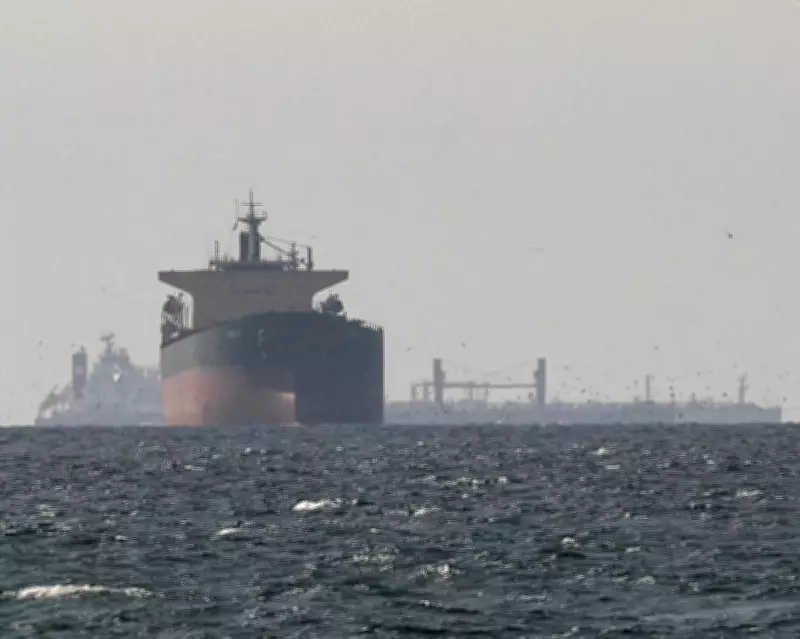
IMF Issues Dire Warning Over Global Economic Stability
The International Monetary Fund has delivered a sobering assessment of the world economy, cautioning that the escalating conflict in the Middle East could precipitate an unprecedented energy crisis with severe global repercussions. As the United States initiates a blockade of the strategically vital Strait of Hormuz, IMF Chief Economist Pierre-Olivier Gourinchas declared that "the world economy faces another difficult test."
Blockade Threatens Global Energy Supply
The closure of the Strait of Hormuz, a critical maritime passage for global hydrocarbon transport, represents a significant escalation in tensions. Gourinchas emphasized that "serious damage to critical facilities in a region central to global hydrocarbon supply raise the prospect of a major energy crisis should hostilities continue." This development comes as fuel prices surge worldwide, placing additional strain on household budgets and business operations.
Australian Treasurer Jim Chalmers, preparing for IMF spring meetings in Washington DC, acknowledged the global economic turbulence, stating Australians are "paying a hefty price for events on the other side of the world." Chalmers plans to advocate for an enduring ceasefire and the reopening of the Strait of Hormuz during bilateral meetings with counterparts from major fuel-supplying nations including South Korea, Singapore, Japan, and China.

Three Economic Scenarios Outlined
The IMF's latest World Economic Outlook presents three distinct scenarios for global economic performance:
- Baseline Scenario: Assumes the conflict concludes within weeks with energy markets normalizing by mid-year. Global growth would reach 3.1% in 2026, though Australia's economy would expand at a modest 2% with inflation averaging 4%.
- Adverse Scenario: Projects oil prices averaging $100 per barrel through 2026, reducing global growth to 2.5% with inflation climbing to 4.4%.
- Severe Scenario: Envisions a persistent energy shock with oil prices reaching $110 this year and $125 next year, causing global growth to plummet to just 2% in 2026 while inflation averages 5.8%.
The severe scenario would bring the global economy perilously close to recession territory, defined as growth below 2%. Such conditions have occurred only four times since 1980, most notably during the global financial crisis and COVID-19 pandemic.
Australian Economic Outlook and Policy Response
With Australia's budget announcement scheduled for May 12, Chalmers described the current moment as "a dangerous time for the global economy" and acknowledged the government is "weighing all of this extreme uncertainty as we prepare a budget focused on resilience and reform." Prime Minister Anthony Albanese has promised Labor's most ambitious budget yet, with potential measures including:
- Revisions to tax discounts and negative gearing rules for property investors
- Additional taxation on booming LNG exports
- Reforms to electric vehicle and battery subsidies
- Implementation of additional budgetary savings measures
Despite expectations of further cost-of-living relief in the upcoming budget, Gourinchas cautioned governments against implementing "popular" non-targeted support measures, advising that "any fiscal support should remain narrowly targeted and temporary" to avoid complicating central banks' efforts to control inflation.
The IMF report highlights how geopolitical tensions in the Middle East have created ripple effects across the global economy, with Australia's inflation rate projected to increase from 2.9% in 2025 to 4% this year before easing to 3.2% in 2027. Unemployment is expected to remain stable in the low 4% range through this period.
As the international community watches developments in the Strait of Hormuz, the IMF's warning underscores the fragile state of global economic recovery and the potentially devastating consequences of prolonged conflict in energy-producing regions.






