

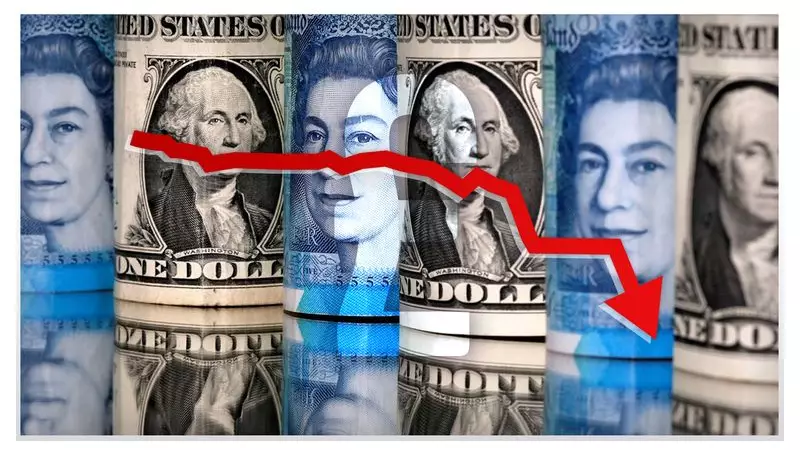
The US Dollar's Dramatic Descent: A Global Economic Concern
Financial markets are currently witnessing what experts describe as a "falling chainsaw" scenario with the US dollar, as its value continues to plummet with no apparent end in sight. This sustained decline carries significant global ramifications, with particular implications for former President Donald Trump's economic legacy and policies. The situation has evolved into what analysts are calling a crisis of confidence surrounding the world's primary reserve currency.
Understanding the Dollar's Decline
The dollar's weakening trajectory began last year when its value against a basket of international currencies, including the British pound, fell by approximately 9%. This downward trend has accelerated in January alone, with an additional decline exceeding 2%. The pound sterling recently reached its highest level against the dollar since July 2021, standing above $1.38, though this appears primarily driven by dollar weakness rather than exceptional pound strength.
Primary Drivers Behind the Currency Crisis
Market analysts attribute much of the dollar's weakness to policies and rhetoric emanating from the Trump administration since its return to power. The president's aggressive trade war tactics have significantly diminished the greenback's influence on the global stage. Additional foreign policy decisions, including military actions in Iran and Venezuela, alongside controversial tariff threats against NATO allies, have further undermined international confidence in US economic leadership.

Several other critical factors are contributing to the dollar's decline:
- Growing market concerns regarding the Federal Reserve's independence
- Substantial increases in public spending that jeopardise budget negotiations
- Heightened fears of another potential government shutdown
- Recent consumer confidence data indicating a significant shift toward negative sentiment
International Dimensions and Market Dynamics
The pressure on the dollar intensified this week amid speculation about potential joint intervention by US and Japanese central banks to stabilise the weak yen. Japan's currency has collapsed due to persistently low interest rates, making it an attractive source of credit for investment in higher-yielding currencies. Ironically, the dollar's own decline has reduced expectations that such intervention will prove necessary.
Political Implications and Economic Strategy
Despite President Trump's public characterisation of the dollar's performance as "great" on Tuesday—a statement that paradoxically triggered further declines—there are complex political dimensions to the currency's weakness. A weaker dollar theoretically makes US exports more competitive while rendering imports less attractive, potentially aligning with Trump's stated objective of reducing US trade deficits.
However, this strategy carries substantial risks, particularly the possibility of triggering widespread selling of US Treasury bonds amid existing concerns about America's debt sustainability. Such a development could dramatically increase government borrowing costs both domestically and internationally.
Specific Implications for the United Kingdom
The dollar's decline presents a mixed picture for British consumers, businesses, and investors. On the positive side, UK travellers to the United States will find their pounds stretching further, while imported US goods and dollar-priced commodities will become relatively cheaper, potentially easing inflationary pressures within the UK economy.
Challenges for British Businesses
Conversely, the situation offers little advantage to UK exporters targeting the American market, particularly given heightened US trade tariffs. British companies with significant US operations or dollar-denominated assets face particular challenges, as their earnings and investment values diminish when converted back to sterling.
This impact extends to workplace pension schemes and other investment vehicles holding dollar-denominated assets. The dollar's more than 11% decline since President Trump's return has effectively cancelled out equivalent gains in asset values measured in dollar terms.

Investment Opportunities and Market Responses
From a different perspective, the weak dollar makes UK market investments more attractive to American investors seeking value opportunities and hedging against potential AI-driven stock market bubbles. Market strategist Karl Schamotta of payments company Corpay captured the prevailing sentiment, noting that "with the 'tariff man' showing no sign of repentance and the US government headed into another shutdown, economic policy uncertainty is soaring once again."
Schamotta added: "Positive fundamentals should eventually reassert themselves, but for now, no one is willing to catch the falling chainsaw that is the US dollar." This vivid metaphor encapsulates the cautious, risk-averse approach currently dominating currency markets as traders and investors navigate unprecedented economic policy uncertainty.





