

The Battle of Wapping: A Watershed Moment in British Industrial History
On 24 January 1986, nearly 6,000 newspaper workers at Rupert Murdoch's News International walked out on strike, marking the beginning of what would become one of the most bitter and violent industrial disputes in modern British history. The catalyst was Murdoch's determination to move print operations from Fleet Street to a new, technologically advanced plant in Wapping, east London.
The Technological Revolution That Sparked Conflict
During the mid-1980s, most British newspapers were still produced using traditional hot metal printing methods. Rupert Murdoch, chairman of News International and publisher of The Sun, News of the World, The Times and Sunday Times, had spent 1985 secretly equipping a new facility at Wapping where journalists could input copy directly on screen, bypassing the powerful print unions that had dominated Fleet Street for generations.
When talks about working conditions collapsed, Murdoch took decisive action. He sacked striking workers overnight and moved all four titles to Wapping, employing members of the Electrical, Electronic, Telecommunications and Plumbing Union to operate the new plant. The first newspapers rolled off the Wapping presses on 25 January 1986, setting the stage for a confrontation that would last thirteen months.

The Initial Confrontation and Union Response
Print workers at The Sun and The Times walked out on 24 January, with their unions regarding the dispute as a battle for their future stake in Fleet Street. The News of the World and Sunday Times print workers followed. Murdoch immediately responded by announcing he would print the newspapers with EETPU members at Wapping and Glasgow.
Management presented journalists with an ultimatum: report for work at Wapping or face dismissal. News International offered journalists an extra £2,000 per year plus BUPA membership to operate the new technology, while those who refused would be instantly dismissed. The Times journalists were given until 27 January to decide their position.
Division Among Journalists and Union Tactics
The National Union of Journalists leadership argued that management's actions involved an unwarranted change in employment contracts. However, many journalists showed willingness to go to Wapping, even if it meant crossing picket lines established by the National Graphical Association and Sogat unions.
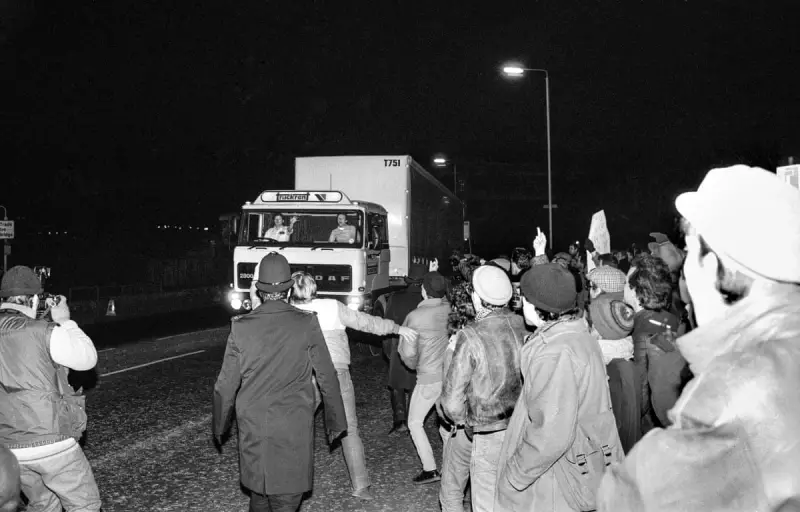
Distribution staff represented by Sogat were instructed not to handle any News International titles, though the union acknowledged this made them liable to litigation under the government's secondary actions laws. The print unions and their supporters established pickets at the entrance to the Wapping plant, with scenes of confrontation becoming increasingly tense.
Production Success Despite Union Opposition
Despite the full-scale strike by NGA and Sogat '82, Murdoch successfully printed the Sunday titles on 26 January, followed by the daily newspapers. More than 1.2 million copies of the Sunday Times were printed at Wapping, along with three million copies of the News of the World – representing 60% of the tabloid's usual print run.
Journalists from The Sun largely moved to Wapping with few exceptions, while The Times journalists were more divided. According to Bruce Matthews, managing director of News International, 65 editorial staff reported for duty on 26 January, sufficient to produce the paper with management involvement.
The Human Dimension: Refuseniks and Practical Realities
While many journalists moved to Wapping, approximately thirty Sunday Times journalists became self-styled "refuseniks" who remained at the Gray's Inn Road offices. One young reporter explained his decision to try Wapping by saying he had no objection to modern technology – and he did have a £60,000 mortgage and a young family.
The pickets at Wapping's entrance, surrounded by ten-foot tall gates and razor wire, shouted "scab" as workers entered the floodlit plant in luxury coaches. One Sogat member remarked "What a way to go to work" as vehicles passed through the heavily fortified entrance.

Broader Implications and Political Ramifications
The dispute quickly assumed national significance, with editorial commentary noting that if not for the contemporaneous Westland affair, Wapping would have dominated every headline. The confrontation was seen as potentially pivotal in the long history of Fleet Street industrial relations, with implications spreading to the Labour party and trade union movement.
The battle raised fundamental questions about how technological change should be managed – whether through partnership and agreement within industries, or through resistance to the last. As the dispute unfolded, it became clear that Wapping represented not just a local industrial conflict, but a watershed moment in British newspaper production and labour relations.
The thirteen-month dispute that followed would transform the landscape of British journalism, marking the end of Fleet Street's traditional printing methods and the beginning of a new era of newspaper production that continues to influence the industry today.





