

India's Cooking Gas Crisis Deepens as Hormuz Closure Disrupts LPG Supply Chain
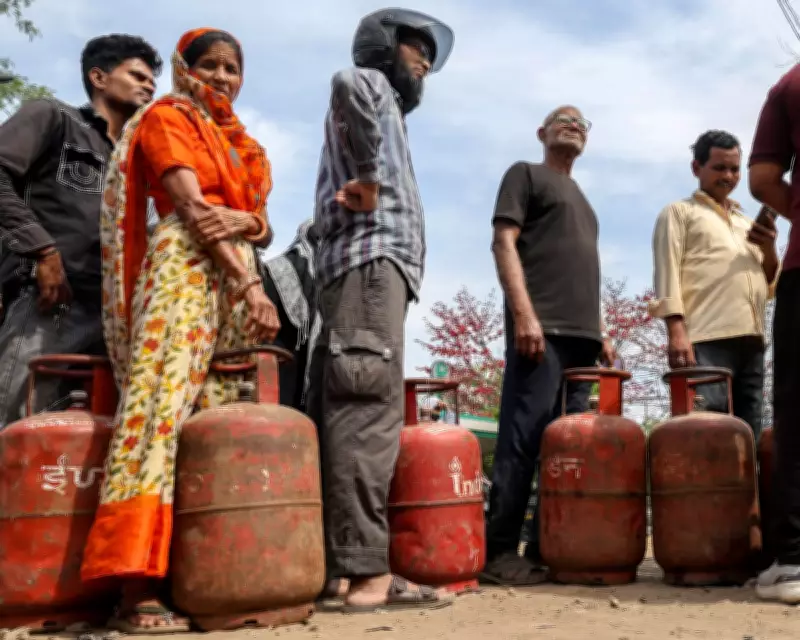
For four consecutive days, Maya Rani has arrived each morning at a gas distributor's office in Delhi, her six-month-old daughter cradled in her lap, waiting for hours. Each day she returns home empty-handed, told that a cooking gas cylinder may not be available for at least another week. Around her, the queue keeps growing, with people clutching forms and documents, hoping to secure a cylinder.
The flame in her kitchen began to fade last week and her husband, as he always does, took their 5kg cylinder to a local refiller. This time, there was nothing available. The only option left was to apply for a government-subsidised supply, a process that has meant repeated visits, long waits and no certainty about when relief might arrive.
Personal Struggles Amid Widespread Disruption
"I feel like crying," Rani said, sitting on the pavement outside the distributor's office while trying to soothe her child. "We have been waiting for days and still don't know when we will get gas." Her husband cannot afford to miss work, so she makes the daily rounds. "We are eating just one meal a day from outside. I've had to ask neighbours to help boil milk for my baby."

Rani's experience is being echoed across South Asia, where disruption to supplies of liquefied petroleum gas (LPG) triggered by the closure of the Strait of Hormuz has pushed the region into its worst gas crisis in decades. Prices have surged dramatically, industries have been forced to scale back or shut completely, and anxiety is spreading rapidly through communities.
Geopolitical Chokepoint Creates Regional Crisis
Before the Iran conflict effectively shut the narrow maritime chokepoint, it carried about a fifth of global fuel shipments, much of it bound for Asian markets. In India, Pakistan, Bangladesh, Nepal and Sri Lanka, where LPG is central to everyday cooking, the impact has been immediate and severe.
Slowing imports have strained distribution systems to breaking point, prompting governments to prioritise household supply and restrict commercial use. The crisis has exposed a deeper weakness: a region with rising energy demand remains heavily dependent on supply routes vulnerable to distant geopolitical shocks.
"This level of exposure was absolutely anticipated," said Akhtar Malik, of the Bureau of Research on Industry and Economic Fundamentals (Brief), a thinktank in Delhi. "The Strait of Hormuz as a chokepoint and the risks it poses have been extensively studied and debated for years."
Inadequate Planning and Storage Capacity
Across South Asia, efforts to build buffers or diversify supply have lagged significantly, leaving little room to absorb shocks. "India built strategic crude reserves but did not create equivalent buffers for LPG," Malik explained. "Globally, energy systems typically maintain 40 to 60 days of reserve cover for critical fuels. India, in contrast, has just over 20 days of LPG storage capacity. The current stress is as much a planning gap as it is a supply disruption."
India imports about 60% of its LPG, with 90% of that routed through the Strait of Hormuz. Only two cargoes have made it through since the strait closed, representing a tiny fraction of daily demand. With supplies from alternative sources such as the United States taking weeks to arrive and at significantly higher cost, the Indian government has moved to stretch domestic supply.
Businesses Bear the Brunt of Shortages
Refineries have been directed to maximise LPG production for household use, and supplies have been prioritised for hospitals and educational institutions, leaving businesses scrambling for alternatives. Restaurants and hotels are among the worst affected sectors.
Industry bodies estimate that about a fifth of eateries in Mumbai have either shut down completely or scaled back operations dramatically, with similar disruptions reported in other major cities. Many establishments have trimmed menus significantly, dropping dishes that require longer cooking times or more fuel.

"We have 30 items on the menu, but we're selling no more than six," said Nandu Kishore, the manager at Shawaya House, a restaurant known for its grilled meat in the densely populated Muslim neighbourhood of Zakir Nagar in south Delhi. "Even those are only possible because we've started using coal." With Eid al-Fitr approaching, the restaurant should have been entering its peak season.
Industrial Shutdowns and Worker Displacement
The impact is now spreading across multiple industries, with gas-dependent plants beginning to scale back or shut operations entirely. In Morbi, Gujarat, the world's second largest tile manufacturing centre, production is close to a complete standstill. Nearly 450 of the town's 670 ceramic units have shut, and about 430 factories have decided to suspend operations for at least three weeks.
For workers, the fallout has been immediate and devastating. Shahidul Alam, 46, who worked at one of the now-closed units, was waiting at a railway station on Wednesday for a train back home to West Bengal.
"The manager told us the factory is shutting and we won't be paid," he said. "We were already struggling to get cooking gas here. Without work, we can't survive – how will we eat?" He described the situation as reminiscent of the Covid-19 lockdown, when thousands of workers were forced to leave industrial towns and return home.
Social Tensions and Alternative Solutions
In some areas, the strain is beginning to spill over into social tensions. Dealers report heated arguments at gas distribution centres, while LPG trucks have become targets for theft as supplies tighten. The shortage has also pushed many households to turn to electric cooking alternatives where possible.
Retailers report that demand for induction burners has surged dramatically in recent weeks, particularly in cities such as Delhi. Some stores are reporting as much as a tenfold increase in sales of electric cooking equipment.
Poorest Communities Hit Hardest
It is the poorest communities who are suffering most severely from the crisis. Ajay Mandal, 30, expressed relief after his first proper meal in 24 hours at a government-subsidised canteen on Wednesday. The canteen, which serves meals for five rupees, had been shut for two days because of the gas shortage.
"If this crisis worsens, many poor people will go hungry," said the construction labourer. After a 10-hour shift, he had been collecting firewood to cook for his family of six, which includes elderly parents and toddlers. "I earn 500 rupees a day. A gas cylinder that costs around 900 rupees is now being sold for 4,000 on the black market. Even a roadside meal that used to cost 30 rupees has doubled. How are we supposed to survive?"
He paused, then added quietly: "People like us will have to eat grass if this goes on."





