

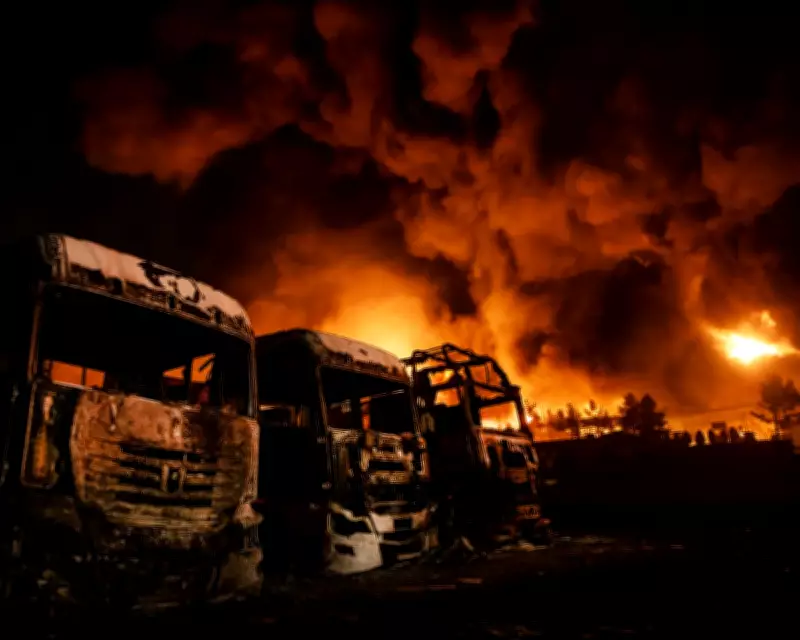
Historic Oil Price Swings Follow Iran's Blockade of Hormuz Strait
Global oil markets have experienced some of the most dramatic price fluctuations in history this week, as the US-Israeli conflict with Iran has severely disrupted the flow of Middle Eastern crude through the Strait of Hormuz. This narrow waterway, located south of Iran, serves as one of the world's most vital trade arteries, transporting approximately one-fifth of global oil and seaborne gas from Gulf production facilities to international buyers.
The Critical Chokepoint in Global Energy
The Strait of Hormuz carries just over 20 million barrels of oil daily, making it the second-busiest oil route after the Strait of Malacca. However, unlike the Malacca corridor, which spans between Malaysia and Indonesia, the Hormuz strait is far more challenging to bypass, earning its reputation as the most significant chokepoint in the global energy system. At its narrowest point, the waterway tapers to a mere 21 miles wide, situated between Iran and Oman.
Through this narrow passage, crude oil and petroleum products from the world's largest petrostates must travel to reach global markets. While Saudi Arabia and the UAE have constructed pipelines that can circumvent the strait, these alternative routes can only handle a fraction of the region's total export capacity.

Iran's Retaliation and Its Global Impact
In retaliation for US-Israeli airstrikes, Iran has effectively weaponized its geographic advantage. The Islamic Revolutionary Guards Corps has threatened to "set ablaze" any vessel attempting to use the trade route, causing hundreds of tankers to halt their crossings. This blockade has sent fossil fuel prices soaring, with fears over supply shortages intensifying due to simultaneous strikes on key oil and gas infrastructure across the region.
At least five energy sites in and around Tehran were hit, leading to descriptions of "apocalyptic" scenes in the Iranian capital. Major oil infrastructure in Saudi Arabia and Qatar has also been affected, compounding the crisis. Additionally, oil storage facilities in Saudi Arabia, the UAE, and Kuwait are nearing capacity, raising the possibility that large oilfields may need to shut down if crude cannot be exported via the Strait of Hormuz.
Economic Fallout and Global Responses
Qatar's energy minister has warned that if the disruption continues, all Gulf energy exporters could be forced to shut down production within weeks, potentially delaying any restart even if the strait reopens. This scenario could drive oil prices as high as $150 per barrel. The international benchmark Brent crude initially surged by almost a third to $119.50 per barrel, marking the first time prices have breached the $100 threshold since Russia's invasion of Ukraine. However, prices later tumbled to around $90 per barrel after former US President Donald Trump suggested the conflict could end "very soon."
Leaders of G7 nations convened to discuss strategies to reverse the sharp rise in global energy prices, highlighting the widespread economic concerns. Meanwhile, countries heavily reliant on Middle Eastern gas imports, such as Pakistan, Bangladesh, and India, are implementing emergency measures. Pakistan and Bangladesh have restricted electricity and fuel use by shutting universities and preparing remote-work policies, while India has received a temporary waiver from US sanctions to purchase stranded Russian oil.
China's Strategic Position Amid the Crisis
China stands as the single largest buyer of crude flowing through the Strait of Hormuz, importing at least 5.4 million barrels per day via tankers traversing the channel last year, including record volumes of sanctioned Iranian crude. Despite being the most exposed to the Gulf energy crisis, China is also the most prepared. The country has leveraged weak oil prices in recent years to amass record-high crude stockpiles, estimated at over 1.2 billion barrels—equivalent to three to four months of reserves. Additionally, China has diversified its gas sources, relying on the Middle East for less than a third of its total gas demand, with imports from Russia and Australia supplementing its needs.

As the situation evolves, the global energy market remains on edge, with the Strait of Hormuz blockade underscoring the fragility of international supply chains and the geopolitical tensions that can trigger widespread economic disruption.





