

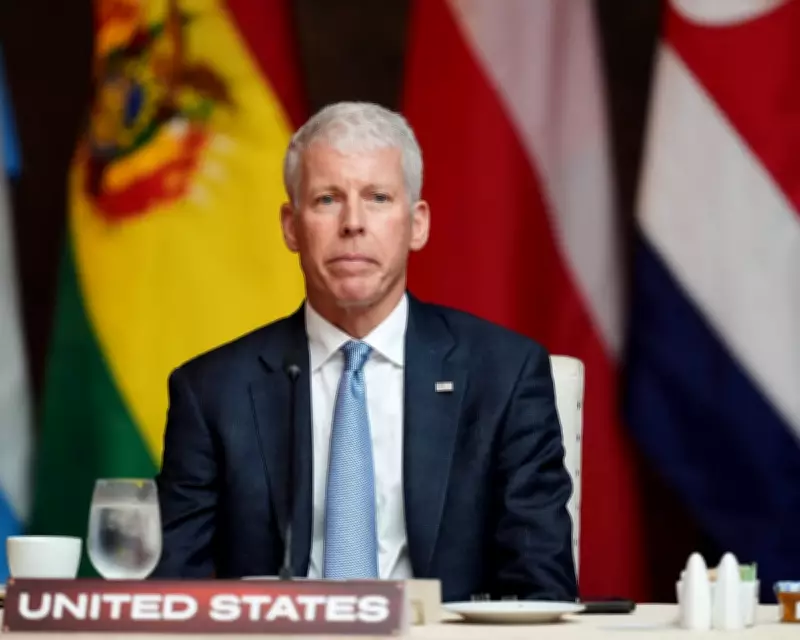
US Energy Secretary Assures Public on Short-Term Price Impact
US Energy Secretary Chris Wright has provided reassurances that the current spike in energy prices resulting from the Iran conflict will be temporary, predicting the disruption will last weeks rather than months. Speaking on CNN's State of the Union, Wright emphasized that the United States has no intention of targeting Iran's energy infrastructure despite escalating tensions in the region.
Conflict Causes Significant Market Disruption
The nine-day conflict between the US-Israel coalition and Iran has created substantial turbulence in global energy markets. The price of West Texas Intermediate crude oil surged by 35% in just one week, while gasoline, diesel, and jet fuel prices experienced sharp increases across the United States. According to AAA motor club data, the average price for a gallon of regular gasoline jumped 14% to $3.41 on Saturday.
Wright acknowledged the visible impact of the conflict, noting that "plumes of thick black smoke and oil raining down could be seen over Tehran" following what he described as Israeli strikes on local fuel depots. However, he stressed that "the US is targeting zero energy infrastructure" in its operations.

Administration Focuses on Long-Term Security
White House officials are framing the temporary energy price increases as a necessary trade-off for addressing what they characterize as a more significant long-term threat. Wright explained the administration's perspective, stating that Iran has continued "a massive expansion of their missile program" while advancing their nuclear capabilities.
"It is simply unacceptable for the United States, for the Middle East geography and for the world economy to have a terrorist regime with nuclear weapons and a gigantic missile arsenal," Wright told CNN.
White House Press Secretary Karoline Leavitt echoed this sentiment during an appearance on Fox Business, describing the price increases as "a short-term disruption for a long-term gain of taking out the rogue Iranian terrorist regime and finally ending their restriction on the free-flow of energy through the straits of Hormuz."
Shipping Disruptions and Recovery Timeline
The conflict has significantly reduced shipping traffic through the strategic Strait of Hormuz, a critical passage for global oil shipments. Wright noted that while a single tanker had passed through the strait in the previous 24 hours, this represented just a fraction of the typical 80-90 vessels that normally transit daily.
"We're nowhere near normal traffic right now," Wright conceded. "And that'll take some time. But, again, worst case, that's a few weeks. That's not months."
Leavitt highlighted administration efforts to mitigate shipping disruptions, including political risk reinsurance for vessels and US Navy escort services for tankers through the critical choke point. She also pointed to increased oil production from Venezuela as helping to offset supply disruptions.
Political Context and International Response
The Trump administration's sensitivity to domestic energy prices comes ahead of crucial congressional elections in November, with cost of living emerging as voters' top concern. President Trump himself has downplayed concerns about price increases, telling Reuters last week, "I don't have any concern about it. They'll drop very rapidly when this is over."
US Ambassador to the UN Mike Waltz emphasized the broader international context during an appearance on ABC News' This Week, noting that Gulf states have become "absolutely united" against Iran's actions. "They are incensed," Waltz said, anticipating "additional diplomatic and possibly military action from them in the coming days and weeks."
Wright remained optimistic about price normalization, predicting that US domestic energy prices "will ultimately fall back" to levels seen during Trump's term. "We want it back below $3 a gallon," he stated. "And it will be again before too long."






