The sign on the pharmacy reads 36°C as women glide past, immaculately dressed with pink peonies and blood red roses in the crooks of their arms. The scent of fresh cherries swirls in the sweltering summer air. The tinkle of piano keys trickles onto wide boulevards lined with mulberry trees. A few streets away, bunnies and ducks shuffle in cages, waiting to be sold in an open-air market. On a hill overlooking the city, a memorial to the more than one million people who died in what just about everyone calls a genocide. Beyond that, glacial valleys; herds of majestic Karabakh horses; mountaintop monasteries and a vast, high-altitude freshwater lake (one of the largest in the world). This is Yerevan: ancient capital of Armenia, a small Christian nation surrounded by mostly non-Christian neighbours. Azerbaijan to the east; Iran to the south; and Turkey, to the west. Metro is here because we were among the lucky few invited on an exciting new journey: the UK’s first-ever direct flight, a five-hour jump to the Caucasus from London Luton with Wizz Air.
Swaddled by volcanic peaks and biblical plateaus
Armenia is a landlocked country. And so the next ‘fly and flop’ destination, it is not. But the scenery is so spectacular, the food so divine, the history so devastatingly profound that it makes up for the lack of coast, and then some. Did we mention that it’s absurdly affordable? We’re talking flights from £45, slap-up meals from £8 and pints from – checks notes – £1.50. This is what we saw in and around Yerevan, and why for a certain kind of traveller, it might be the most thrilling new route from the UK this year.
‘Pink City’
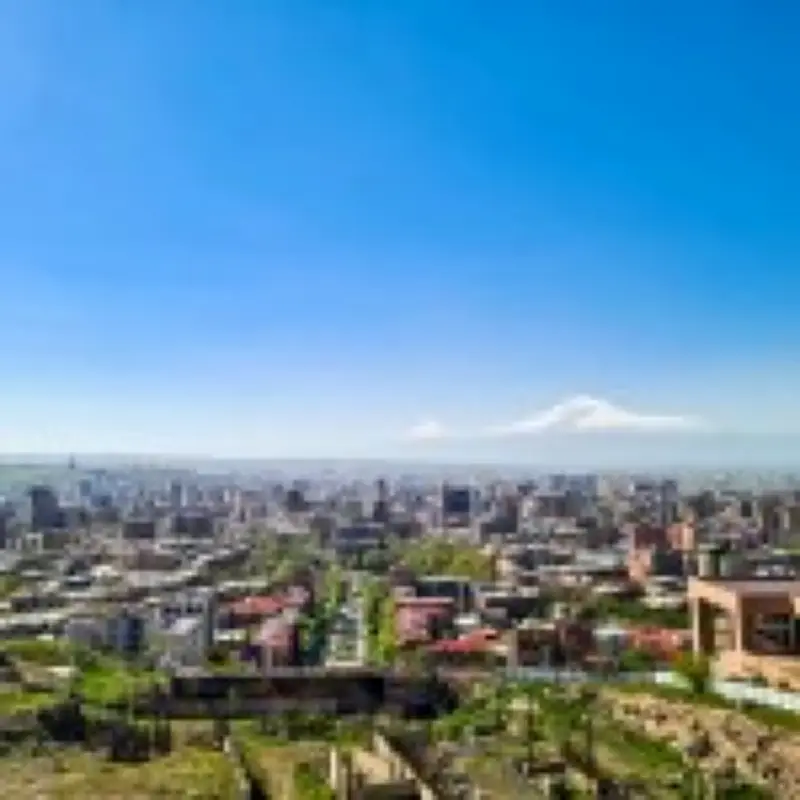
Established all the way back in 782 BC (29 years before Rome), Yerevan is one of the world’s oldest continuously inhabited cities, and one of its most beautiful. It sits against a dramatic backdrop. The silhouette of Mount Ararat – sacred to Armenians, though it lies just across the border in Turkey – looms large, the mountain where, legend has it, Noah’s Ark came to rest. Armenia wears its ancient identity with pride: it was the first nation to adopt Christianity as its state religion, in the year 301, a head start on the rest of the world. The city is built from tufa, a stone that comes in a kaleidoscope of colours that turn rosy in the afternoon light: pinks, golds and splashes of turquoise. It has earned Yerevan a lovely nickname: the Pink City. From 1924, however, a new vibe was ordered under USSR rule. Rather than Soviet Brutalism, though, local architect Alexander Tamanyan was all about curves. Most buildings have arched windows and covered arcades. There are several striking circular structures, and the opera house is a fine example of classic Armenian design. But nothing is more impressive than the Cascade, a building likened to the Hanging Gardens of Babylon, with stacks of waterfalls and terraced gardens outside and an impressive Museum of Art within. This is where our journey starts.

Cultured country
From the off, it’s clear that Yerevan is a city that takes culture seriously. Everywhere there are statues and museums to poets, artists, composers. At the Vernissage Market, stalls are laden with handwoven carpets (renowned for their quality since Silk Road days) and hand-carved chess sets, a nod to the nation’s favourite pastime. It is not an exaggeration to say that almost every woman here carries a bouquet of exquisite blooms, the kind that would cost hundreds in the UK. In Armenia, giving flowers is deeply embedded in culture, a daily custom to mark every milestone from dates to weddings and welcoming friends to a home. But there is another reason we are treated to such a magnificent display: Russia, by far and away the biggest export market, has just announced a ban on fresh flowers from the South Caucasus country. The streets are filled with coffee shops and live music, outdoor bars and restaurants buzzing with laughter and conversation. Opera is big here, as is jazz. There are several places to catch a trio, but Ulikhanian Club is a cut above the rest. For £10 you get a seat at a two-hour show. The bartenders do a mean whiskey sour.

Armenian food is delicious
We’re talking tolma (stuffed vine leaves, like dolma elsewhere), khorovats (kebabs), lavash flatbread, lahmacun (a sort of cheese-less pizza), manti dumplings and lots and lots of meat. Yerevan is full of food joints for every budget, but the ones that stand out are Grill.am (tasty £4 kebabs), Tun Lahmujo (authentic Caucasian cuisine) and Rehan: part Armenian, part Lebanese, wholly delicious. For fine dining, try Dolmama. Kim Kardashian, one of the most famous Armenians, has eaten here. Make a reservation (you’ll need one). Also worth a stop is Nairi, a restaurant that spills out of the Grand Hotel Yerevan in the heart of town. It’s a lovely spot to spend an afternoon, people-watching and cooling down in the spray of the fountain. Armenians are creative, and nowhere draws the hipster crowd more than Karmir Photo Lab, a trendy cafe-cum-studio where you’ll find fashionable people and fantastic cherry cake. Then there is the wine. Not so famous as its neighbour Georgia, Armenia nevertheless produces some exceptional stuff. The most celebrated is Areni, a red that’s a bit like a fuller-bodied Pinot Noir. A great place to try it is In Vino, Yerevan’s oldest wine bar where you can enjoy charcuterie (for two) and a bottle of your choice for around £35.
The darkest of histories
In a 2018 episode of Parts Unknown, Anthony Bourdain visits Armenia and has a conversation with a cybersecurity consultant called Ruben Muradyan. Ruben makes an interesting observation: ‘When you are being oppressed throughout your history, knowledge is something that can’t be taken from you… They can take your home, they can take your fortune, but knowledge and skill remain with you all the time.’ He is talking, of course, about the Armenian genocide, the systematic annihilation of as many as 1.2 million Christian Armenians living in the Ottoman Empire during World War I. As the first of the modern genocides, it holds a complicated place in world history. For decades, the Armenian community, dispersed throughout the globe, struggled with recognition (the diaspora is estimated to be about eight million, dwarfing the three million citizens living in the country itself). Today, more than 20 countries officially acknowledge the atrocities as genocide, including most of Europe, though not the UK. Two countries officially deny the Ottoman government’s role in the elimination of the Armenian community: Azerbaijan and Turkey. The National History Museum on Republic Square (£5) and the memorial complex on Tsitsernakaberd Hill (free) are exceptional and a major draw for history lovers. Both offer harrowing insight into the human cost of ethnic discrimination. On the other side of the city in Victory Park, the colossal Mother Armenia statue houses a smaller but equally fascinating museum on Nagorno-Karabakh. In the 1920s, the Soviet Union placed the historically Armenian-majority region inside the borders of Soviet Azerbaijan. Then, as the Soviet Union collapsed in the late 1980s, ethnic Armenians sought to unite with Armenia, triggering a full-scale war. It has started and stopped several times since. In March 2025, the two governments said they were prepared to end the nearly 40-year conflict.
Getting out of the city
Beyond Yerevan, Armenia is full of surprises, all accessible by marshrutka (local white minibuses) or very affordable taxis (never more than £5-ish on local ride share app, Yandex). There is the weird. In the village of Zovuni about 30 minutes north, a monument that might one day be the ‘world’s largest’ Jesus statue is taking shape. The 33-metre aluminium likeness of Christ will stand atop a 44-metre pedestal if it ever gets assembled, but it keeps running into trouble. Plans for the statue to be built atop Mount Hatis, a 2,500-metre peak around 30km northeast of Yerevan, were first announced in 2022 by controversial Armenian businessman Gagik Tsarukian. Soon after, the Armenian Apostolic Church publicly opposed the project because statues of Jesus are considered offensive in the country. Then, equally controversial MMA fighter Conor McGregor (who recently declared he has given his life to Christ) praised the project in a viral AI-generated social media post, calling it ‘magnificent’. It’s all a bit of a mess. For now at least, the statue lies in pieces on a construction site behind a corrugated iron fence, marked on Google Maps as ’Statue de Jesus Christ en construction’. There is the wonderful. The area around Dilijan is known as ‘Armenian Switzerland’, a mountain region blanketed in forest with spectacular hiking trails, medicinal mineral water springs and a diverse population of golden eagles, red deer, and brown bears. Nearby Lake Sevan is one of the largest freshwater alpine lakes in Eurasia, and perched on rocky shelf overlooking its dazzling depths is a writer’s retreat that’s now a very dilapidated hotel. Once, this lakeside modernist building was a haven for Soviet authors and poets. It counts Jean-Paul Sartre and Simone de Beauvoir among its previous guests. Despite part of the building being off limits (it is, literally, crumbling), you can still enjoy a local beer on the terrace, served by the lovely landlady Wera. The beer will be warm, but the view makes up for it. And then there are things so extraordinarily unique, you won’t find anything like them anywhere else in the world. In the village of Arinj, on an unremarkable pot-holed street, is a black door marked with the sign: Levon’s Divine Underground. The story of what lies behind it goes something like this. When Tosya Gharibyan asked her husband to dig a basement under their house to store potatoes, she had no idea he would eventually produce one of Armenia’s most bizarre but best-loved tourist draws. Their one-storey house outside Yerevan may not look like much, but today it brings in visitors from across the globe after a 23-year labour of love by Tosya’s late husband, Levon Arakelyan. They come to see a twisting network of subterranean caves and tunnels that runs 31 metres deep. Every inch of it, carved by hand. A builder by trade, Levon would toil for 18 hours a day — only pausing to take a quick nap and then rush back to the cave, confident that he was being guided ‘by heaven’. He was even working on the project on the day he died in February 2009, aged 67. Until now, Armenia has trailed Georgia when it comes to UK visitor numbers. But that will surely change with the launch of direct flights. Still relatively undiscovered, it’s a place with plenty to offer – beautiful cities, magnificent landscape, profound history and lovely locals. Go now, before everyone else does.
The essentials
Wizz Air flies from London Luton to Yerevan Zvartnots Airport twice a week, on Mondays and Fridays. One-way fares from £45.99. British citizens can travel to Armenia without a visa for up to 180 days in a one year period. The local currency is the Armenian dram. Most UK phone providers apply high rates for calls and data in Armenia, but local Sim cards with unlimited data are available on arrival at Yerevan airport for around £10. AirAlo and Saily also sell eSims that work in Armenia.
Where to stay
- £: Avenue 30. Doubles with balconies from £67 per night, including breakfast.
- ££: Tufenkian Historic Hotel Yerevan. Doubles from £132 per night, including breakfast.
- £££: Grand Hotel Yerevan (one of the small luxury hotels of the world). Doubles from £148 per night, including breakfast.