

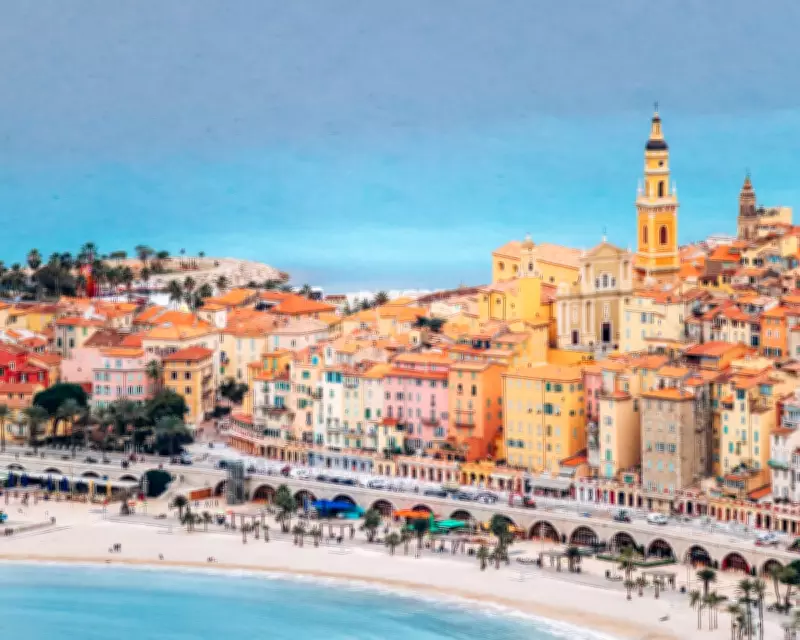
The Borderland Gem Where France Meets Italy
Nestled on the sun-drenched French Riviera, just moments from the Italian border, Menton stands as a captivating seaside town that defies simple classification. With its famously mild winters and celebrated lemon groves, this unique destination has long attracted artists, writers, and travelers seeking its distinctive Mediterranean charm.
A History of Changing Allegiances
"It's not France, it's not Italy, it's Menton" – this local saying perfectly captures the town's complex identity. Throughout its storied past, Menton has changed hands numerous times, belonging to the Grimaldis of Monaco, becoming part of the Kingdom of Sardinia, and experiencing complete annexation by Italy during World War II. The town only became definitively French following a public vote in 1860, yet its Italian soul remains vibrantly alive in every aspect of daily life.
The Golden Heart: Menton's Lemon Culture
Today, visitors are immediately struck by the prevalence of yellow hues throughout Menton – a visual celebration of the town's beloved citrus heritage. The unique microclimate, featuring warm winters, terraced hills, and sandy soil, creates perfect conditions for growing exceptional citrus fruits.

Mauro Colagreco, chef at the acclaimed Mirazur restaurant located just steps from the border, explains the special qualities of local produce: "You can eat the peel of a Menton lemon; it has a thick, sweet rind. You can eat the whole thing; it's totally organic and very juicy." He particularly notes the distinctive "smile" – a small curvy fold at one end that characterizes the Menton lemon.
Yellow Time: The Fête du Citron Festival
Late February through March transforms into "yellow time" in Menton, when lemons, daffodils, and mimosa create a golden landscape across the hillsides. This period hosts the spectacular Fête du Citron, a two-week festival featuring parades, giant floats, and enormous citrus-covered sculptures. The 92nd edition recently showcased massive models including a whale, 12-meter-high parrots, and entwined storks – all meticulously decorated with citrus fruits.
Interestingly, while celebrating the Menton lemon, the festival now sources its 123 tonnes of oranges and lemons primarily from Spain and Portugal, as the local variety has become too precious and rare for such large-scale decorative use.
Border Life: Cycling Between Cultures
Luciano Fondrieschi, who runs R Bike Menton cycling shop along the promenade between the old town and Italian border, observes the lively cultural interplay: "Menton is a French town with an Italian regard." He notes that while most harbor boats bear Italian registration, French cars dominate the roads.
Fondrieschi's shop serves as a microcosm of Menton's international character, welcoming British cyclists completing 36-mile rides to Sanremo, Italian pensioners returning from pizza lunches in Dolceacqua, and Luxembourg travelers needing repairs before continuing to Saint-Jean-Cap-Ferrat. His in-store cafe perfectly blends French and Italian offerings with brioches, rústico caprese, aromatic cordials, and café au lait.
Streets of International Memory
Menton's street names reveal its cosmopolitan history alongside traditional French tributes. Alongside avenues honoring Pasteur, Victor Hugo, and Général de Gaulle, visitors find avenues Cernuschi and Laurenti, plus streets named Pietra Scritta, Isola, Urbana, Pieta, and Mattoni. International influences appear in Square Victoria (commemorating Queen Victoria's 1882 stay), avenue Blasco Ibáñez (honoring the Spanish writer who lived here in the 1920s), and avenue Katherine Mansfield (who stayed at villa Isola Bella).
Remarkably, these last two connect via rue Webb-Ellis, named for William Webb Ellis – the schoolboy credited with inventing rugby who spent his final years in Menton during the 1860s. His hilltop grave in Vieux Château cemetery overlooks the sea, perpetually adorned with rugby balls and club ties from visiting enthusiasts.

Artistic Sanctuary and Historical Curiosities
Higher still in Trabuquet cemetery rests English illustrator Aubrey Beardsley, who died at 25 alongside other young artists, writers, and aristocrats drawn to Menton's therapeutic climate and botanical gardens during the late 19th century.
French artist Jean Cocteau left his mark in 1955 when he decorated the Salle des Mariages with mythological scenes featuring centaurs and a Menton marriage ceremony. Visitors can obtain keys from the town hall to view this remarkable artwork.
Nearby, Allo Robert presents a fascinating emporium of early 20th-century French and Italian curiosities – from illuminated Tabac signs and 1930s soda siphons to champagne buckets and blue chairs from Nice's promenade. The shop's sign perfectly captures Menton's blended heritage: "de curiosités … et tutti quanti" ("curiosities … and so on").
Practical Information for Travelers
For accommodations, the seafront Hôtel Napoléon offers solar-heated pools with doubles starting from €106. Culinary enthusiasts can enjoy Mauro Colagreco's La Pecoranegra restaurant, serving exceptional pizzas, vitello tonnato, and flavored burrata that perfectly represent Menton's Franco-Italian culinary fusion.





