Friday 24 April 2026 2:00 pm | Updated: Tuesday 21 April 2026 10:46 am
Why the Norwegian Arctic Is the Best Place to See the Northern Lights
By Luke Abrahams
This Arctic outpost at the north of the Scandinavian nation is perhaps Europe’s best-kept travel secret, says Luke Abrahams.

Nighttime in Jøkelfjord, Norway, 215 miles north of the Arctic Circle. I dread to think what temperature it is. I’m hiding from the bitter air in a hot tub, although the opulence is interrupted when the power cuts out. The bubbles feel more unnerving than luxurious when you can’t see, but eventually my eyes adjust to the night sky, and a hauntingly beautiful shade of electric green glides over the peaks of the jagged Finnmark Alps. This is my first glimmer of Mother Nature’s greatest show: the Northern Lights. With Arctic travel booming, plenty of places are touting ‘the best displays’ but mark my words, this is the surest place to see them, and this year marks the ideal moment to finally book that dream trip.
In the astronomical calendar, 2026 is a big year for Northern Lights spotting thanks to a phenomenon dubbed the Solar Maximum. This peak in the sun’s 11-year solar cycle is a period characterised by intense change. An increase in sunspots, intense solar flares and coronal mass ejections caused by the sun’s magnetic field becoming more active and molecularly complex.
A Phenomenal Place for the Northern Lights
As a general rule, the best time to see the Northern Lights is from late August to mid-April, but at Isbreen, you see them every night thanks to its location slap bang in the middle of the so-called aurora oval, precisely 70 degrees north of the Arctic Circle.
I’m done gawping from the bubbles so I dress quickly and rush outside. The green intensifies and a swathe of silver-grey clouds fill the sky. In a flash, the entire sky lights up, and the static arcs of the silvery geocharged clouds explode into a rapidly pulsating dance of colour, from red to an extremely rare white. This is what owner of the lodge Christine Gaffney says is ‘the corona effect.’ The ultimate Northern Lights experience during which the rays of the aurora look as though they are raining down upon you.
I am no believer in heaven. But for a split second the claw-like motions of the boreal curtain made it seem as though the universe was opening a hidden door into another world. Seeing the lights billow and surge on loop for the first time was like stepping onto a cosmic rollercoaster. It was spellbindingly quixotic, making me feel like I was being squeezed into a gargantuan wormhole, trapped in a hypnotic state of interstellar wonder.
The next morning, I woke in a snowy wilderness, the arctic landscape a picture of barren beauty. Desolate and silent, around 50 people live here on the fringes of Jøkelfjord, a vast watery inlet that snakes its way to the Norwegian Sea. The main attraction here – aside from the long colourful auroras of the long polar nights – is the Øksfjordjøkelen glacier. It is the only one on mainland Europe that meets the sea. Beyond the ice, it’s off the grid and “edge of the world” stuff. You can only count the remote fjord and towering Finnmark Alps for company.
Slowing Down and Being Present
Isbreen has been a sleeper hit among the word-of-mouth glitterati, who come here for a dose of the quiet life. The lodge is intimate, designed to “create a space for presence, reflection, and meaningful moments”, according to owner Christine, who opened the property in 2024. Half British, half Norwegian, the entrepreneurial mother has spent over 30 years in the luxury travel business, and owns several high-end tour operators, including Due North Air, an off-piste heli charter that swoops its way over the polar ice caps. The key to her success? “Keep it simple,” she says. “True luxury lies in the art of slowing down, being present, and immersing yourself fully in the rhythm of nature”. The result is typically Scandi – forest sauna and cold lake plunges encouraged.

Of the five geodesic domes, mine is the most spectacular. Named after the mountain it overlooks, Skalsatind, it’s a vision of Nordic cool. Kitted out in rugs, throws and ceramic nicknacks, the accommodation is affectionately known as the “bigloo,” its double domed interiors featuring a separate living space complete with mountain views and a medley of chairs and poofs for zenning out. The Arctic surroundings are the main event, thanks to panoramic windows in the ensuite bedroom, and there are a pair of reclining reading chairs to gaze over the hypnotic calm of the fjord. This is Norway unpolished, anti-brand and unpretentious.
Forty Charismatic Arctic Huskies
Outside of Isbreen, adventure comes in many forms. Swimming in the fjord with Orcas is big business come the winter months, as is humpback whale spotting, Arctic fishing and whizzing aboard zodiacs to experience the intense winds of the Norwegian Sea. In the summer, there are long hikes into the hills and wildflower forests under the midnight sun. And when September hits, the hot ticket is a bird’s eye view of The Great Reindeer migration when Sámi nomads (Norway’s indigenous peoples) guide their herds over the Finnmark plateaus.
On a wildly cold Valentine’s Day afternoon I set off to Parken Gard Husky and dairy farm to meet husband and wife duo Arne Karlstrøm & Marianne Skjøthaug. Between them, they care for 40 charismatic Alaskan huskies who compete in big time races like the 1,200km Finnmarksløpet, racing through hostile Arctic terrain. Both Arne and Marianne have competed: Marianne became the first woman to win the world championships in 2011. Now the champion faces her biggest challenge: me. After spending 10 minutes getting to know the dogs, she schools me in the art of dog sledding. Balance is key, as is common sense and a knack for putting your heels on the break. “These dogs only know one thing” she tells me, “and that is to run.” And with that we set off into the abyss of the Langfjordbotn mountains.
Darting past frozen rivers and snowcapped trees, the adrenaline kicks in and I scream great woops of joy. Howling huskies are at their happiest when they are working and as we trudge through the icy landscapes, their legs pump like pistons and their tongues loll with excitement. While powerful and hilariously entertaining, one major downside is that they can poop on the run, an odious skill that results in a few unwelcome brown missiles – something Marianne says you get used to over time.
My Last Day Began with the Most Surreal Experience
We eventually arrive at her cabin and Arne rocks up atop a snowmobile full of piping hot tea and hot chocolate as well as cakes, fresh bread, meats and butter churned from their dairy farm he oversees with his brother, Tore (who I recognise from a snowshoeing expedition through the mountains). Sharing stories and jokes, we sit and watch Blue Hour – an occurrence during winter when the sun drenches the landscape in deep blue – before we race down to the kennels under the stars and the sparkle of The Northern Lights.
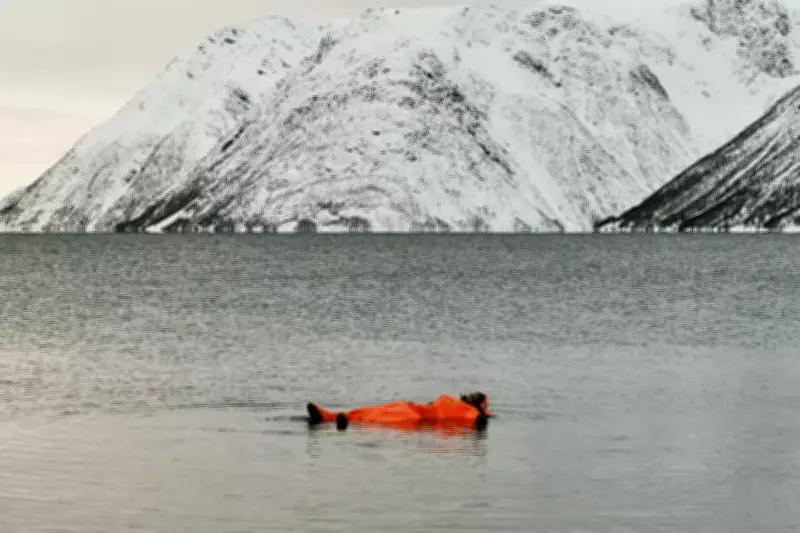
My last day began with perhaps my most surreal experience: Arctic floating. Before I hit the water, I changed into my fully sealed, bright orange thermal dry rescue suit. The look was giving giant orange Tellytubby rather than Norwegian chic, but for the sake of staying alive, the fashion faux pas was worth it.
With Christine by my side, I headed down to the fjord and was let loose. This was my Interstellar moment: as I trudged through the freezing cold water, I felt primordial and ancient. It was like stepping onto another world surrounded by alien mountains and desperately lonely landscapes. The water eventually hit my thighs, and I suddenly heard Christine shout “now.” With a sharp turn I faced her and let myself fall back.
Lying flat on my back, silence eclipsed the world around me and the feeling of total weightlessness consumed my body. I felt like a drifting otter: safe, snug and deeply relaxed. It was the ultimate meditation, with only the sounds of the lapping water and frosty winds to keep me company. After spending 10 minutes silently drifting, I backstroked to shore with a feeling of profound calm. Now I understand the Scandi idea of enlightenment, “going with the flow” in a literal sense. For someone who detests the cold, I was oddly comforted by it. By the time I set off for the airport, I already missed the snow. As I got one last glimpse of Jøkelfjord, this, I thought to myself, is the world’s best kept secret.
Visit the Norwegian Arctic
All-inclusive from 25,000 NOK (approx. £1,939 per night) based on two guests sharing. Daily flights with SAS to Alta airport depart from London Heathrow.