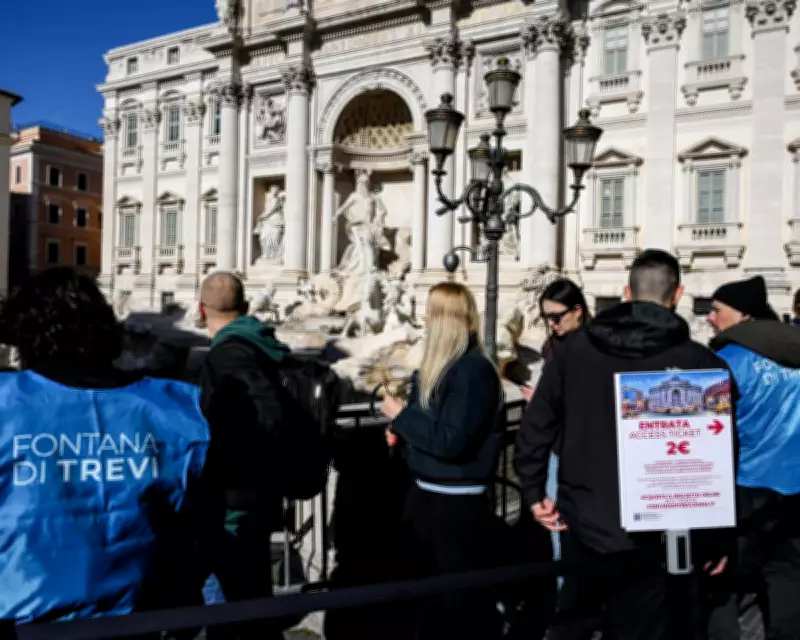
As of this week, visitors to Rome's iconic Trevi Fountain must pay a €2 fee to access its basin, a move by city officials designed to protect the monument from the pressures of mass tourism. The charge, which applies during peak hours, has sparked a mix of acceptance and criticism among tourists, highlighting the ongoing global debate over balancing preservation with public access to historical sites.
A New Era for the Trevi Fountain
The €2 fee, equivalent to roughly £1.70, is now mandatory for those wishing to walk down the steps to the fountain's basin between 11:30 am and 10:00 pm on weekdays, and from 9:00 am to 10:00 pm on weekends. This initiative, enacted after years of deliberation by Rome council officials, aims to better manage the overwhelming crowds that flock to the late baroque masterpiece. In 2025 alone, the Trevi Fountain attracted over 10 million visitors, underscoring the urgent need for crowd control measures.
Visitors who pay the fee can enjoy unlimited time at the basin, participating in the beloved ritual of tossing coins over their shoulders—a tradition said to ensure a return to the Eternal City—and capturing selfies against the fountain's sparkling white marble backdrop. However, strict rules prohibit eating, drinking, or smoking in the area to maintain cleanliness and respect for the site.

Funding Conservation Efforts
Simona Ugolinelli, the councillor coordinating the measure, emphasised that the fee is a modest contribution towards safeguarding the Trevi Fountain. "This is a very small payment to allow us to protect the Trevi fountain," she stated, noting that the charge is expected to generate approximately €6.5 million annually. These funds will be reinvested not only in the fountain's upkeep but also in other monuments across Rome, supporting broader conservation efforts in the Italian capital.
Ugolinelli pointed out that Rome is not pioneering such fees, citing examples from other global tourist destinations where similar charges are often higher. "This measure will enable us to better manage tourism flows while preserving our historical assets, meaning visitors will be able to enjoy their beauty all the more," she added, highlighting the dual benefits of revenue generation and enhanced visitor experience.
Mixed Reactions from Tourists
On the first day of implementation, under a clear blue sky, most visitors appeared to comply willingly with the new fee, using cash or contactless payment machines, with online ticket options also available. Teresa Romero, a Portuguese tourist celebrating a milestone birthday in Rome, expressed support for the charge, stating, "I think it's normal and €2 is nothing – the price of a coffee. The most important thing is to preserve history."
However, not all reactions were positive. Irma Pavitashvili, a tourist from Georgia, voiced her disapproval, saying, "This isn't a good thing at all. This fountain should be for everyone." Similarly, Alma Peterson, a visitor from the United States, argued, "It's not right to charge people – this is history, it should be free." These sentiments reflect a broader tension between accessibility and preservation in culturally significant sites.
A Growing Trend in Italian Tourism
The introduction of the Trevi Fountain fee is part of a wider trend in Italy, where charges for previously free attractions are becoming increasingly common as visitor numbers surge. Since 2023, the Pantheon—renowned for its ancient oculus—has imposed a €5 entry fee, a measure that Ugolinelli described as "working very well." Other Italian cities have adopted similar strategies; for instance, day trippers to Venice must pay to enter during peak seasons, and Verona now charges tourists to access the courtyard linked to Shakespeare's Romeo and Juliet.
These measures underscore Italy's proactive approach to tackling overtourism, which threatens the integrity of its historical landmarks. By implementing fees, authorities aim to reduce overcrowding, generate essential revenue for maintenance, and ensure that future generations can continue to appreciate these cultural treasures. As tourism continues to rebound post-pandemic, such policies may become a standard feature in heritage management worldwide.

While the €2 fee at the Trevi Fountain has divided opinion, it represents a critical step in Rome's efforts to balance the demands of modern tourism with the imperative of conservation. As visitors adapt to this new reality, the hope is that the iconic fountain will remain a vibrant, well-preserved symbol of Rome's rich history for years to come.