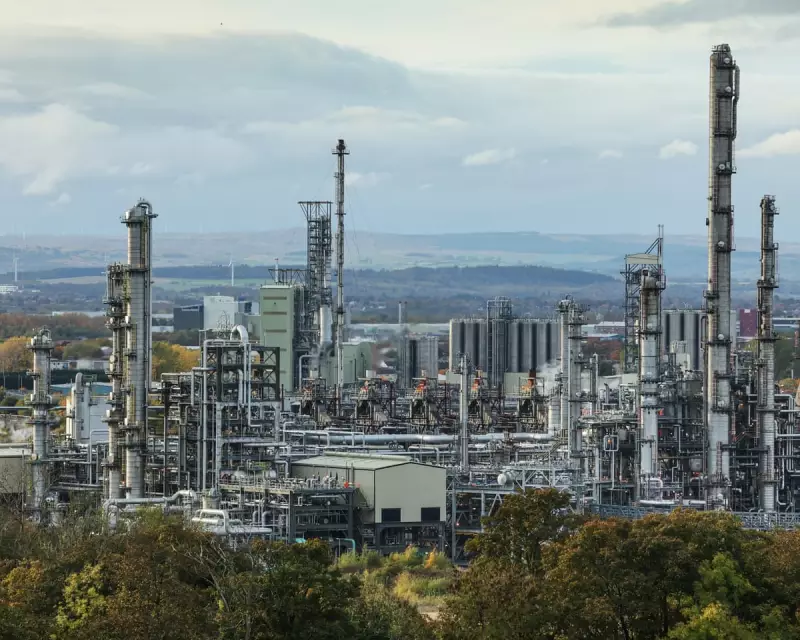
The UK government has stepped in with a £120 million public support package to secure the future of the crucial Ineos ethylene plant at Grangemouth. While Prime Minister Keir Starmer hailed the move as a commitment to "back British industry," the eleventh-hour intervention has sparked intense debate over whether a coherent national strategy exists to protect the nation's shrinking heavy industrial base.
A Patchwork of Interventions
The deal, which ensures ethylene production continues at the Firth of Forth site for another five years, underscores the plant's critical importance. Ethylene is a foundational feedstock for medical plastics, advanced manufacturing, and the automotive and aerospace sectors. Without the Ineos facility, which supplies other chemical plants, the UK's already diminished chemicals industry would face a far more precarious future.
However, this rescue stands in stark contrast to other recent decisions. The oil refinery on the same Grangemouth site was allowed to close this year and convert to an import terminal. Meanwhile, ExxonMobil's ethylene plant at Mossmorran is scheduled to shut in February after unsuccessful talks with ministers. Conversely, the government earlier recalled parliament to take control of British Steel in Scunthorpe. This inconsistent approach leaves industry observers questioning the guiding principles behind state intervention.

The Policy Gaps Undermining Industry
If the ministerial goal is to halt deindustrialisation while pursuing decarbonisation, analysts point to at least three major areas where policy appears disjointed and slow.
First, there are significant delays in tackling the UK's uncompetitively high industrial energy prices. The promised British industrial competitiveness scheme, offering savings of up to 25% on electricity bills for around 7,000 firms, will not be operational until April 2027. This timeline leaves businesses struggling with costs for years, with the vague "up to" phrasing adding further uncertainty.
Second, North Sea oil and gas policy sends mixed signals. While no new exploration licences will be granted, the extension of the Energy Profits Levy (the "windfall tax") until 2030 discourages investment needed to maintain existing fields. This is despite the Department for Energy recently approving more "tieback" licences to prolong the life of current sites. Notably, Treasury revenue forecasts from the levy are repeatedly downgraded by the Office for Budget Responsibility.
Third, the planned Carbon Border Adjustment Mechanism (CBAM), designed from 2027 to prevent "carbon leakage" by levying imports, has glaring omissions. The chemicals sector is not included, and the government is merely consulting on whether refineries should be, despite acknowledging their role in energy security and the industrial base.
Searching for a Coherent Vision
While the previous Conservative administration was also criticised for ad-hoc plant-by-plant crisis management, the current Labour government's ambition to support "places like Grangemouth" is facing its first major tests. The argument for saving the ethylene plant is economically solid, but it exposes a broader strategic vacuum.
The UK is not alone in this challenge; much of Europe grapples with similar pressures of high energy costs, global competition, and the green transition. However, the juxtaposition of the Grangemouth rescue with the Mossmorran closure and delayed support schemes suggests that, for now, deindustrialising events are still outpacing cohesive policy-making. The call for a clear, modern industrial strategy that matches political rhetoric with actionable, timely support grows ever louder.