

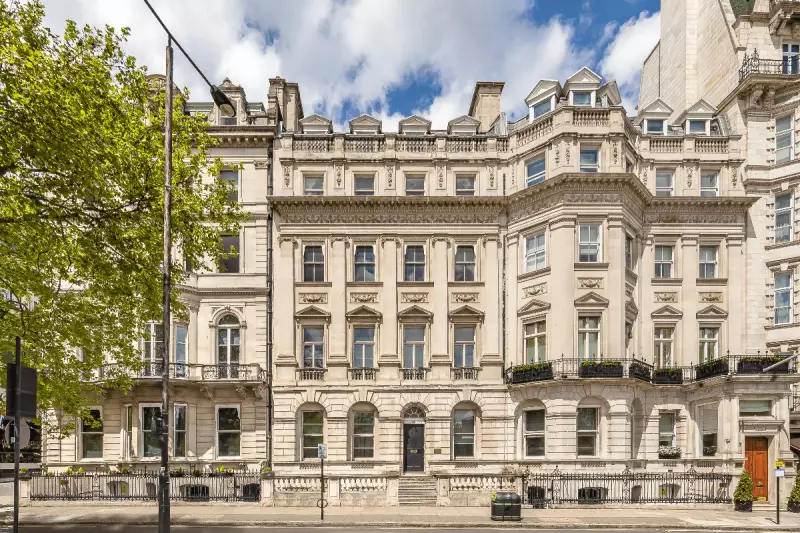
London's property sector is demonstrating encouraging signs of renewed vitality, positioning itself as a potential catalyst for broader UK economic expansion. However, this emerging momentum cannot be taken for granted, emphasising the need for sustained strategic focus and investment.
The Critical Role of London's Built Environment
Historically, London's housing market has served as a reliable indicator of the United Kingdom's overall economic health. Given that the built environment contributes approximately one quarter of the nation's GDP, its performance directly influences capital flows, job creation, and overall market confidence. When construction activity slows, the negative effects extend well beyond the immediate property sector, impacting numerous related industries and the wider economy.
A Decade of Decline in Construction Starts
Recent data from Molior presents a stark picture of the challenges facing London's development landscape. Over the past ten years, construction starts in the capital have plummeted by a staggering 84 per cent. In 2015, London recorded 33,782 new home starts, but by 2025, this figure had collapsed to just 5,547. This dramatic reduction represents more than a temporary market fluctuation; it indicates a deep-seated structural slowdown that requires comprehensive intervention.

Emerging Signs of Recovery and Market Responsiveness
Despite these concerning long-term trends, there are tentative yet positive indicators that market confidence can be restored when appropriate conditions are established. Molior's figures reveal a significant improvement throughout 2025, with new home starts increasing from 1,385 in the first quarter to 2,294 in the fourth quarter, representing an almost doubling of activity over the year.
When compared to the final quarter of 2024, the progress appears even more substantial. Government data indicates there were merely 1,280 housing starts in London during that earlier period. This upward trajectory matters not because it immediately solves the underlying housing shortage, but because it demonstrates the market's capacity to respond rapidly to greater clarity and stability in the regulatory environment.
Government Initiatives and Collaborative Dialogue
The package of measures outlined by the Greater London Authority and the Ministry of Housing, Communities & Local Government in late 2025 played a crucial role in stimulating market activity. Perhaps equally important, these initiatives signalled the beginning of a more open and constructive dialogue between government bodies, City Hall, and the property industry. This improved communication is now starting to yield positive results, though the latest figures serve as a reminder of how fragile this recovery remains.
The Fragility of Current Progress
At the conclusion of the fourth quarter in 2025, construction had halted on 5,009 homes across 51 development sites throughout London. These represent schemes where sites are effectively in a state of suspension. In certain instances, contractors have encountered severe financial pressure as costs have escalated sharply. In other cases, developers have paused delivery in response to weaker sales conditions, where the cost-benefit analysis no longer proves favourable.
Both scenarios lead to the same fundamental conclusion: without confidence in the medium and long-term outlook, accompanied by political and regulatory stability, investment capital remains hesitant to enter the market. Enhancing the long-term attractiveness of London and the United Kingdom as a whole is essential to initiating meaningful development at the necessary scale.
Long-Term Investment Over Short-Term Solutions
The United Kingdom's next phase of economic growth will not be driven by temporary fiscal interventions or political rhetoric. Instead, it will be shaped by long-term investment decisions in urban centres and major regeneration projects. From transport-led developments to large-scale mixed-use neighbourhoods, these ambitious schemes require patient capital, predictable planning outcomes, and credible public-private partnerships. Where these elements align successfully, private investment naturally follows.

The property sector should be recognised for what it truly represents: a fundamental engine of productivity and economic growth. It supports millions of jobs, underpins the financial system, and provides the physical infrastructure within which all other economic activities operate. Treating the property industry with the same strategic importance as financial services would send a powerful signal to international investors about the UK's commitment to sustainable development.
Investor Sentiment and Future Prospects
Looking ahead to 2026, investor sentiment appears increasingly positive. A recent survey conducted by Knight Frank revealed that the United Kingdom has become the top target location globally for international investment. London is likely to be the primary recipient of this capital due to its demonstrated resilience, stability, liquidity, and strong market fundamentals, all of which contribute to attractive investment returns.
However, investors also seek markets that offer long-term visibility and consistency in policy direction. London and the wider UK can meet these expectations, but only through continued collaborative efforts across both public and private sectors.
Nurturing the Green Shoots of Recovery
The emerging signs of recovery in London's property market must be carefully nurtured and supported. The immediate task involves building upon this foundation, restoring confidence among developers and investors, and ensuring London once again becomes a city that constructs housing at the scale its economy and growing population demand. Achieving this objective will require determined and persistent leadership from both private industry and public sector institutions.
The alternative presents a concerning outlook. At best, it would mean the continuation of a prolonged period of housing under-supply and stalled economic growth. At worst, it could lead to a steady erosion of one of the world's greatest cities from its prominent position on the global stage. This is a price that London, and the United Kingdom as a whole, simply cannot afford to pay.





