

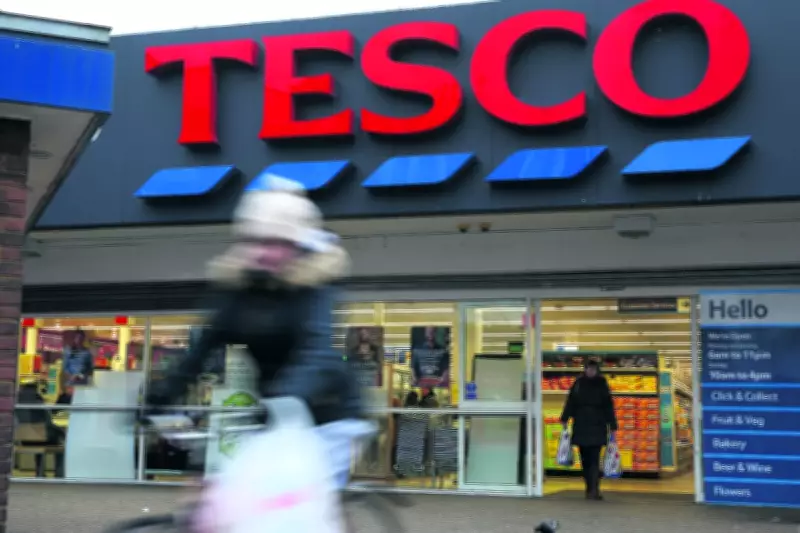
Tesco's Crucial Moment Amid Global Supply Chain Crisis
As Britain's largest supermarket chain prepares to release its full-year financial results this Thursday, all eyes are on how Tesco will navigate the turbulent waters created by the ongoing conflict in Iran. The retailer's performance will serve as a critical indicator for how the entire supermarket sector is responding to global supply shocks that threaten to drive food inflation dramatically higher across the United Kingdom.
The Chancellor's Emergency Summit
Earlier this month, Chancellor Rachel Reeves summoned grocery executives to an emergency meeting to discuss how the Iran war would impact British consumers' weekly shopping baskets. Among the assembled supermarket leaders, none commanded more attention than Tesco's chief executive Ken Murphy, whose company's forthcoming results will provide the first comprehensive look at how retailers are adapting to these unprecedented challenges.
Murphy, who succeeded the famously cost-cutting Dave Lewis in October 2020, has maintained a notably lower public profile than some of his more outspoken industry counterparts. Yet his strategic decisions have fundamentally reshaped Tesco's competitive position through aggressive price matching with discount rivals and significant technological investments.

Tesco's Strategic Transformation
Under Murphy's leadership, Tesco has dramatically intensified its competition with German discount grocers Aldi and Lidl, adding approximately 250 products to its Aldi price match range annually. The supermarket has simultaneously expanded its technological capabilities, more than doubling its technology department headcount while enhancing the Tesco app with features like the last-minute delivery service Whoosh.
Murphy has also continued his predecessor's focus on operational efficiency, launching several job-reduction initiatives aimed at "simplifying" the organization, including cutting 180 head office positions earlier this year. These strategic moves have helped Tesco maintain its dominant market position, currently commanding an impressive 28 percent share of the UK grocery market.
From Overexpansion to Renewed Focus
Tesco's current resilience represents a remarkable recovery from its troubled period in the 2010s, when the company's ambitious international expansion and diversification into financial services, cafes, and garden centers caused it to "take its eye off the ball" in its core UK market, according to Richard Hunter, head of markets at Interactive Investor.
"Having commanded what was essentially a 'Tescopoly' in the early 2000s, the company's brief international foray created significant vulnerabilities," Hunter explained. "The sudden emergence of budget German supermarkets Aldi and Lidl forced Tesco to refocus on what it does best rather than trying to do everything."
The supermarket's revival has been powered by two key initiatives: the highly successful Clubcard loyalty scheme and the aggressive Aldi price match program. Dan Coatsworth, head of markets at AJ Bell, noted that "the way Tesco fought back from the German discounters was to use the Clubcard scheme to price match," creating what has been ranked as the UK's best loyalty program through dramatic differences between standard and Clubcard-discounted prices.
Financial Performance and Market Position
Tesco delivered a quietly confident trading update in early January, reporting strong Christmas sales growth of three percent year-on-year. The company's share price has surged by 43 percent over the last twelve months and by more than 66 percent over the past two years, matching the performance of rival Sainsbury's while significantly outperforming Marks & Spencer, whose stock has fallen eight percent during the same period.
While Tesco opted not to adjust its operating profit forecast of £2.9 billion to £3.1 billion, the company indicated it expects performance to reach the upper end of this range. This stability represents what Hunter calls "a considerable achievement given the traditional ferocity" of the UK grocery sector.

The Iran Conflict's Looming Shadow
The most significant challenge facing Tesco and its competitors emerged just as the company's financial year concluded in February, when US and Israeli strikes on Iran sparked a conflict that has created global chaos in supply chains and fuel prices. Because Tesco's financial year ended in February, its upcoming results are unlikely to reflect the full impact of this disruption, though analysts expect the company to issue cautious forward guidance about potential challenges ahead.
The Food and Drink Federation, representing Britain's 12,000 food and drink manufacturers, predicts that food inflation will soar from three percent to nine percent by year's end, potentially reaching double digits if the Middle East conflict persists. Supermarket executives from Asda, Marks & Spencer, and other rivals have already called on the government to reduce taxes on retailers to help avoid passing these increased costs directly to consumers.
Market analyst Michael Hewson emphasized that "guidance is likely to be key here, with all UK food retailers having to bear the costs of higher energy prices, labour costs, as well as increased competition as Aldi and Lidl continue to open new stores."
Coatsworth predicted that Tesco's backward-looking results and forward-looking outlook would likely present "very different" tones, with the company adopting a "very cautious" stance about future challenges. Higher employment costs and reduced consumer spending driven by inflation fears will require careful navigation, making Tesco's evaluation of these expenses particularly crucial for investors.
As Britain's supermarket bellwether prepares to report, the industry awaits not just a financial snapshot but a roadmap for navigating what promises to be one of the most challenging periods in recent grocery retail history.





