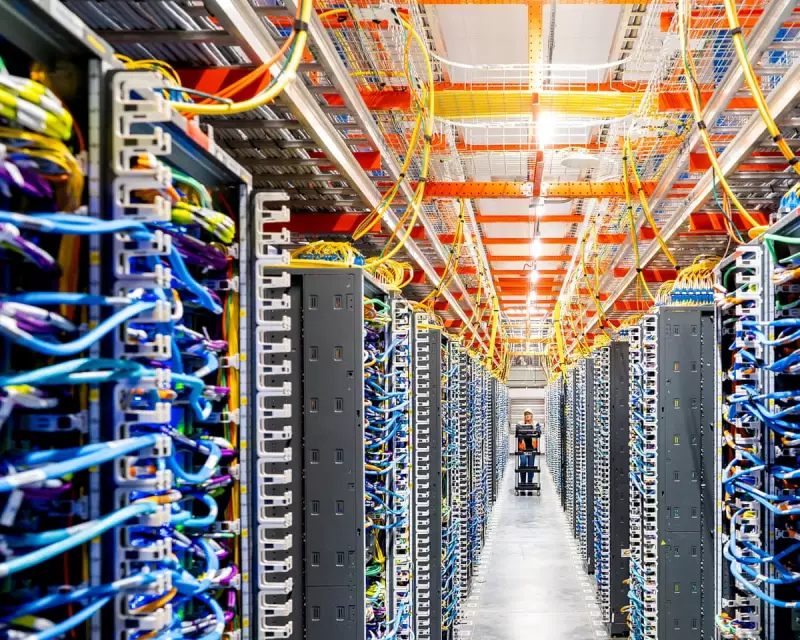
In a striking image from October 2025, a technician works diligently at an Amazon Web Services AI datacenter in New Carlisle, Indiana, symbolising the physical infrastructure underpinning the artificial intelligence revolution. This visual sets the stage for a week where technology dominated global conversations, from the Swiss Alps to Silicon Valley.
Davos: Where Tech CEOs Painted Visions of AI Dominance
At the World Economic Forum in Davos, delegates found themselves immersed in discussions that extended beyond politics to the transformative potential of artificial intelligence. The picturesque town was temporarily transformed, with shopfronts adorned with neon slogans from tech firms and consultancies promising to integrate AI into business strategies.
Cloudflare's wood-panelled headquarters urged collaboration with its message to "connect, protect and build together", while Wipro's bold declaration to "Dream Solve Prove Repeat" echoed through the streets. Inside the conference halls, tech leaders articulated ambitious hopes for AI's physical manifestations to envelop the globe in the coming years.

Microsoft's Vision: Distributed Token Factories
Microsoft's chief executive, Satya Nadella, captivated audiences with his concept of "token factories" – a term he uses for datacenters. He argued that these facilities must be distributed worldwide to democratise AI's benefits. "To me, a long term, scalable solution is to have all of these token factories part of the real economy connected to the grid, connected to the telco network – and that’s what will drive that scale, whether it’s in the global south, or in the developed world," Nadella explained.
Meanwhile, Google showcased the latest iteration of its Google Glasses to enthusiastic delegates, and numerous sessions in the Davos congress centre explored AI's potential benefits. A notable addition was a lively chat with Elon Musk, though with SpaceX's IPO on the horizon, his focus leaned more towards Martian ambitions than terrestrial AI.
Bubble Concerns Amid the Glitz
Beneath the glittering surface, significant concerns emerged about whether this AI frenzy might constitute an epic bubble. In an interview with the Financial Times, DeepMind chief Demis Hassabis acknowledged that some aspects of AI investment appear "bubble-like", but he reassured that Google would withstand any potential burst.
Nadella offered a sobering test for identifying a bubble: "A tell-tale sign of this as a bubble, is if all we’re talking about are the tech firms." This remark underscored the broader economic implications at stake.
Silicon Valley's Drama: Billions Chasing Dreams Over Products
Away from Davos, Silicon Valley has been captivated by what the Wall Street Journal described as a "very human drama". Thinking Machines Lab, a startup founded by former OpenAI chief technology officer Mira Murati, made headlines after firing its own chief technology officer, Barret Zoph, over a relationship with a colleague and alleged productivity issues.
In a twist, Zoph and two other employees reportedly signed offers with OpenAI shortly after, despite having left the company just a year earlier to join Murati's venture. The stakes here are monumental, involving billions of real dollars and over $10 billion in potential value. Thinking Machines has raised $2 billion in venture capital since its founding in February 2025, achieving a valuation of $12 billion, yet it has released only one product: Tinker, a tool for customising large language models.
The Rise of Humans&: Valuation Without a Product
Another example of this trend is Humans&, a new company profiled in the New York Times. Founded just three months ago by researchers from Google, Anthropic, and Elon Musk's xAI, it aims to foster collaboration between humans and machines through innovations in areas like reinforcement learning and memory. Despite its lofty goals, the company has not launched a single product.
Yet, Humans& has raised $480 million from investors including Nvidia, Jeff Bezos, and Google, and is valued at $4.48 billion. This pattern highlights how massive investments are chasing futuristic dreams with little tangible output, fueling fears of an AI bubble even as capital continues to flow.

Tesla's Autonomous Expansion in Texas: A Regulatory Contrast
In a related development, Elon Musk announced that Tesla had removed human safety monitors from its Robotaxis in Austin, Texas, as part of its autonomous vehicle business expansion. Tesla's vice-president of software later clarified that only "a few unsupervised vehicles" were deployed within the broader fleet, but this move underscored Texas's hands-off regulatory approach.
Unlike California, which has stringent testing and permitting requirements for autonomous vehicles, Texas offers significant leeway. The Texas Department of Motor Vehicles lacks regulatory authority over autonomous vehicles, which are instead governed by the state's transportation code. Currently, there is no application process required for operators, and vehicles can drive without a human present for personal, non-commercial use as long as they comply with traffic laws.
California's Stringent Framework
In contrast, California's Department of Motor Vehicles mandates three stages of testing and permitting for commercial autonomous vehicles, with regulators considering additional requirements. This disparity allowed Tesla to thrive in Texas, where its Robotaxi service operates with fewer restrictions, while confusion arose in California last October when Musk announced a ride-hailing service without proper authorisation.
As AI continues to shape global economies and daily life, these stories from Davos, Silicon Valley, and Texas illustrate the complex interplay of vision, investment, and regulation driving the technology forward.