

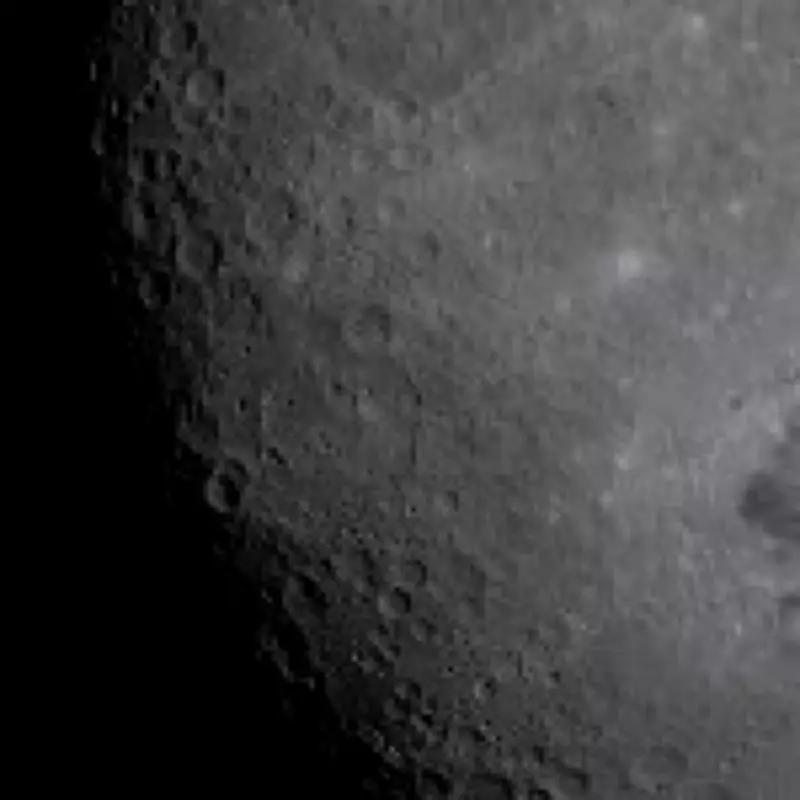
NASA's Artemis II Mission Captures 'Smiling Face' on Moon's Dark Side
In a remarkable discovery during humanity's return to lunar exploration, NASA's Artemis II crew has captured images of what appears to be a smiling face on the dark side of the moon. The photographs were taken as the spacecraft conducted its historic flyby of the Orientale Basin on April 6, 2026, marking the first complete view ever obtained of this mysterious lunar feature.
Eagle-Eyed Observers Spot Unusual Formation
As mission images circulated among space enthusiasts and the general public, sharp-eyed followers quickly identified what looks unmistakably like a cheerful facial formation within one of the moon's craters. The discovery has sparked widespread fascination and creative interpretations across social media platforms and scientific communities alike.
One enthusiastic observer remarked: "It's cute like a hippo," drawing a playful comparison to Moo Deng, the famous pygmy hippo from Thailand who became an internet sensation. Another supporter enhanced the image with a simple doodle, commenting: "This is all I see," while others noted the crater's resemblance to Doraemon, the beloved time-traveling robotic cat from Japanese manga and anime culture.

Historic Mission Breaks Multiple Records
The smiling crater discovery occurred during a mission already filled with historic milestones. Just days before capturing these intriguing images, the Artemis II astronauts achieved the distinction of traveling farther from Earth than any humans in history, surpassing the previous record set by Apollo 13 in April 1970.
During their record-breaking journey, which took them 248,655 miles from our planet, the crew experienced poignant moments of remembrance. In an emotional communication with Mission Control, astronaut Jeremy Hanson proposed naming two previously unseen craters after their spacecraft, Integrity, and commander Reid Weisman's late wife, Carroll.
"We lost a loved one," Hanson said tearfully from space. "Her name was Carroll, she was the mother of Katie and Ellie. It's a bright spot on the moon. We would like to call it Carroll." Mission Control responded immediately: "Integrity and Carroll crater. Loud and clear."
Connections to Apollo Legacy
The six-hour lunar flyby represents NASA's first return to moon exploration since the Apollo era, creating a powerful connection between past and present space achievements. The Artemis II crew received a special wake-up message from Apollo 13 commander Jim Lovell, recorded just two months before his passing in August 2025.
Lovell's message resonated through the spacecraft: "Welcome to my old neighbourhood. It's a historic day, and I know how busy you'll be, but don't forget to enjoy the view." These words from a space exploration pioneer underscored the continuity of human curiosity and discovery that spans generations.
Scientific Significance and Public Engagement
While the "smiling face" crater has captured public imagination with its whimsical appearance, scientists emphasize that such pareidolia—the human tendency to see familiar patterns in random shapes—is common in planetary observation. The Orientale Basin itself represents a significant geological feature that can provide crucial insights into the moon's formation and history.
The Artemis II mission continues to break new ground, with Mission Control expecting the spacecraft to exceed Apollo 13's distance record by more than 4,100 miles before completing its journey. This combination of scientific achievement, emotional human moments, and unexpected discoveries like the smiling crater demonstrates how space exploration continues to captivate and inspire people worldwide.






