

Astronomers Discover 'Forbidden' Giant Planet That Defies Formation Theories
Astronomers have made a groundbreaking discovery of a unique "forbidden" giant planet that is challenging fundamental theories about how planets form in the early stages of stellar evolution. The planet, designated TOI-5205 b, has been studied extensively using the powerful James Webb Space Telescope (JWST), revealing characteristics that could reshape our understanding of planetary systems.
A Planetary System That Shouldn't Exist
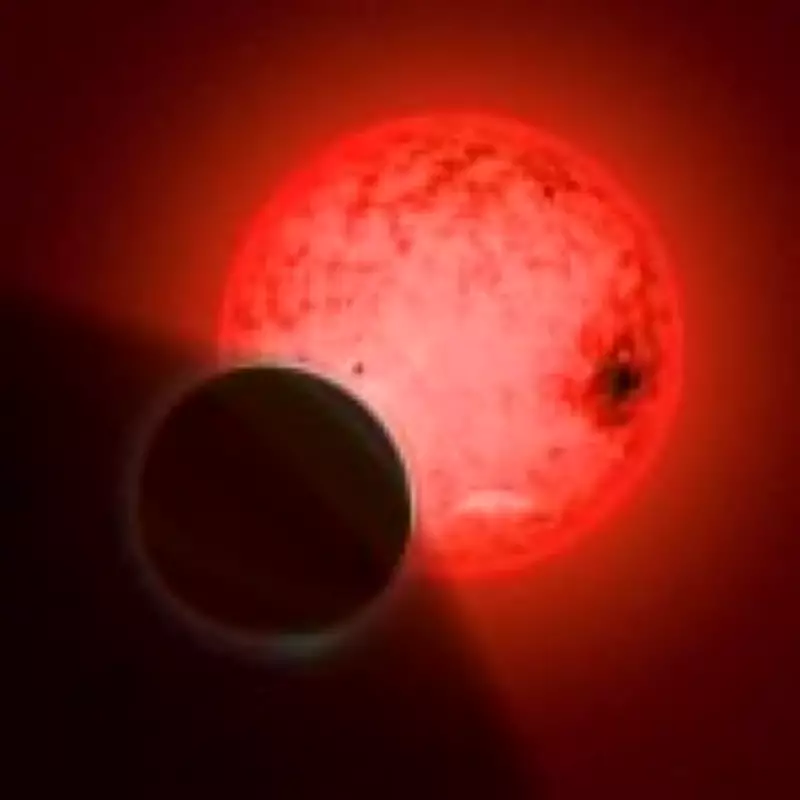
The research, published this week in The Astronomical Journal and led by Caleb Cañas of NASA Goddard Space Flight Center with contributions from Shubham Kanodia of Carnegie Science, focuses on a planetary system that defies conventional wisdom. TOI-5205 b is approximately the size of Jupiter but orbits a comparatively small, cool star—a configuration that current astrophysical theories struggle to explain.
Such systems are often described as "forbidden" because existing models cannot adequately account for how such massive planets can form so close to low-mass stars. The discovery represents a significant challenge to established theories of planetary formation and evolution.

Surprising Atmospheric Composition Revealed
When TOI-5205 b passes in front of its host star during what astronomers call a transit event, it blocks approximately 6% of the star's light. By analyzing this light using sophisticated spectrographs, researchers have been able to determine the chemical composition of the planet's atmosphere with unprecedented precision.
Observations of three separate transits revealed a particularly surprising result: the planet's atmosphere contains a significantly lower concentration of heavy elements—what astronomers refer to as "metallicity"—than both Jupiter and its own host star. This makes TOI-5205 b unlike any giant planet studied to date.
While researchers detected methane and hydrogen sulfide in the atmosphere—findings that were somewhat expected—the unexpectedly low metallicity has prompted new questions about the planet's formation and internal structure.
Computer Models Suggest Internal Complexity
To better understand these puzzling results, researchers employed advanced computer models to estimate the planet's internal composition. These simulations suggested that while the outer atmosphere shows low metallicity, the planet as a whole may be far richer in heavy elements than surface observations indicate.
"We observed much lower metallicity than our models predicted for the planet's bulk composition, which is calculated from measurements of a planet's mass and radius," explained Kanodia. "This suggests that its heavy elements migrated inward during formation and now its interior and atmosphere are not mixing."
The researchers concluded that these findings point toward "a very carbon-rich, oxygen-poor planetary atmosphere" that differs substantially from what current formation models would predict.
Challenging Planetary Formation Theories
Planets typically form from discs of gas and dust that surround young stars during their early development. While giant planets are thought to emerge from these protoplanetary discs, systems like TOI-5205 b present a direct challenge to existing models of how such worlds come into being.
This research forms part of the broader "Red Dwarfs and the Seven Giants" program, which utilizes the James Webb Space Telescope to study similar systems—sometimes referred to as GEMS, or giant exoplanets around M-dwarf stars. These investigations aim to understand the prevalence and characteristics of planetary systems that current theories cannot adequately explain.
Future Research Directions
Further observations of TOI-5205 b and similar "forbidden" planetary systems are expected to help clarify how these challenging worlds form and evolve. As astronomers continue to study these systems with increasingly powerful instruments, they hope to develop new models that can account for the diversity of planetary systems observed throughout the galaxy.

The discovery of TOI-5205 b represents not just the identification of another exoplanet, but a fundamental challenge to our understanding of how planetary systems form and evolve around different types of stars. As research continues, astronomers anticipate that these "forbidden" worlds will provide crucial insights into the complex processes that govern planetary formation throughout the universe.





