

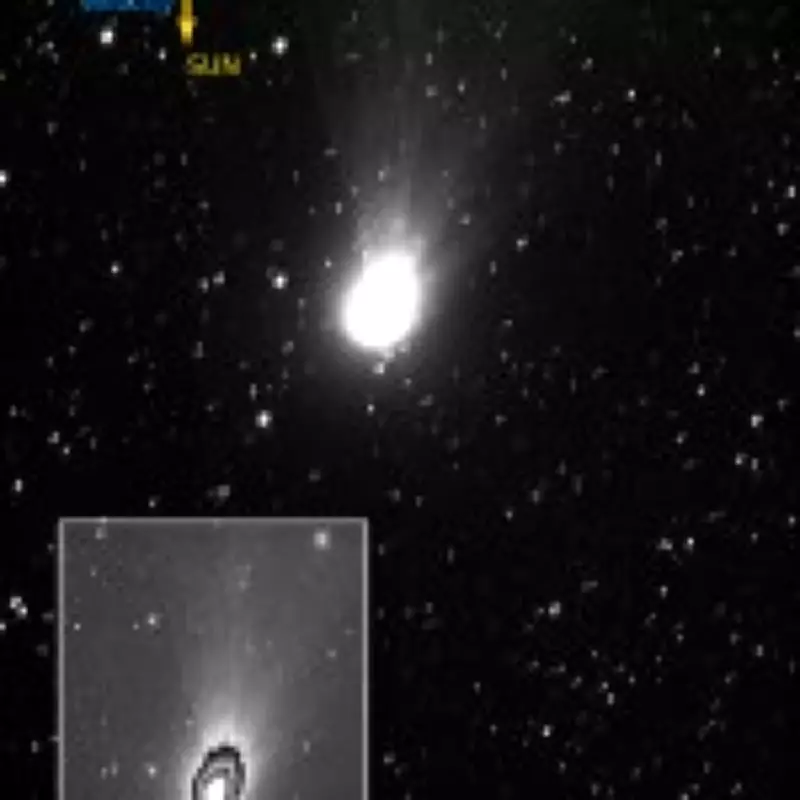
A European spacecraft bound for Jupiter has delivered the most detailed and closest image to date of the mysterious comet 3I/ATLAS, an interstellar visitor that once sparked panic among astronomers over a potential Earth impact. The striking image, captured by the science camera on the European Space Agency's Jupiter Icy Moons Explorer (Juice), shows the comet spewing dust and gas as it continues its journey through space, providing unprecedented insights into its unusual nature.
From Panic to Fascination: The Comet's Journey
Last year, the discovery of comet 3I/ATLAS caused significant concern among scientists when initial observations suggested a small chance it could strike Earth. However, these fears quickly dissipated after further monitoring, though the comet's behavior continued to baffle and fascinate experts. The new image from Juice offers the closest look yet, revealing a bright halo of gas known as the coma surrounding the tiny, invisible nucleus, along with a long tail and hints of rays, jets, streams, and filaments.
Technical Details of the Capture
The camera, named JANUS, took this image on November 6 last year, just seven days after the comet made its closest approach to the Sun. At the time, Juice was approximately 66 million kilometers away from 3I/ATLAS. The image has now been transmitted back to Earth, where scientists are eagerly analyzing the data. An inset in the image shows the same data processed to highlight the coma structure, with arrows indicating the comet's direction of movement in blue and the relative direction of the Sun in yellow.

Despite being an interstellar visitor from outside the Solar System, 3I/ATLAS behaves in a manner consistent with a 'normal' comet, according to initial assessments. Throughout November, Juice utilized five of its science instruments—JANUS, MAJIS, SWI, PEP, and UVS—to observe the comet, collecting a wealth of information that will help reveal its composition and activity.
Data Analysis and Future Plans
Following the observations, Juice was positioned on the opposite side of the Sun from Earth, using its main high-gain antenna as a heat shield and its smaller medium-gain antenna to send data back at a reduced rate. This delay meant that instrument teams only received the data last week, and they are now working intensively to analyze it. In total, JANUS captured over 120 images of 3I/ATLAS across a broad wavelength range.
The European Space Agency's instrument team is examining all these images to understand what they reveal about the comet. Meanwhile, the MAJIS and UVS teams are studying spectrometry data, the SWI team is investigating composition data, and the PEP team is analyzing particle data. Together with the ESA team working on Juice's navigation camera, which also photographed the comet, they plan to convene in late March to discuss their findings.
Broader Context and Speculation
The Juice spacecraft is scheduled to arrive at Jupiter in July 2031, continuing its mission to explore the gas giant and its icy moons. In a related development, Harvard scientist Dr. Avi Loeb suggested in November that the space rock might be on a mission to Jupiter, adding to the intrigue surrounding this celestial object. This discovery highlights the ongoing efforts in space exploration to monitor and understand potential threats from near-Earth objects while advancing scientific knowledge.
As analysis progresses, the data from Juice promises to shed light on the mysteries of interstellar comets like 3I/ATLAS, contributing to our understanding of the cosmos and enhancing planetary defense strategies. This event underscores the importance of international collaboration in space missions and the role of advanced technology in unraveling the secrets of the universe.






