

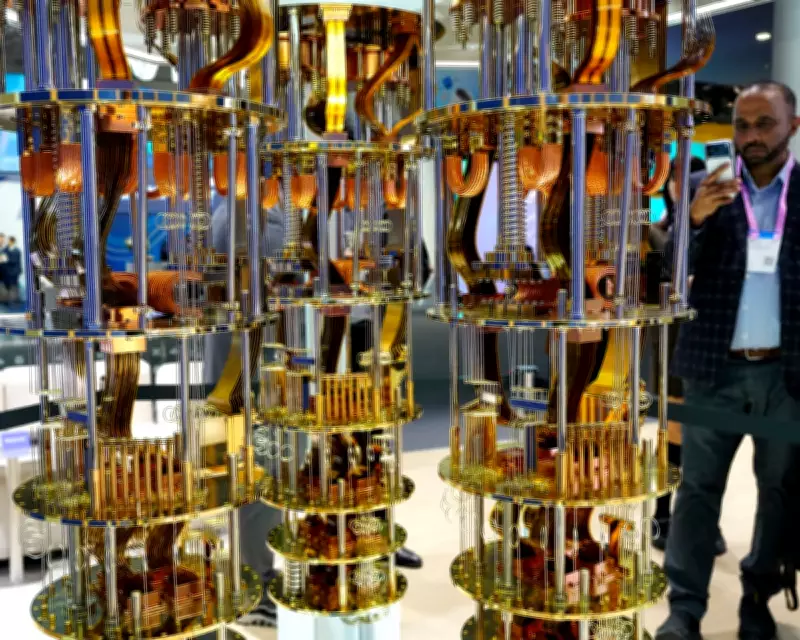
At the National Quantum Computing Centre near Oxford, Technology Secretary Liz Kendall has unveiled a bold £1bn funding initiative to propel the United Kingdom into a leading position in the global quantum computing race. This move comes as the government seeks to retain homegrown talent and draw lessons from the United States' overwhelming dominance in the artificial intelligence sector.
Learning from AI Mistakes
Kendall emphasized the critical need to avoid repeating past mistakes, where the UK lost ground in AI development. "I do look at what's happened on AI," she stated. "We must learn those lessons and ensure our brilliant scientists, spinouts, and startups have the support to thrive here, rather than feeling compelled to relocate to the US for funding and scale."
This concern is underscored by examples like DeepMind, a pioneering AI firm co-founded by Nobel laureate Demis Hassabis, which remains based in London but was acquired by Google in 2014 for £400 million. Meanwhile, Silicon Valley giants such as Meta have been aggressively recruiting top-tier talent, highlighting the competitive pressures facing the UK's tech ecosystem.

Quantum Computing Explained
Quantum computing represents a revolutionary leap beyond classical computing. While classical computers encode information in bits—simple 0s and 1s transmitted as electrical pulses—quantum computers utilize qubits. These qubits, housed in compact chips, are particles like electrons or photons that can exist in multiple states simultaneously, a quantum property known as superposition.
This allows qubits to process vast numbers of outcomes concurrently, enabling computations that are impossible for traditional machines. However, maintaining qubits requires highly controlled environments, free from electromagnetic interference, to prevent disruption.
Funding and Future Goals
The £1bn pledge, driven by science minister Patrick Vallance, aims to assist companies in designing large-scale quantum computers for use by scientists, researchers, the public sector, and businesses. An additional £1bn, previously announced, will support practical applications in fields such as finance, pharmaceuticals, and energy.
Kendall articulated a vision for the UK to build a domestic, cutting-edge quantum computer by the early 2030s, securing associated economic benefits, job creation, and national security. She asserted, "I want to be at the front of the grid and leading, not taking a back seat."
Current Landscape and Challenges
The UK has already fostered notable quantum startups, including Quantinuum, a US-UK firm recently valued at $10 billion (£7.5 billion). Despite advancements, such as Google's algorithm enabling a quantum computer to operate 13,000 times faster than classical counterparts, fully fault-tolerant quantum computers remain a distant goal.
These advanced machines would require hundreds of thousands of qubits to achieve tasks promising major scientific breakthroughs, such as designing new chemicals, drugs, and alloys through more efficient molecular representation.
As the global competition intensifies, the UK's strategy focuses on leveraging its strengths in research and innovation to prevent talent drain and establish a robust quantum infrastructure, ensuring it remains a key player in this transformative technology frontier.






