

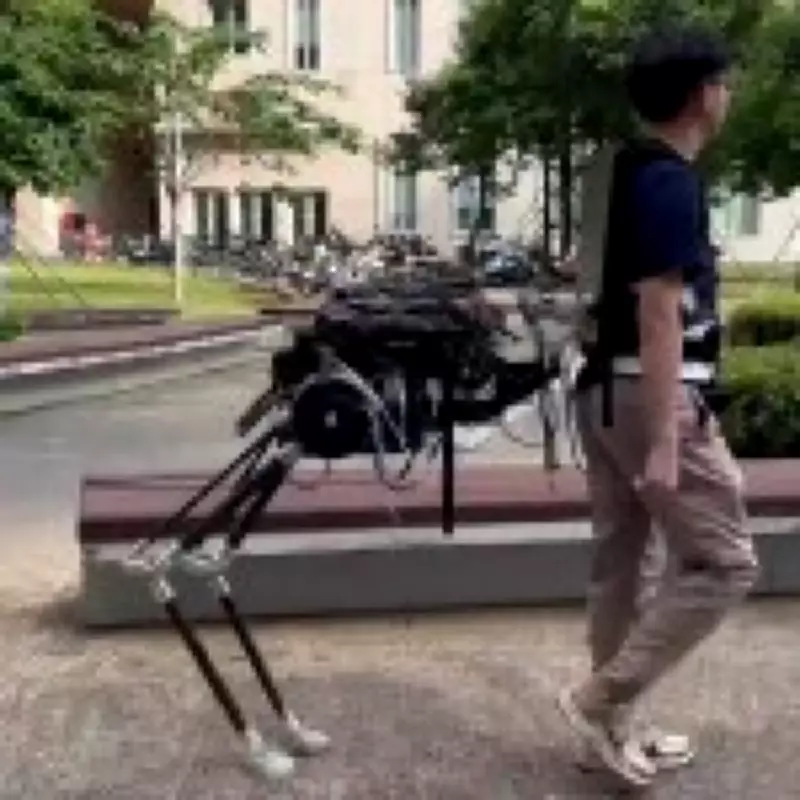
Chinese Research Team Creates Revolutionary Wearable Robot System
Scientists in China have achieved a remarkable breakthrough in robotics by developing a wearable system that effectively transforms humans into 'bionic centaurs' through the addition of two extra mechanical legs. This innovative human-robot hybrid moves in a four-legged configuration reminiscent of the mythical half-horse, half-man creatures, representing a significant advancement in wearable assistive technology.
Technical Specifications and Design Innovation
The groundbreaking system was developed by a research team at Southern University of Science and Technology in Shenzhen, led by principal investigators Zhixin Tu, Yihao Jiang, and Chenglong Fu. Unlike traditional exoskeletons that attach directly to a person's biological legs, this novel approach features two independent three-degree-of-freedom robotic legs connected to a robotic torso, all coupled to the human user through a passive softening elastic mechanism worn on the back.
This unique configuration creates what the researchers term a 'human-Centaur quadruped system' that optimizes vertical load distribution while providing horizontal forward force through the human's center of mass during walking. The compliance-based interaction allows the robotic legs to move in perfect synchronization with the wearer, sharing substantial portions of the load while assisting forward motion.

Performance Metrics and Practical Applications
Experimental evaluations demonstrate that the Centaur robot effectively adapts to varying human walking directions and speeds while seamlessly collaborating with users across diverse terrains. During comprehensive testing, participants carrying approximately 44 pounds (20 kilograms) experienced a 35% reduction in metabolic energy expenditure and a remarkable 52% decrease in foot pressure compared to walking without assistance.
The system operates through an intelligent load-adaptive mechanism where lighter loads maintain a relatively firm connection for coordination, while heavier loads trigger increased flexibility that allows the robotic legs to absorb more force and carry greater weight shares. This sophisticated approach enables humans to focus primarily on steering and balance maintenance while the robot performs the majority of mechanical work required for load transportation.
Advanced Control Systems and Future Implications
The research team developed sophisticated motion-planning and control systems enabling the robotic legs to precisely match user speed and direction. During trials, the mechanical limbs successfully supported more than half of carried weight while allowing participants to maintain natural walking patterns without significant gait alterations.
Researchers envision numerous practical applications for this technology, particularly benefiting workers who regularly transport heavy equipment across challenging environments. Potential implementation areas include military logistics operations, disaster-relief missions, and industrial transport tasks where supplies must be carried across difficult terrain that conventional vehicles cannot navigate effectively.
The complete research findings and technical specifications have been published in the prestigious academic journal The International Journal of Robotics Research, marking a significant contribution to the field of wearable robotics and human augmentation technology.






