

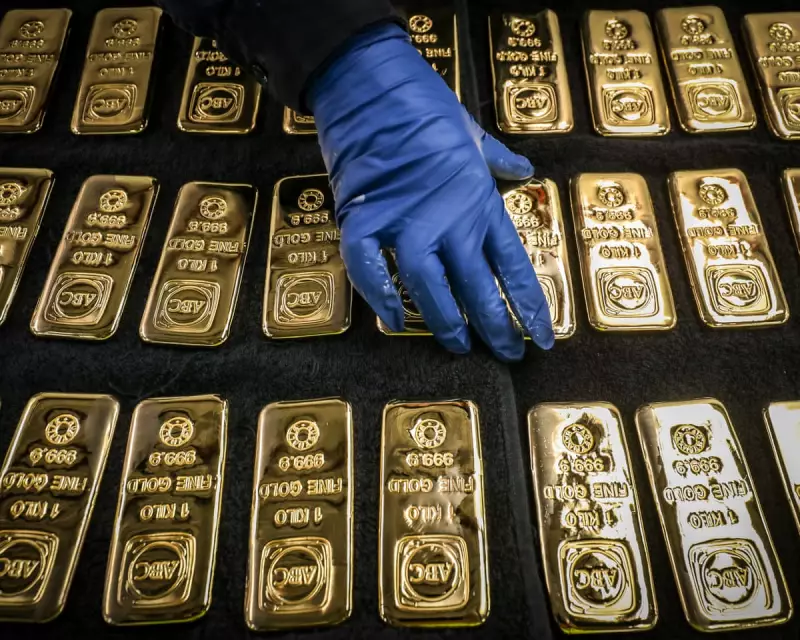
In a world increasingly defined by geopolitical instability and economic unpredictability, investors are seeking traditional safe havens, with gold prices reaching unprecedented heights. This global flight to safety has cast a harsh new light on a decades-old financial decision by Australian authorities, revealing a multi-billion dollar opportunity cost.
The Global Rush to Gold Amid Trump-Era Chaos
The international political climate, marked by the actions of US President Donald Trump, has become a primary driver of market anxiety. Trump's military threats towards Venezuela, territorial ambitions regarding Greenland, and public feuds with institutions like the Federal Reserve have created profound uncertainty. This has caused the US Economic Policy Uncertainty Index to remain three times higher than when Trump was elected in November 2024.
In such turbulent times, gold's status as the ultimate safe-haven asset has been resoundingly reaffirmed. The price of gold recently surged past US$4,600 per ounce for the first time in history. This represents a staggering 73% increase since Trump took office just 14 months ago. Analysts note this ascent is faster than during the 2008 Global Financial Crisis, the COVID-19 pandemic shutdowns, or the aftermath of the September 11 attacks.

Australia's Missed Golden Opportunity
While the soaring price indirectly benefits Australia as the world's third-largest gold producer, boosting export values and corporate tax receipts, a historic misstep is now painfully clear. In 1997, the Reserve Bank of Australia (RBA), with the full backing of then-Treasurer Peter Costello, sold 167 tonnes of gold—a staggering two-thirds of the nation's reserves.
The rationale at the time was that gold yields were low and the gold standard was obsolete, with other central banks also selling. Costello told Parliament that reinvesting the proceeds would generate higher annual profits for the RBA. The sale fetched approximately A$2.5 billion.
The financial reality today tells a different story. By December 2024, those same 167 tonnes of gold would have been worth an estimated A$33 billion. Had the RBA invested the original sale proceeds across its typical non-gold asset portfolio, that sum would now be worth around A$9.6 billion. The decision has therefore left the RBA's balance sheet roughly A$23.4 billion worse off.
The Silver Lining for Australian Finances
Despite the historic blunder, the current price boom offers some contemporary fiscal benefits. The RBA's remaining 80 tonnes of gold have seen their value leap from $9.6 billion in December 2024 to $15.7 billion recently—a 64% gain, making its gold holdings more valuable than ever.
Furthermore, the elevated price is turbocharging Australia's export economy. Gold is on the verge of becoming the nation's second-largest export, potentially overtaking liquefied natural gas (LNG) and coal. This surge directly translates to higher corporate tax revenue from mining companies, with last month's Mid-Year Economic and Fiscal Outlook (MYEFO) revising corporate tax receipts up by $4.3 billion for 2025–26, partly due to higher gold and commodity prices.
The episode serves as a stark lesson in long-term asset management. While no one in 1997 could have predicted the specific rise of a figure like Donald Trump, the fundamental purpose of gold as a hedge against systemic risk and uncertainty was well understood. In a "world going to hell," as columnist Greg Jericho puts it, the safety of a larger gold reserve is a luxury Australia's central bank likely wishes it still possessed.






