

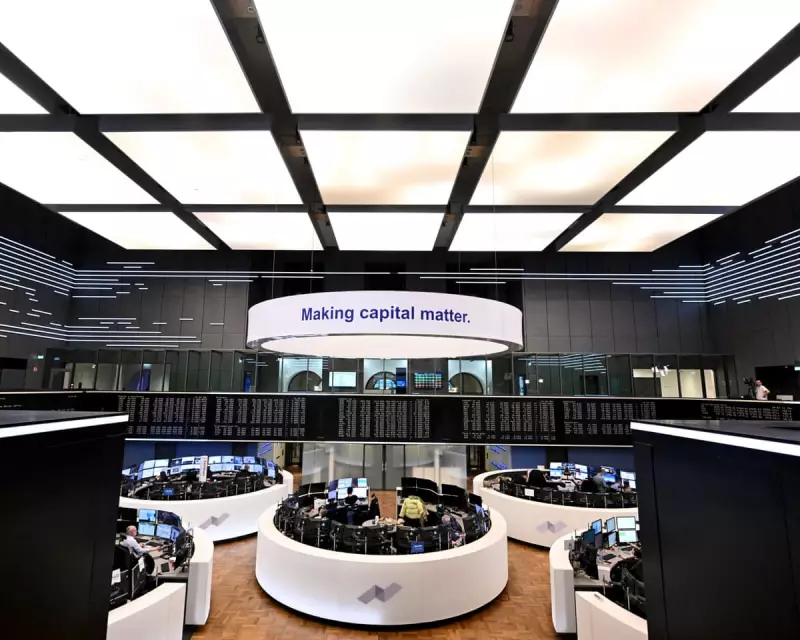
Financial markets displayed a notable calm on Monday, weathering the latest geopolitical storm from the United States. Former President Donald Trump's weekend threat to impose tariffs on eight European nations, including the UK, failed to trigger a major sell-off in London.
Market Reaction: A Study in Relative Calm
While Germany's Dax index fell by a significant 1.3%, the UK's benchmark FTSE 100 closed down just 0.4%, a move barely registering on traders' radars. The session's stability was underscored by a major £7.7 billion bid for insurer Beazley, which arrived at a substantial premium, indicating underlying corporate confidence.
This muted response, according to analysts, stems from market desensitisation. Jonas Goltermann, deputy chief markets economist at Capital Economics, notes that over a year into Trump's second term, participants have grown sceptical that his rhetoric will always translate into action. Markets widely anticipate a postponement of the 1 February deadline for the first proposed 10% tariffs, awaiting a crucial US Supreme Court ruling on the legality of Trump's existing tariff policy.

Beyond Tariffs: The Spectre of Capital Market Warfare
However, beneath the surface calm, analysts are flagging profound long-term risks that extend far beyond goods tariffs. The primary concern is no longer just a potential UK or eurozone recession triggered by sustained tariffs.
George Saravelos, global head of FX research at Deutsche Bank, raised a more immediate and alarming possibility: retaliatory measures moving into capital markets. "Europe owns Greenland, it also owns a lot of Treasuries," he wrote, alluding to the vast holdings of US debt and equities by European funds. He suggested these investors may become reluctant to hold US assets "in an environment where the geoeconomic stability of the western alliance is being disrupted existentially."
The scale is significant. Saravelos calculates that European countries own approximately $8 trillion in US bonds and equities, nearly double the holdings of the rest of the world combined. This gives Europe a potent, if nuclear, option, as the US relies on foreign capital to fund its large external deficits.
Complacency and Unpriced Long-Term Shifts
The current investor complacency itself is a risk, guaranteeing a more violent reaction if fears are realised. Furthermore, markets are notoriously poor at pricing seismic, long-term geopolitical shifts where outcomes are unclear.
The potential break-up of NATO, hinted at by the extraordinary context of Trump's remarks regarding Greenland, represents exactly this kind of shift. While a coordinated European decision to dump US Treasuries remains a distant prospect, the diplomatic direction is clear. France's President Emmanuel Macron has already spoken of activating the EU's "anti-coercion instrument" to restrict US company access to the single market.
"It is a weaponisation of capital rather than trade flows that would by far be the most disruptive to markets," Saravelos concluded. Such an escalation would represent a dramatic new phase in transatlantic tensions, one that makes Monday's modest stock market moves seem like a distant memory.






