

Mounting concerns are being raised over a potential bubble in artificial intelligence, with analysts warning that the staggering levels of investment may be unsustainable without a clear path to significant profits. The consequences of a burst could be severe for the wider economy.
The Staggering Scale of AI Investment
The US stock market remains heavily dominated by AI-focused companies. Despite some dips since mid-2025 for key players like Nvidia, Oracle, and Coreweave, 75% of the returns from the S&P 500 index are attributed to just 41 AI stocks. The so-called "Magnificent Seven"—Nvidia, Microsoft, Amazon, Google, Meta, Apple, and Tesla—alone account for 37% of the index's performance.
This concentration, built largely on one type of technology—Large Language Models (LLMs)—is fuelling fears of an overinflated sector. AI leaders dismiss such talk. Jensen Huang, CEO of the $5 trillion chip-maker Nvidia, stated last month, "We are long, long away from that."

However, scepticism persists. "If a few venture capitalists get wiped out, nobody's gonna be really that sad," said Gary Marcus, AI scientist and emeritus professor at New York University. He warned the "blast radius" could be far greater, given AI's contribution to US economic growth. "In the worst case, what happens is the whole economy falls apart, basically. Banks aren't liquid, we have bailouts, and taxpayers have to pay for it."
The Trillion-Dollar Bet on Compute and Data Centres
The scale of the boom is rooted in how modern AI is built. The breakthrough of OpenAI's ChatGPT-4 in early 2023 came from a massive increase in "compute"—the raw computing power used for training. It required 3,000 to 10,000 times more power than its predecessor, GPT-2, and was trained on vastly more data.
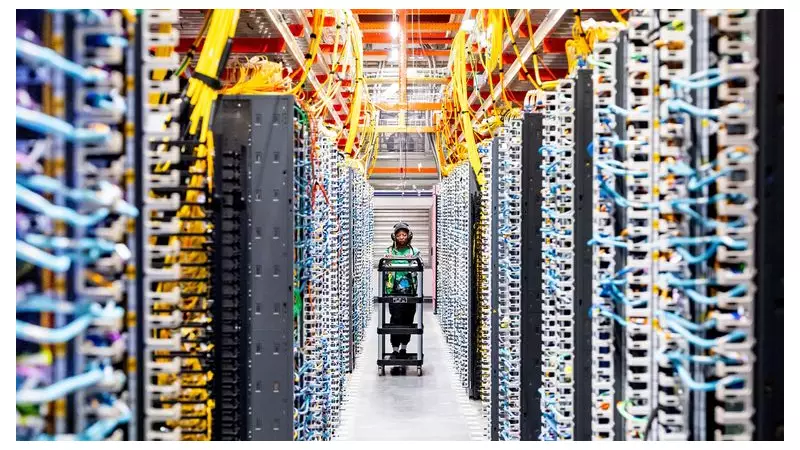
The industry bet has been that simply repeating this trick of scaling up would lead to more powerful AI. This triggered a race to build mega-data centres, or "computer cities." Microsoft, Amazon, Google, Meta, and Oracle are projected to spend around $1 trillion on AI by 2026. OpenAI alone plans to commit $1.4 trillion over three years.
Projects like the Stargate complex in Texas, expected to cover an area the size of Central Park by mid-2026, and Meta's $27 billion Hyperion data centre in Louisiana, which will consume double the power of New Orleans, illustrate the frenzy. This surge is straining America's power grid, causing connection delays for years.
Depreciation, Profits, and the Scaling Hypothesis
Two critical pressure points threaten the bubble's stability: rapid depreciation and unclear profitability.
Unlike traditional infrastructure, AI data centres and their specialised chips may need constant, costly upgrades. Nvidia releases new processors yearly, claiming a three-to-six-year lifespan. However, famed investor Michael Burry, who predicted the 2008 crash, is now betting against AI stocks, arguing chips may need replacing every three years or sooner due to competition.
The Economist recently estimated that if AI chips depreciate every three years, it could wipe $780 billion from the value of five big tech firms. If the cycle shortens to two years, the loss could reach $1.6 trillion.
Meanwhile, profits are not keeping pace. OpenAI is expected to make just over $20 billion in 2025—a huge sum but negligible against its planned $1.4 trillion expenditure. Adoption is rising, with OpenAI reporting 800 million weekly active users, yet only 5% are paying subscribers. Business adoption is slow; US Census data shows only 8-12% of companies used AI for production in early 2025, with figures for larger firms recently falling to 12%.
Most crucially, confidence in the core "scaling hypothesis"—that bigger models inevitably mean better AI—is wavering. Ilya Sutskever, co-founder of OpenAI, recently said, "Is the belief that if you just 100x the scale, everything would be transformed? I don't think that's true." He predicted a return to a research-focused phase.
"It's really just a scaling hypothesis, a guess that this might work. It's not really working," concluded Professor Marcus. "So you're spending trillions of dollars, profits are negligible and depreciation is high. It does not make sense. And so then it's a question of when the market realises that."






