

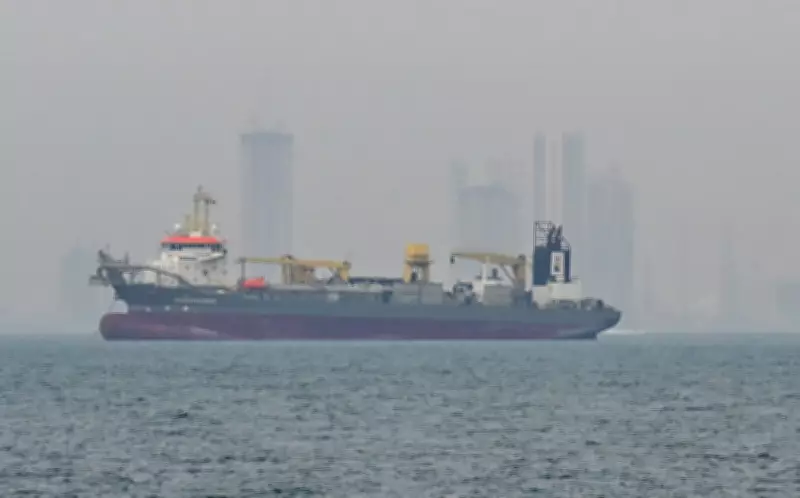
Global Stock Markets Plunge Amid Failed Reassurance Over Strait of Hormuz Crisis
Global stock markets experienced significant declines on Wednesday, despite former US President Donald Trump's offer to deploy the US Navy for escorting tankers through the Strait of Hormuz. This crucial waterway, a vital artery for global oil and gas shipments, has been effectively closed by Iran following recent military strikes by the US and Israel, sparking fears of a prolonged energy supply crisis that has reverberated across international economies.
Asian Markets Lead Sell-Off as Shipping Grinds to a Halt
In Asia, stock markets came under intense pressure, with South Korea's benchmark Kospi index plummeting by as much as 11.3% before recovering slightly to a 7.7% loss, leading to a temporary suspension of trading in Seoul. Japan's Nikkei 225 also fell sharply, dropping 3.9% in Tokyo. The sell-off occurred as shipping through the Strait of Hormuz, which typically handles about one-fifth of global oil supplies and numerous seaborne gas tankers, has largely ground to a halt due to the ongoing Middle East conflict.
Oil prices continued their upward trajectory, with Brent crude, the international benchmark, rising by 1.4% to reach $82.53 per barrel on Wednesday. This surge follows a week of significant gains as investors brace for potential disruptions to energy supplies. The United Kingdom Maritime Trade Operations reported incidents affecting ships near the United Arab Emirates and Oman, heightening concerns over regional maritime security.

Trump's Intervention Fails to Quell Market Anxiety
Donald Trump attempted to mitigate fears of long-term disruption to the global oil market by suggesting on his Truth Social platform that the US military is prepared to protect vessels navigating the Gulf and offer political risk insurance at reasonable prices. He emphasized, "If necessary, the United States Navy will begin escorting tankers through the Strait of Hormuz, as soon as possible. No matter what, the United States will ensure the FREE FLOW of ENERGY to the WORLD." However, this assurance did little to stabilize market sentiment, as investors remained wary of the geopolitical tensions.
The US military has reported destroying 17 Iranian ships, including a submarine, since Saturday, with Commander Brad Cooper of the US Central Command stating that no Iranian ships are currently underway in the Arabian Gulf, Strait of Hormuz, or Gulf of Oman. Despite these actions, the closure of the strait by Iran has crippled a key economic corridor, raising alarms about sustained energy shortages.
Expert Insights and Broader Economic Implications
David Solomon, CEO of Goldman Sachs, cautioned that markets may take "a couple of weeks" to fully process the impact of the US-led military operations in the region. Speaking in Sydney, Solomon noted, "I'm actually surprised that the market reaction has been more benign given the magnitude of this," highlighting that geopolitical events often have muted effects unless they directly impact economic growth. He added that the implications for both short-term and medium-term market dynamics remain uncertain.
In the United States, Wall Street was poised to open lower based on pre-market trading data, reflecting ongoing concerns. Trump, known for closely monitoring US stock market performance as a gauge of his administration's success, faces a challenging economic landscape as global indices tumble. The broader economic fallout includes potential disruptions to trade and energy flows, with analysts warning of ripple effects across sectors dependent on stable oil supplies.
As the situation evolves, stakeholders worldwide are closely watching developments in the Strait of Hormuz, with the potential for further market volatility and strategic shifts in global energy policies. The crisis underscores the interconnectedness of geopolitical events and financial markets, emphasizing the need for robust risk management in uncertain times.






