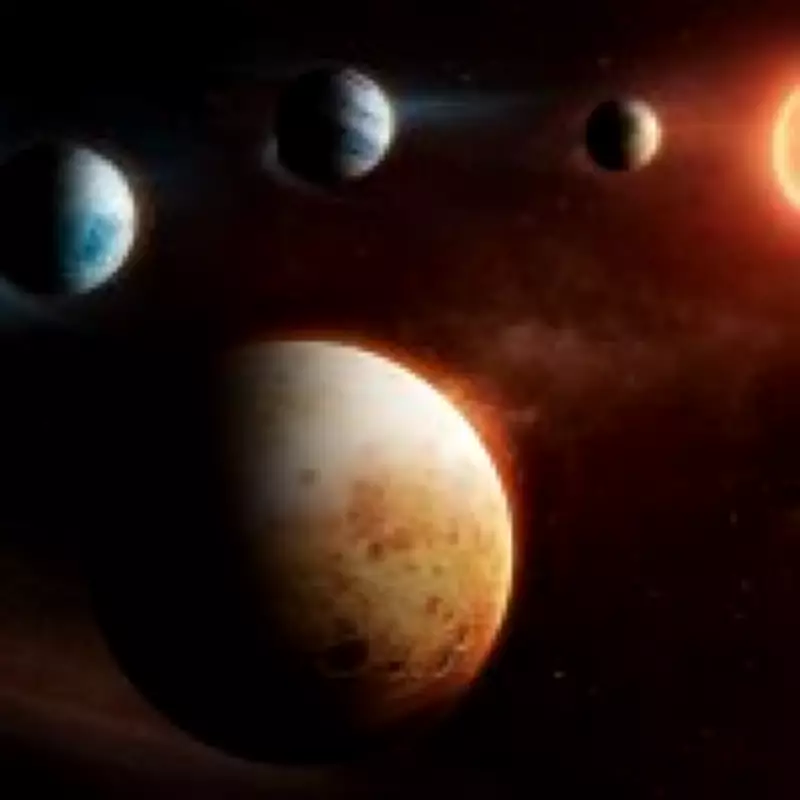
Astronomers Uncover 'Inside-Out' Star System That Defies Conventional Wisdom
In a groundbreaking discovery, an international team of scientists has identified a star system that completely upends established theories about planetary arrangement. Located approximately 116.27 light-years from Earth, this system features a configuration previously deemed impossible: rocky planets positioned farther out, with gas giants closer to the star.
A Cosmic Anomaly Challenges Established Patterns
Traditionally, solar systems like our own follow a predictable pattern: the inner planets are rocky, such as Mercury, Venus, Earth, and Mars, while the outer planets are gaseous giants like Jupiter and Saturn. This rock-then-gas sequence has been observed in countless exoplanetary systems across the galaxy. However, the newly studied system, designated LHS 1903, presents a startling reversal.
Led by Thomas Wilson from the University of Warwick, the research team discovered that LHS 1903 hosts three planets, with the closest being rocky and two gas worlds situated nearby. Intriguingly, a fourth planet was also found orbiting the star, and it too is rocky rather than gaseous. Wilson explains, 'This system really opens up what a star system should look like. Before our study, we thought that smaller planets were only in the inner system and larger planets were further away. But now LHS 1903 breaks this thinking and unveils that a whole wide range of systems could be out there for us to discover.'

Unraveling the Mystery of an Inside-Out Formation
The peculiar arrangement raises questions about how such a system could form. Stars, including red dwarfs like LHS 1903, emit intense solar radiation that can strip away planetary atmospheres, typically leaving inner planets barren. Yet, in this case, the outermost planet remains rocky. Wilson's team, whose findings were published in the journal Science, proposes that the fourth planet may have either lost its atmosphere or never formed one due to a unique formation process called inside-out planet formation.
This theory suggests that planets in the system were born at different times and under varying conditions. Wilson elaborates, 'What we think happened was that the planet closest to the star was born first, and then the second furthest was formed, and then the third and fourth. This means that these alien worlds would have been born at different times and in different environments. This is a big deal because it would mean that planets in the same star system look different because of where and when they were formed.'
Implications for Our Understanding of Planetary Systems
To illustrate the strangeness of this configuration, Wilson invites us to imagine an inside-out version of our own solar system. 'Jupiter and Saturn would gravitationally throw around the other planets, either out of the system, into each other, or into the sun. If Earth survived this, it'll likely be very far from the Sun and so very cold.' This thought experiment underscores how LHS 1903 challenges fundamental assumptions about planetary stability and diversity.
Advanced Technology Reveals Hidden Details
The discovery was made possible by the European Space Agency's CHaracterising ExOPlanet Satellite (Cheops). Unlike instruments designed to find new exoplanets, Cheops specializes in analyzing known planets to determine their composition. Max Guenther, the project scientist, compares the process to using a body mass index (BMI) to assess a person's physique. 'You measure a human in terms of size and mass but once you start to draw and describe the person, they become a person. What you see in the images is an interpretation of the actual measurements.'
Using transmission spectroscopy, often called the blink method, Cheops captures subtle changes in starlight as planets transit their host stars. Guenther notes, 'Cheops is no different from a smartphone camera – just way more expensive and stable. If you take a photo on a cloud-free night, you'll see white dots on a black background. That's the same pictures that we're taking.' By monitoring these flickers, which can indicate a planet's presence by blocking as little as 1% of light, scientists gather data on atmospheric composition and planetary mass.

Embracing Scientific Revision and Future Explorations
This finding highlights the dynamic nature of scientific inquiry, where being proven wrong can lead to profound insights. Guenther reflects, 'It doesn't mean that everything is wrong, it just means it was too simplistic because we had limited data so far.' The discovery of LHS 1903 not only expands our understanding of planetary systems but also fuels excitement for future explorations, suggesting that the universe may harbor even more unexpected configurations waiting to be uncovered.