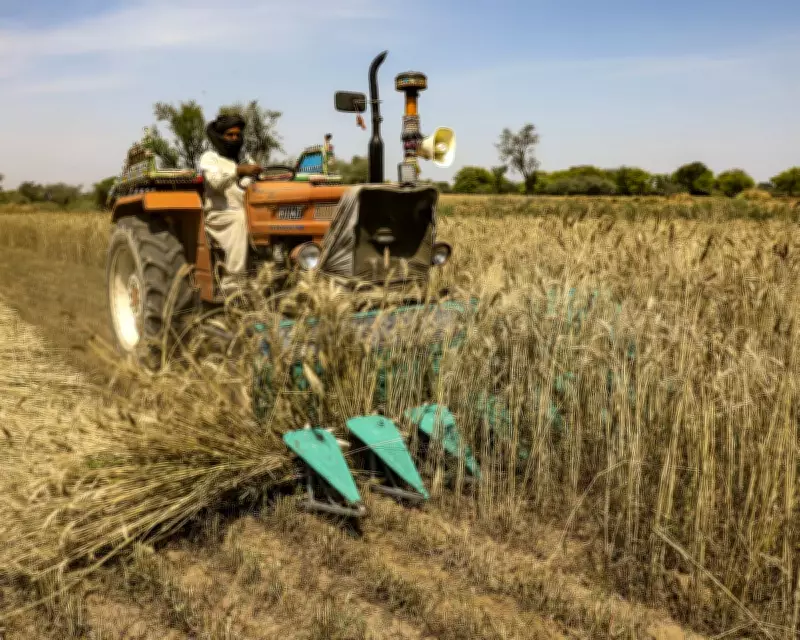
Hormuz Shipping Blockade Ignites Global Fertilizer and Food Emergency
The world is acutely aware of the Strait of Hormuz's critical role in energy flows, but a new and pressing concern has emerged: its indispensable function in the global fertilizer market. As a maritime choke point, this waterway facilitates a staggering one-third of all raw material trade for fertilizers, alongside 20% of natural gas shipments essential for production. The current near-total blockade of shipping through the strait has been labeled a "food security timebomb" by David Miliband, head of the International Rescue Committee, who warns that the window to prevent a massive global hunger crisis is rapidly closing.
Fertilizer Production and Trade Disruptions in the Gulf
The Gulf region is not only a transit hub but also home to some of the world's largest fertilizer factory sites. International organizations are raising alarms that a prolonged transport shutdown could severely disrupt production and escalate costs. In 2024, approximately 16 million tonnes of fertilizers were shipped by sea from this area, according to the UN Conference on Trade and Development (Unctad). Iran ranks as the fourth-largest global exporter of urea, the most widely used nitrogen fertilizer, following Russia, Egypt, and Saudi Arabia.
Moreover, the Middle East supplies about 45% of the global trade in sulphur, a key raw material for fertilizer manufacturing, as well as for producing various metals and industrial chemicals. Since Iran began threatening attacks on shipping, only a minimal number of vessels carrying vital ingredients like ammonia, nitrogen, and sulphur are transiting the strait, crippling the supply chain.

The Qatar Fertiliser Company (QAFCO), the world's largest single site for urea exports and provider of 14% of global urea, has been offline for nearly a month after Qatar closed its gas plants in response to Iranian strikes. Doha lacks alternative export routes for urea beyond the Strait of Hormuz and also depends on the channel for food imports for itself and the neighboring United Arab Emirates.
Impact on Global Food Production and Prices
Roughly half of global food production relies on synthetic nitrogen fertilizer. Without it, crop yields would plummet, driving up prices of household staples such as bread, rice, potatoes, and pasta, while also increasing the cost of animal feed. The world's poorest nations are among the most vulnerable to these fertilizer price hikes. Farmers are experiencing a "double shock" due to surging prices for both fertilizer and fuel, as noted by the UN's Food and Agriculture Organization, which fears that a lengthy closure of the strait could limit global supplies.
Prices have already surged since the conflict began, evoking memories of the soaring fuel and fertilizer costs following Russia's invasion of Ukraine in 2022 and the global fertilizer crisis of 2008 triggered by high oil prices. Egyptian urea prices, a key benchmark, have risen by over 60%, reaching $780 per tonne from about $484 in late February, according to the CRU Group, a consultancy monitoring commodity prices.
While costs for fertilizers like diammonium phosphate (DAP), urea, and potash have not yet matched 2022 peaks, analysts caution that prices remain under significant pressure. The extent of future increases partly hinges on when the Strait of Hormuz reopens. "The fertilizer market is in paralysis waiting for the conflict to end," said Chris Lawson, vice-president of market intelligence and prices at CRU, noting that supply disruption has been severe but could worsen.
Regional Vulnerabilities and Long-Term Consequences
The impact of fertilizer price increases varies by nation, depending on their reliance on Gulf imports and the timing relative to agricultural cycles. Many European and North American farmers had already secured fertilizer for the spring planting season, but large importers like Australia, where shipments typically arrive between April and June, face particular pressure.

Growing concerns also center on India, the world's second-largest fertilizer user after China, as the sowing season for major crops such as rice and wheat approaches. India depends on imports of raw materials like liquefied natural gas and finished fertilizer products. Although the Indian government subsidizes fertilizer for food producers, any supply disruption could reduce food production and drive prices higher.
Less affluent neighbors, including Sri Lanka, Pakistan, and Bangladesh, are almost entirely dependent on Gulf fertilizer imports. African nations such as Malawi, Tanzania, Uganda, Kenya, and Sudan are also reliant. The world's least developed economies have minimal capacity to absorb price shocks, with increased costs for fertilizer, fuel, and food quickly straining household budgets and public finances.
While global commodity markets have not yet seen food price rises—since the Middle East is not a major exporter of wheat and other crops like Russia and Ukraine—the long-term effects could be severe if trade route disruptions persist for months. Fertilizer plants worldwide may soon max out storage and curtail production if they cannot transport products or receive new raw materials.
Efforts to mitigate economic consequences, such as the US loosening sanctions on Belarusian potash producers and suspending sanctions on Russian oil, are not expected to boost global fertilizer supplies, as Russia has little spare capacity to ramp up production. The world stands at a critical juncture, with the fertilizer crisis threatening to escalate into a widespread hunger emergency if the conflict continues unresolved.