In a dramatic escalation of his long-standing ambition to acquire Greenland, former US President Donald Trump has declared he will impose punishing tariffs on a host of European allies, including the United Kingdom, until the autonomous Danish territory is sold to the United States.
The Tariff Ultimatum: From 10% to 25%
In a detailed post on his Truth Social platform on Saturday, Trump outlined a stark economic threat. He stated that a 10% tariff would be imposed on all goods sent to the USA from Denmark, Norway, Sweden, France, Germany, the UK, the Netherlands, and Finland, effective from 1 February 2026.
This levy, he warned, would then skyrocket to a 25% tariff on 1 June 2026. The financial penalty, Trump asserted, would remain in force "until such time as a Deal is reached for the Complete and Total purchase of Greenland." This move directly targets nations he claims have recently engaged with Greenland for "purposes unknown," a clear reference to recent NATO troop deployments to the Arctic island.

Security Fears and Protests in Nuuk
Justifying his aggressive stance, Trump repeated unfounded claims about Greenland's defences, suggesting incorrectly that its residents have "two dogsleds as protection." He framed the potential acquisition as a critical national security issue for the US, alleging that both China and Russia covet the strategically important territory.
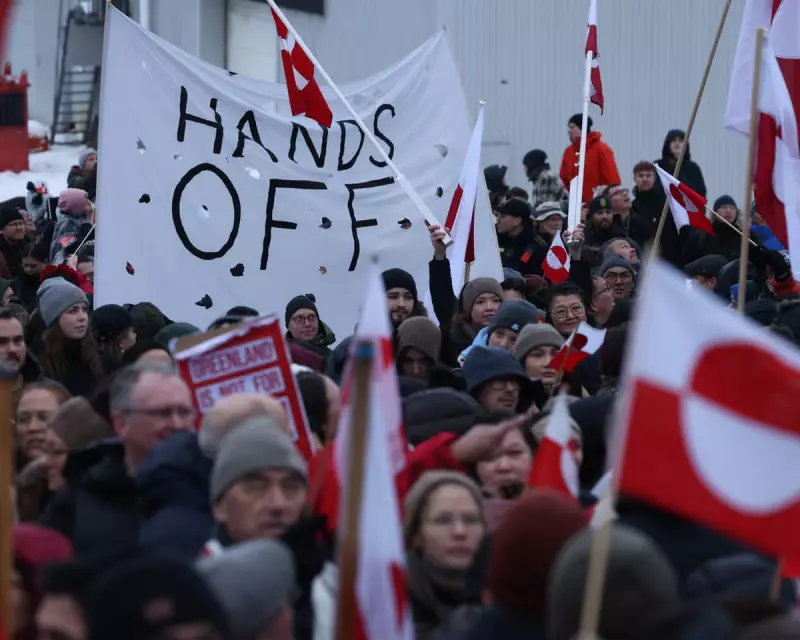
His threats have not been met quietly. On 17 January 2026, hundreds marched in Nuuk, Greenland's capital, to protest against Trump and his stated intent to acquire their homeland. The demonstration highlighted the strong local opposition to the idea, which is viewed as a colonial-era land grab.
European Response and American Public Opinion
The European reaction has been one of firm unity and reassurance. Danish Prime Minister Mette Frederiksen has emphasised that Greenland's defence is a "common concern" for the entire NATO alliance. The recent deployment of European troops to the territory, partly reported by The Guardian, serves a dual purpose: to explore sustained ground deployment options and to signal to the US that European members are committed to Arctic security.
Critically, Trump's campaign appears to find little favour at home. A Reuters/Ipsos poll published recently found that fewer than one in five Americans approve of his efforts to acquire Greenland. Opposition is bipartisan, with both Democrats and Republicans largely against the move. A mere 4% of Americans believe the US should use military force to take the island, underscoring the controversial nature of Trump's tariff-backed strategy.
The situation creates a significant diplomatic and economic rift, placing longstanding transatlantic alliances under unprecedented strain as a former US president leverages trade as a tool for territorial acquisition.