Axel Burrough: Architect of Iconic Cultural Spaces
Axel Burrough, the visionary architect behind Manchester's Royal Exchange theatre and the restoration of St Luke's church in London for the London Symphony Orchestra, has passed away at the age of 79. His career was defined by innovative designs that seamlessly merged futuristic concepts with historic preservation, leaving an indelible mark on the UK's cultural landscape.
The Royal Exchange Theatre: A Space-Age Marvel
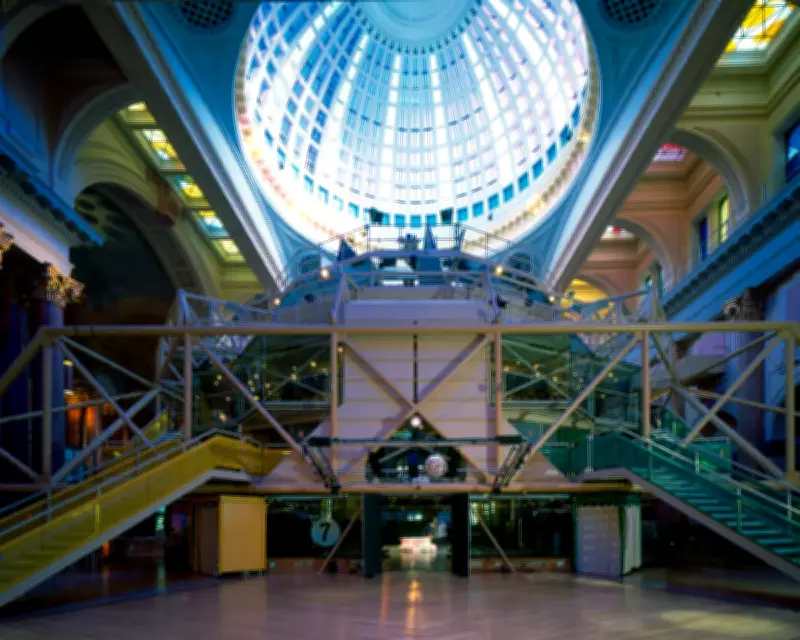
Inspired by the 1969 moon landing, the Royal Exchange theatre in Manchester stands as a dramatic interpretation of "space age" architecture. Co-designed by Burrough alongside David Levitt and Malcolm Brown, this heptagonal theatre-in-the-round features a structure of tubular steel and glass, reminiscent of NASA's lunar lander. Opened by Laurence Olivier in 1976, it seats 750 people, all within 10 meters of the stage center, creating an intimate and immersive experience.
Nestled within the neo-classical confines of the historic Royal Exchange building, the theatre represents a building-within-a-building, showcasing a striking contrast between old and new. Despite suffering damage in the 1996 IRA bomb attack, it remains a beloved landmark in Manchester, recently voted the city's favorite building. Burrough's meticulous work involved solving complex geometry with a Sinclair scientific calculator, a testament to his dedication in an era before computer-aided design.

St Luke's Church: A Modern Intervention in History
As a director at Levitt Bernstein Architects, Burrough led the transformation of the 18th-century St Luke's church in Old Street, London, into a performance and rehearsal space for the London Symphony Orchestra. Originally designed by Nicholas Hawksmoor, the church faced severe subsidence issues, leading to its abandonment and roof removal. English Heritage once listed it as one of England's most important buildings at risk.
Burrough's restoration, completed in 2003, introduced four massive steel columns that support a new roof, independent of the original walls. This modern intervention allowed the building's historical layers to remain visible, creating a palimpsest effect. He noted that the rough texture of the walls enhanced acoustics, making it ideal for musical performances. The project culminated in an emotional moment when the LSO first played there, marking seven years of hard work.
A Career of Creative Reuse and Collaboration
Born in Frenchay, near Bristol, Burrough studied architecture at Cambridge University and joined Levitt Bernstein in its early years. His portfolio includes a range of cultural projects, such as the Pier Arts Centre in Orkney, the Theatre Royal in Bury St Edmunds, and the Bristol Beacon concert hall. A consistent theme in his work was the reworking of existing structures, from burnt-out Victorian schools to art deco cinemas, demonstrating the value of creative reuse.
Burrough was a recognised expert in theatre design, with a particular interest in Georgian theatres. He served as a trustee for the Theatres Trust and the Almeida Theatre, contributing to the national advisory body for theatres. His collaborative approach involved working with acousticians like Carl Giegold and artists like Rana Begum, ensuring each project combined rigour with artistic flair.
He is survived by his wife, Jeni Walwin, their three daughters, and two grandchildren. Axel Burrough's legacy exemplifies how historic buildings can be given dynamic second lives through thoughtful and innovative architectural solutions.