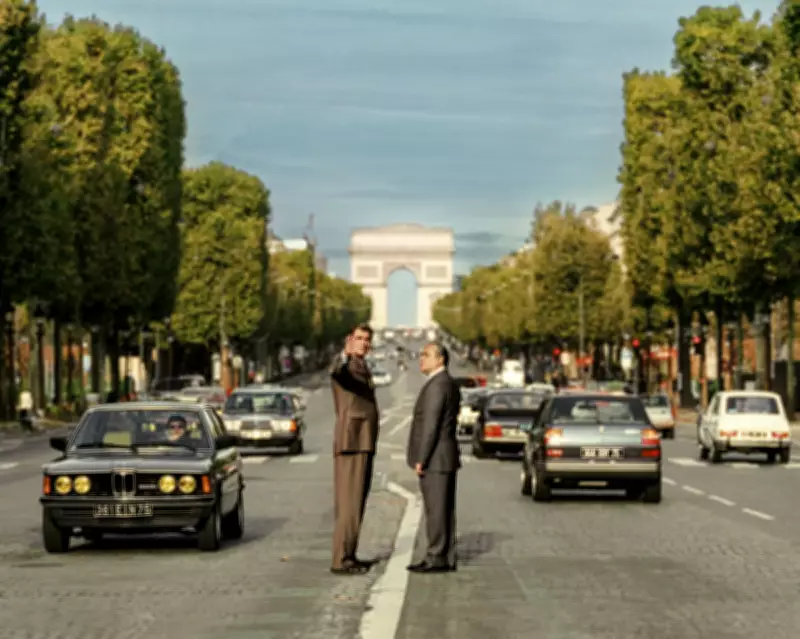
The Great Arch Film Exposes Paris Monument's Troubled Construction
Stéphane Demoustier's meticulous new drama The Great Arch presents a sobering examination of artistic vision colliding with political reality. While initially appearing to follow the recent trend of French brand-heritage films like Eiffel or Widow Clicquot, this adaptation of Laurence Cossé's 2016 novel reveals itself as something far more complex: the testimony of a monumental failure that spiritually crushed its creator.
A Visionary Architect's Struggle
The film centers on Danish architect Johan Otto von Spreckelsen, portrayed with airy disdain by Claes Bang. In 1983, Von Spreckelsen unexpectedly won an international competition to design the statement building for Paris's western business district, now known as the Arche de la Défense. The architect's obscurity was such that the French embassy in Denmark didn't even recognize his name, requiring President Mitterrand's adviser Jean-Louis Subilon (played by Xavier Dolan) to track him down while he was fishing in a Danish lake.
Upon arriving in France, the purist architect refused to deviate from the perfect dimensions of his "Cube," viewing it as the culmination of his life's work. However, he immediately found himself caught between the pernickety caprices of the French premier (Michel Fau) and the cost-cutting wiles of technocrat Subilon, setting the stage for a protracted battle between artistic integrity and political expediency.

Artistic Purity Versus Bureaucratic Reality
Von Spreckelsen hired Paul Andreu (Swann Arlaud), designer of the futuristic Terminal 1 at Charles de Gaulle airport, as his site manager while insisting that artistic credit remain exclusively his. Demoustier frames this retro piece in a boxy 4:3 ratio, fastidiously detailing the architect's battles, compromises, and perceived betrayals throughout the construction process.
The film meticulously documents specific conflicts including:
- The glass facade specifications
- The suspended cloud form underneath the canopy
- The Carrara marble selection, for which Von Spreckelsen enlisted Mitterrand's direct support
Even with backing from his wife Liv (Sidse Babett Knudsen) in his politicking efforts, Von Spreckelsen gradually succumbed to paranoia and rage in the face of relentless interference from French officials and bureaucrats.
A Critical Examination of Creative Genius
While The Great Arch demonstrates exacting attention to the construction process, it remains more reticent about the man himself. Unlike his subject, Demoustier provides limited insight into Von Spreckelsen's guiding principles, making the architect's irritating intransigence obvious while staying vague about the underlying emotional reasons or the extent of his egotism.
As one character observes, even Michelangelo never truly invented anything entirely new. Bang's performance emphasizes airy disdain rather than firebrand creativity, leaving his portrayal somewhat unmoored from the heavyweight supporting cast, which includes the always-shrewd Arlaud. The film presents a somewhat generic depiction of Tormented Architectural Genius, yet its crushingly downbeat ending offers an intriguing and sobering exposé of the supposed Gallic cult of the artist.
The Great Arch ultimately serves as a powerful reminder of how national vanity and bureaucratic ego can compromise even the most visionary architectural projects. The film will be screening at the Cine Lumière in London beginning March 11th, offering audiences a compelling look at the complex intersection of art, politics, and monumental construction.