African Guernica Joins Picasso's Masterpiece in Madrid Museum Display
A significant artistic dialogue unfolds at the Reina Sofía museum in Madrid, where Dumile Feni's African Guernica from 1967 is now exhibited directly opposite Pablo Picasso's renowned Guernica. This powerful juxtaposition marks the inaugural exhibition in a new annual series titled History Doesn't Repeat Itself, But It Does Rhyme, aiming to foster cross-cultural artistic conversations and challenge historical biases in art curation.
Confronting Apartheid Through Art
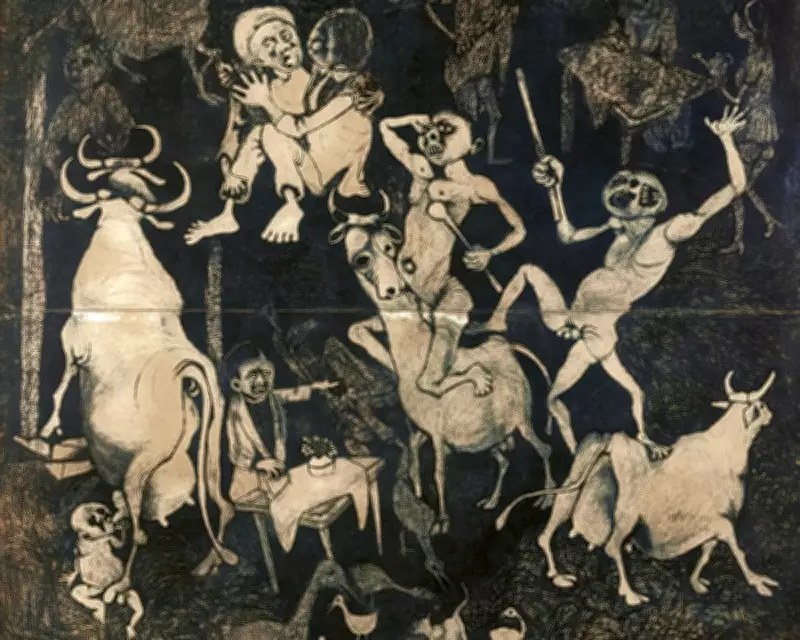
Created by the late South African artist Dumile Feni, African Guernica is a charcoal and pencil drawing that vividly captures the anguish and brutality of living under apartheid. Unlike Picasso's anti-war masterpiece, which responds to the Nazi bombing of Guernica, Feni's work delves into the systemic violence and dehumanization of racist tyranny. The drawing features haunting imagery, including a three-legged man with a grotesque mask, a cow suckling a baby, and shadowy figures, all rendered on now-yellowing paper to evoke a sense of historical weight and urgency.
This exhibition represents the first time African Guernica has been displayed outside South Africa, on loan from the University of Fort Hare. Feni, who died in exile in New York in 1991, was a self-taught artist deeply influenced by indigenous African art forms such as rock painting and mask-making. His exposure to European modernism, including works by Goya, Bosch, and Picasso, further enriched his artistic vocabulary, creating a unique fusion that challenges traditional art historical narratives.

Curatorial Insights and Artistic Legacy
According to Manuel Segade, director of the Reina Sofía, the exhibition seeks to rectify long-standing biases in art history, particularly the marginalization of African art. "Just as western art has relegated women to one side when it comes to the history of art, so has the history of art been constructed according to racist parameters that have condemned African art to handicrafts or to savagery," Segade explained. By placing Feni's work alongside Picasso's, the museum encourages a re-evaluation of both pieces, highlighting their distinct yet interconnected themes.
Tamar Garb, the exhibition's curator and a professor of art at University College London, emphasizes the importance of this artistic dialogue. "Picasso's Guernica itself could not have existed without African sculpture," Garb noted, pointing to the profound influence of African art on European modernism. However, she cautions against viewing the two Guernicas as equivalent; while Picasso's work is an anti-war cry, Feni's responds to the slow, pervasive violence of apartheid. The title African Guernica was likely assigned by a gallerist or commentator, but Feni embraced it, using the name to frame his work within a broader artistic context.
Additional Works and Global Significance
The exhibition also features five other works by Feni, showcasing his mastery of drawing on an epic scale. Among these is the 53-meter-long scroll You Wouldn't Know God if He Spat in Your Eye, created during his time in London, and the large charcoal drawing Hector Pieterson from 1987, which reimagines a famous photograph of a boy killed by apartheid police. Garg argues that Feni's use of charcoal, pencil, and conté crayon at such monumental dimensions places him in a rare category of 20th-century artists, with few peers globally in the 1960s working at similar scales.
This exhibition not only honors Feni's legacy but also prompts reflections on art's role in addressing social and political issues. By bringing together works from different cultural frameworks, the Reina Sofía fosters a deeper understanding of how art can confront tyranny, celebrate resilience, and inspire change across continents and eras.