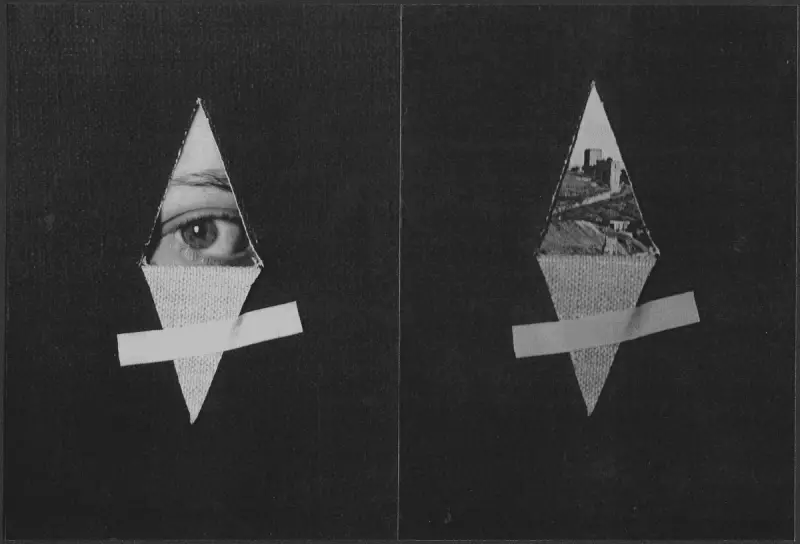
In the hushed, white-walled space of a London gallery, artist Edita Schubert approaches her canvas not with a brush, but with a surgical blade. For Schubert, the act of creation is one of controlled violence and meticulous repair, a physical and emotional process that has defined her acclaimed career.
A Radical Departure from Tradition
Schubert's methodology is a stark departure from conventional painting. She does not apply pigment to build an image; instead, she subtracts material to reveal it. Her primary tool is a scalpel, which she uses to slice, carve, and incise into prepared layers of canvas and paint. "I had to plunge the knife into the canvas," Schubert explains, describing the initial, daunting step in her process. This act is both literal and metaphorical, representing a direct engagement with themes of trauma, memory, and the body.
The artist prepares her surfaces by building up numerous strata of paint, often allowing them to dry completely between applications. This creates a dense, skin-like membrane. The subsequent cutting is not random destruction but a highly disciplined form of drawing. Each incision is deliberate, exposing the hidden colours and histories beneath the surface. The resulting works are textured, topographic landscapes that invite close inspection, their scars and fissures forming intricate, often hauntingly beautiful, compositions.

Exploring the Anatomy of Trauma and Healing
Schubert's work is deeply informed by personal and collective experience. Her themes frequently grapple with psychological wounding, the fragility of the human form, and the slow, often imperfect, process of healing. The scalpel, an instrument associated with both harm and surgery, becomes the perfect vehicle for this exploration. She wields it with the sensitivity and precision of a draughtsman, using its sharp edge to trace narratives of pain and recovery.
Her upcoming solo exhibition, titled 'Incisions', is scheduled to open at a prominent central London gallery in early 2026. This highly anticipated show will bring together a major new body of work developed over the last two years. Critics and curators have noted the powerful evolution in her technique, where the incisions have become more complex, and the revealed under-layers more chromatic and suggestive.
The physicality of her practice is exhausting. Schubert describes long sessions of intense focus, where the pressure of the blade and the resistance of the material demand complete physical and mental presence. "It is a performance of sorts," she notes, "a ritual where the gesture is everything." This performative aspect connects her work to action painting, yet her actions are subtractive and surgical rather than additive and gestural.
Carving a Unique Niche in Contemporary Art
Edita Schubert's innovative approach has secured her a unique position within the UK's contemporary art scene. Her work challenges the very definition of painting, pushing it into the realm of sculpture and textile art. By treating the canvas as a corporeal entity to be dissected, she prompts viewers to reconsider the relationship between surface and depth, injury and artistry, destruction and creation.
Her pieces are held in several important public and private collections, and her influence is growing among a younger generation of artists interested in materiality and process. Art historians have begun to place her work in dialogue with post-war artists who also attacked the canvas, though Schubert's method is distinguished by its clinical precision and deeply personal symbolism.
As preparations for her 2026 exhibition intensify, Schubert continues her daily dialogue with blade and canvas. Each cut is a word, each composition a sentence in a visual language she has pioneered. In an art world often saturated with digital and conceptual practices, her work stands as a potent reminder of the power of physical gesture and the profound stories that can be told not by adding, but by courageously taking away.