The Disturbing Genius of Erotica Pioneer Félicien Rops
During an oppressively hot Parisian week in 1878, Belgian artist Félicien Rops created one of his most infamous works: a painting depicting a blindfolded, naked woman walking her pet pig. This piece, titled Pornocrates (roughly translating to "the ruler of fornication"), exemplifies the provocative nature of Rops' artistic vision that continues to challenge audiences today.
An Exhibition That Confronts Sexual Imagery
Laboratory of Lust, a new exhibition at Kunsthaus Zurich running from March 6th to May 31st, presents a comprehensive exploration of Rops' controversial oeuvre. The exhibition features works from the Royal Library of Belgium's extensive collection of approximately 2,000 Rops pieces, including secret albums originally intended for private male collectors' cabinets.
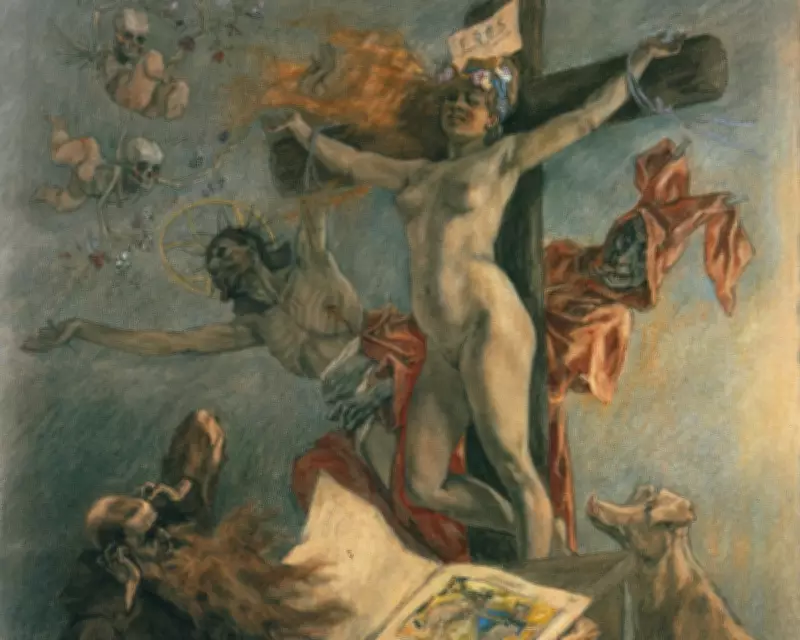
"Even today's viewers are sometimes left breathless—whether at the sight of a naked woman tied to a cross, a risque Parisian woman walking her pig, or an Eve being ensnared by a phallic snake," notes Ann Demeester, director of Kunsthaus Zurich. This reaction would have delighted Rops, who once wrote about his most shocking images: "I sometimes do things like this to bring my backside up to the level of your faces."

The Artistic Vision That Scandalized the Belle Epoque
Rops developed a distinctive style that blended erotic imagery with satanic elements, creating works that French art critic Félix Fénéon described as coming from an artist "who paints phalluses the way others paint landscapes." His portfolio includes:
- Naked witches riding brooms through fantastical landscapes
- Voyeurs in formal top hats observing intimate scenes
- Courtesans riding penis-shaped bicycles in surreal compositions
- Women of the demimonde, whom he called Ropsiennes
Rops' influence extended to later artistic giants, with Pablo Picasso creating a cartoon homage depicting a man in pig form performing cunnilingus on a woman—a direct response to Rops' provocative imagery.
The Man Behind the Controversy
Born in 1833 in Namur, Belgium, to a wealthy industrialist family, Rops seemed destined for conventional respectability. He studied law and married a magistrate's daughter who owned a local castle. However, art, Parisian life, and philandering proved irresistible attractions.
With his razor-sharp goatee and brooding brow—bearing resemblance to a young Ethan Hawke—Rops cultivated a shabby-garret style of dress that complemented his bohemian lifestyle. He abandoned his wife and son to live for three decades in a menage à trois with sisters Léontine and Aurélie Duluc, fathering children with both women.
Despite—or perhaps because of—this unconventional domestic arrangement, Rops achieved remarkable professional success. By the mid-1870s, he had become Paris's highest-paid illustrator, creating work for literary giants including Charles Baudelaire and Paul Verlaine. He received the Légion d'honneur in 1898, the same year he died at age 65.
Collecting and Exhibiting Provocative Art
According to Claude Piening, specialist in 19th-century European pictures at Sotheby's, Rops maintains a dedicated collector base despite the challenging nature of his subject matter. "His watercolours and oil paintings don't come up often because many are spoken for by museums and collectors," Piening explains. "What does come up is his printed work, and if you're a bibliophile you'll see his work in frontispieces."
A rare watercolor titled Le Calvaire (Les Sataniques)—depicting a woman strangled by her own hair beneath a crucified Satan—sold at Sotheby's in 2007 for approximately £160,000. The auction catalogue noted the work's peculiar blend of horror and humor, observing that "Satan's testicles sitting atop the woman's face like a beret are more comical than frightening."
Contemporary Relevance in Conflicted Times
Curators Jonas Beyer of Kunsthaus Zurich and Daan van Heesch of the Royal Library of Belgium face particular challenges presenting Rops' explicit works in today's cultural climate, marked by #MeToo, OnlyFans, and conflicting conversations about sexuality.

"That's a central question," acknowledges Beyer regarding the exhibition's timing. "I think in Zurich it will be a task to show such explicit works. It's very traditional." He notes the potential dissonance between Rops' phallic imagery and Zurich's associations with high-end chocolate and luxury watches.
Van Heesch emphasizes the importance of presenting Rops comprehensively: "He was one of the most accomplished and successful symbolist artists of his time, working together with all the famous authors. But at the same time his art is so disturbing, violent and shocking, and fascinating as well. I think we want to look him in the eye and read him a bit against the grain, without cancelling him."
The exhibition ultimately seeks to contextualize Rops' work within broader discussions about how male culture perceives women—a conversation that remains urgently relevant in light of contemporary revelations about power dynamics and sexuality.