Beneath the Great Wave: Hokusai and Hiroshige Review – How Two Japanese Masters Reinvented Art
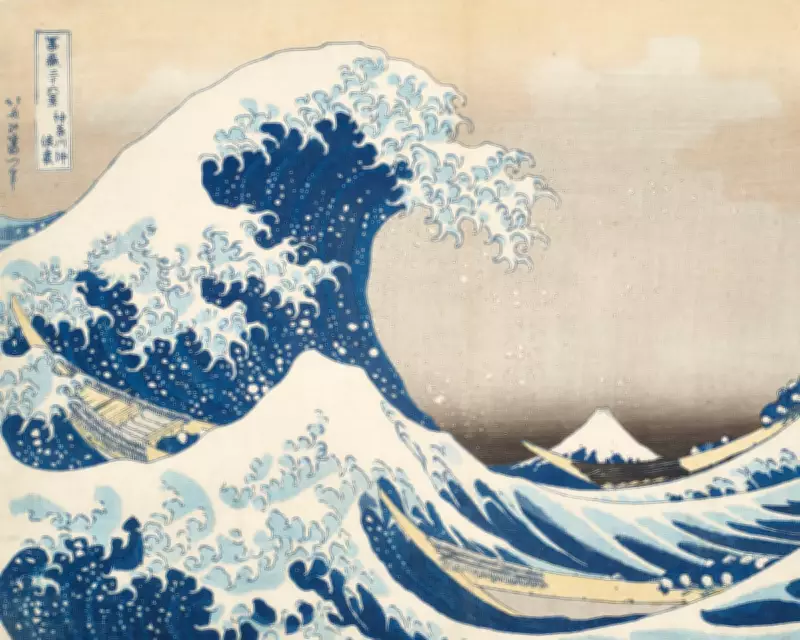
Familiar yet deadly, Kanagawa oki nami ura (Under The Great Wave off Kanagawa, or The Great Wave) by Katsushika Hokusai (1760–1849) stands as a centerpiece in a startling exhibition at the Whitworth in Manchester. On loan from a private collection, this breathtaking woodblock print, though ubiquitous today, serves as an apocalyptic vision of a world on the brink of change, reminding us of its enduring power.
The Floating World: From Mass Media to Artistic Revolution
The printed images produced in Japan between the 17th and 20th centuries, collectively known as "pictures of the floating world," were once affordable commodities, sold for about the price of a bowl of noodles. These mass-produced works, collected casually like posters or magazines, initially captured the sexy, charming, and dazzling snapshots of Tokyo high-life, offering vicarious enjoyment to those who could not afford such luxuries. Manufactured by workshops of artists and artisans, they democratized art, making professional creations accessible to ordinary people for the first time. Their breathtaking beauty not only captivated audiences but also irrevocably changed the history of art.
The first and most enduringly popular subjects for these collectible prints were famous actors from the kabuki theatre and beautiful women, often courtesans from the brothel district of Yoshiwara. The exhibition's first half illuminates the dreams and desires driving popular culture by introducing the denizens of this floating world. For instance, Kunichika's portrait of an actor as a "heavenly being" pulses with heart-throbbing, gender-bending energy, reminiscent of Rudolph Valentino in a bolero vest. Similarly, Eizan's depiction of a "fashionable beauty" applying lipstick, with a delicately turned ankle visible through her gown, exudes an erotic, voyeuristic charge that feels both intentional and unavoidable, akin to stumbling upon a half-dressed model in the pages of Vogue Italia.

Darkness Beneath the Glamour: Transgressive and Emotional Depths
The transgressive nature of these images is integral to their allure. In a celebrated picture by Hiroshige, one of the two masters central to this show, a man leaving the red light district at dawn covers his face to avoid recognition. As viewers immerse themselves in more of these works, the darkness beneath the glamour becomes increasingly apparent. Shunchô's disarmingly elegant portrait of three sex workers accompanied by two young girls reveals a grim reality: the girls are serving apprenticeships in the industry, possibly sold by impoverished families. This hedonism is sharply counterpointed by an offstage despair, adding depth to the visual narrative.
Hiroshige's heartbreaking image of a geisha by a river at night further exemplifies this emotional complexity. With her lantern-carrying attendant cropped out, she stands alone against the shimmering darkness, absorbed in thought. This portrayal introduces a startling psychological depth, with the cast of her mouth economically expressing mono no aware—the sweet and melancholy revelation that all things must pass. While her specific thoughts remain unknown, the deep feeling precipitating this contemplation is palpable, bridging the fleeting and the eternal.
Expanding Horizons: From Pleasure Districts to Cosmic Order
This irony—that eternal truths emerge from dwelling on the world's fleeting nature—animates all great art, a category to which the exhibition's second half unquestionably belongs. Focusing on mid-19th century landscapes by Hiroshige and the immensely influential Hokusai, it showcases a remarkable expansion in commercial printmaking from Tokyo's pleasure districts to the cosmic order. This miracle, akin to those that electrified Elizabethan London and Renaissance Florence, stems from multiple factors, though the masterpieces on display highlight key contributors.

Exposure to European art via Dutch sailors provided a new toolbox for constructing the visible world. Hokusai, clearly delighted, used western perspective to compose landscapes with dramatic depth and striking graphics in his groundbreaking Thirty-Six Views of Mount Fuji—a series so popular it eventually grew to 46 prints. In response, the younger Hiroshige created his magnificent Fifty-three Stations of the Tōkaidō Road, blending western and Asian compositional models to build hallucinatory vistas that later enchanted the impressionists and transformed European painting.
There is insufficient space to fully describe the bands of color Hokusai applies to skies through pine trees and plum gardens, but one literal translation of mono no aware as "the ah!-ness of things" captures its essence. The most celebrated print, of course, is The Great Wave, which lends the show its title. Despite its familiarity, often rendering it cosy in university common rooms, this is a terrifying vision: the wave threatens to overwhelm fishing boats and even Mount Fuji itself, symbol of Japan and divine order. As exhibition literature notes, the mountain's name may derive from fu-shi, meaning "not-death," making this apocalyptic scene a reflection of anxiety during Japan's final decades of isolation, the closing Edo period, and impending change.
Genius and Collaboration: Transforming Consciousness Through Art
Hokusai's wave is presented alongside Hiroshige's homage or riposte, printed about 25 years later. This transcendentally harmonious composition, with Mount Fuji standing untroubled and time seemingly halted, illustrates the differences in temperament and technique between the artists. It also introduces the most elusive factor in transforming woodblock prints from disposable media into instruments for expanding human consciousness: the near-simultaneous emergence of two artists capable of accessing previously unreachable ideas and feelings, and making them accessible to masses. This shorthand is genius.
However, this genius should not obscure their reliance on independently gifted collaborators or their roots in a specific time and place. Yet, it connects them to other thinkers preoccupied with reconciling the ever-changing appearance of things with persistent ideas and identities. They conclude that the boundary between life and death is more fluid than conventionally perceived, vividly showing it: spume from Hokusai's wave crest becomes snow on Mount Fuji, while flecks of foam from Hiroshige's transform into a flock of birds flying over its summit. Beneath the Great Wave: Hokusai and Hiroshige is at the Whitworth, Manchester until 15 November, offering a profound exploration of art's transformative power.