Lucian Freud's Drawings: The Intimate Foundation of a Master's Work
A groundbreaking exhibition at London's National Portrait Gallery, titled "Lucian Freud: Drawing into Painting," reveals the profound significance of the artist's works on paper. Featuring 175 paintings and drawings, the show demonstrates how Freud's drawings were not mere sketches but essential components of his artistic evolution, often created after paintings were completed as a means of exploration and rediscovery.
The Transformative Encounter with Francis Bacon
In 1951, Lucian Freud created three remarkable drawings of fellow artist Francis Bacon that would fundamentally alter his approach to art. According to biographer William Feaver, Bacon posed provocatively, undoing his trousers and rolling up his sleeves while suggesting Freud capture this moment. This encounter proved pivotal for Freud, who later confessed to Feaver that he felt constrained by his drawing technique at the time.
"I got very impatient with the way I was working. It was limited and a limited vehicle for me," Freud explained. "I realized that by working in the way I did I couldn't really evolve. The change wasn't perhaps more than one of focus, but it did make it possible for me to approach the whole thing in another way."

Despite Freud's self-criticism, the three line drawings of Bacon display extraordinary precision and fluidity, showcasing the artist's relentless pursuit of artistic truth that would characterize his entire career.
Drawing as Multiple Disciplines
For Freud, drawing served numerous purposes throughout his life. As a child, he used drawings to write letters. As a mature artist, he employed drawing to prepare canvases with ghostly images that would disappear beneath layers of paint, solve compositional problems by studying works at the National Gallery late at night, and create what curator Sarah Howgate describes as "painting without paint" through his substantial etching work from the 1980s onward.
David Dawson, Freud's assistant from the early 1990s and the subject of his final portrait, explains that drawing after completing a painting represented Freud's continuous quest for artistic authenticity. "He's finding things out, he's exploring, and it's a quicker route to explore with a pencil or charcoal than the whole oil spectrum," Dawson notes.
The Uncompromising Truth of Drawing
Freud maintained that drawing represented the most honest form of artistic expression. "He always said you can never lie with drawing," Dawson reveals. "Whereas with paint, it's such an attractive medium, you can slightly smudge things, if you cut corners – which he never did, but you can. You can fake it a bit with paint. You can't with drawing."
This commitment to truthfulness is evident throughout the exhibition, which includes several pen-and-ink and charcoal works related to Freud's monumental 1981-1983 painting "Large Interior, W11 (after Watteau)." Howgate emphasizes that many of these drawings were created in response to the finished painting rather than as preparatory studies.
Notable Works in the Exhibition
The exhibition showcases several key pieces that illustrate Freud's drawing mastery:

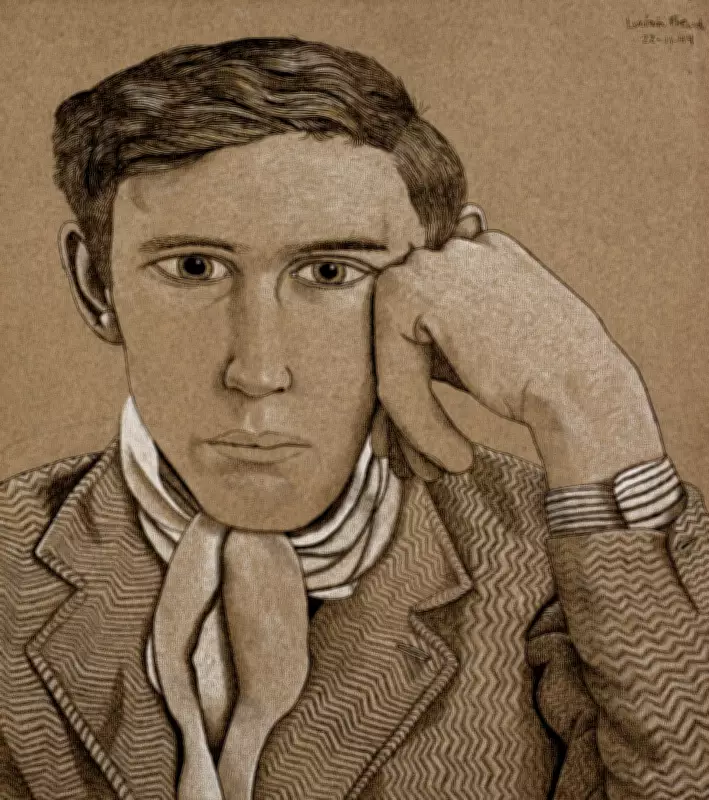
- Portrait of a Young Man, 1944: This early work demonstrates Freud's remarkable attention to detail in rendering hair texture, jacket weave, and cravat folds. His use of white chalk on colored paper recalls Ingres, earning Freud the description from art historian Herbert Read as "the Ingres of existentialism."
- Bella in her Pluto T-Shirt (etching), 1995: This etching of Freud's daughter reveals the artist's revision process, with an earlier version showing Bella without facial features. The work documents moments when Freud changed his mind and had the copper plate smoothed for reworking.
- Girl in Bed, 1952: This drawing exemplifies Freud's approach to portraiture, where he sought to capture his subjects' inner lives rather than using them as blank canvases for his own expression.
- Solicitor's Head, 2003: Dawson describes Freud's intense working method for this portrait, with the artist standing less than a meter from his subject. "He'd come up really close to you, like, really close," Dawson recalls. "It wasn't relaxed. And that kept you as a sitter slightly on edge because he didn't quite know ... He was battling with himself every day."
- David Hockney, 2002: This portrait resulted from approximately 120 hours of sitting, according to Howgate. While Hockney created his own drawing of Freud during their sessions, Freud reportedly spent only 45 minutes on his drawing of Hockney before departing.
The Legacy of Freud's Drawing Practice
The exhibition powerfully demonstrates how drawing served as Freud's primary means of artistic investigation throughout his career. Whether as preliminary studies, problem-solving exercises, or post-painting explorations, his works on paper reveal the constant experimentation and refinement that underpinned his celebrated paintings. The show offers visitors unprecedented insight into the creative mind of one of Britain's most important 20th-century artists, highlighting how his drawings provided the essential foundation for his major works.
"Lucian Freud: Drawing Into Painting" continues at the National Portrait Gallery in London through May 4, presenting a comprehensive examination of how drawing fundamentally shaped Freud's artistic vision and practice.