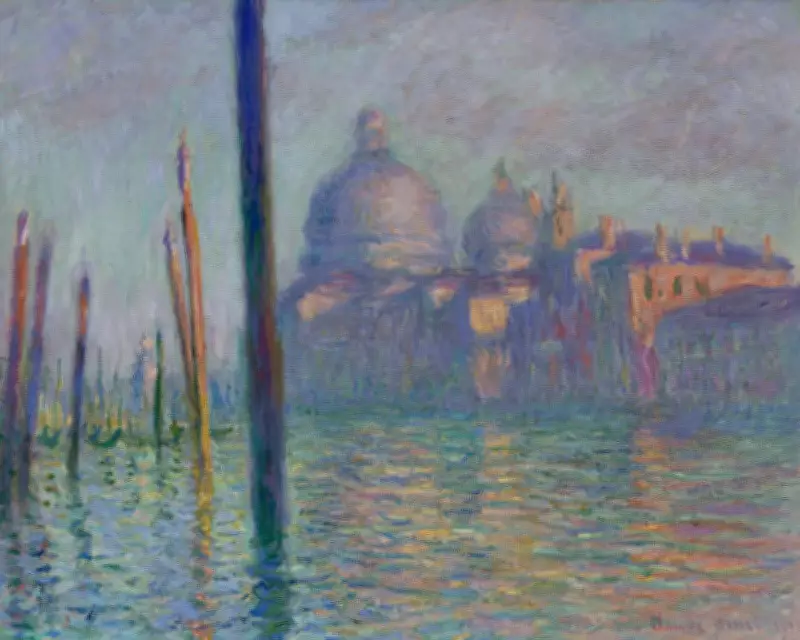
Monet's Venetian Twilight: How the Impressionist Master Finally Captured Venice
Claude Monet was sixty-eight years old before he first set foot in Venice, remarkably avoiding a city that had captivated Europe's greatest painters for centuries. When the French impressionist finally arrived in 1908, he created dozens of paintings that now form the centerpiece of "Monet and Venice," a groundbreaking exhibition at San Francisco's de Young Museum.
The Reluctant Visitor
"It might have been insecurity, because Venice had been painted so famously and by so many major names in western history," explained Melissa Buron, who co-curated the exhibition with Lisa Small. Even a master like Monet could feel intimidated by Venice's artistic pedigree, which may explain his delayed visit to the iconic city.
Monet's Venetian journey was originally scheduled for just two weeks, barely enough time for paint to dry. Yet he extended his stay to two months, producing numerous oil paintings that reveal his unique vision of the water-filled city. "We wanted to emphasize that his trip to Venice was not predestined," Buron emphasized. "I originally thought 'he's an artist of water and light, of course he would go to Venice,' but it really almost never happened."

A Second Honeymoon in Twilight Years
When Monet and his wife Alice arrived in Venice, they blended seamlessly into the community of artists and tourists painting the city's storied canals. "It was sort of like a second honeymoon for them to be able to have this experience in their twilight years," Buron noted. Despite his fame, Monet remained relatively anonymous among the city's visitors.
The exhibition brings together two dozen of Monet's Venetian works alongside paintings by other masters who captured Venice, including James McNeill Whistler, Pierre-Auguste Renoir, John Singer Sargent, JMW Turner, and Paul Signac. With over one hundred works total, including Monet's early pieces and late waterlilies, the show creates an entrancing visual journey.
Artistic Community and Friendly Rivalry
Monet was familiar with his contemporaries' Venetian works through personal connections and museum visits. While in London during the Franco-Prussian war in 1871, he saw Turner's Venice paintings at the National Gallery, and he even purchased one of Signac's post-impressionist depictions of Santa Maria della Salute church.
"I'm sure there was a sense of competition among some of the artists – they're each trying to say something about Venice," said Buron, "but there was a lot of sharing too, like suggestions about art suppliers to use." This collaboration proved essential since Monet hadn't brought sufficient art supplies, expecting only a brief tourist visit rather than an extended painting expedition.
Venetian Visions and Subtle Variations
The exhibition organizes Monet's works by location, featuring his depictions of the Grand Canal, Palazzo Contarini (painted from a gondola), San Giorgio Maggiore church, and the Palazzo Ducale. Most sites include multiple versions of the same view, allowing visitors to appreciate Monet's subtle variations in tone, texture, warmth, and framing.
"There are subtle variations between them, which I think is really interesting," Buron observed. "For instance, in the two paintings of the Palazzo Ducale, they look so similar, but you do see one has a slightly warmer glow than the other one." This repetition encourages deeper engagement with each canvas, revealing the artist's evolving perception of Venetian light and atmosphere.
Venice's Impact on Monet's Late Masterpieces
Perhaps most significantly, the exhibition demonstrates how Monet's Venetian experience revitalized his artistic vision. On the eve of his trip, Monet had "renounced the waterlily project 'once and for all'" after disappointing feedback from his dealer Paul Durand-Ruel in 1907. Yet after returning from Venice, he reversed this decision and pursued the waterlilies with renewed ambition.
"I think Monet being in Venice, where he's surrounded by water and light every day, it's plausible that because of that the waterlilies are something that he's inspired to continue," Buron suggested. The exhibition's final gallery showcases Monet's waterlilies, illustrating how his Venetian immersion influenced these late masterpieces.

A Historic Gathering of Venetian Works
"Monet and Venice" represents the largest collection of the artist's Venetian paintings assembled since their original exhibition in 1912. The concept originated when Buron contemplated Monet's Grand Canal painting in the de Young's permanent collection, envisioning a gallery filled with such luminous works.
"It's the light, and the way that he has captured this really evanescent moment in time. I mean, it's just so beautiful," Buron reflected. "And this idea that he wrote about, it's too beautiful to be painted, what a fascinating challenge for an artist." The exhibition remains on view at the de Young Museum in San Francisco through July 26, offering visitors an unprecedented opportunity to experience Monet's Venetian transformation.