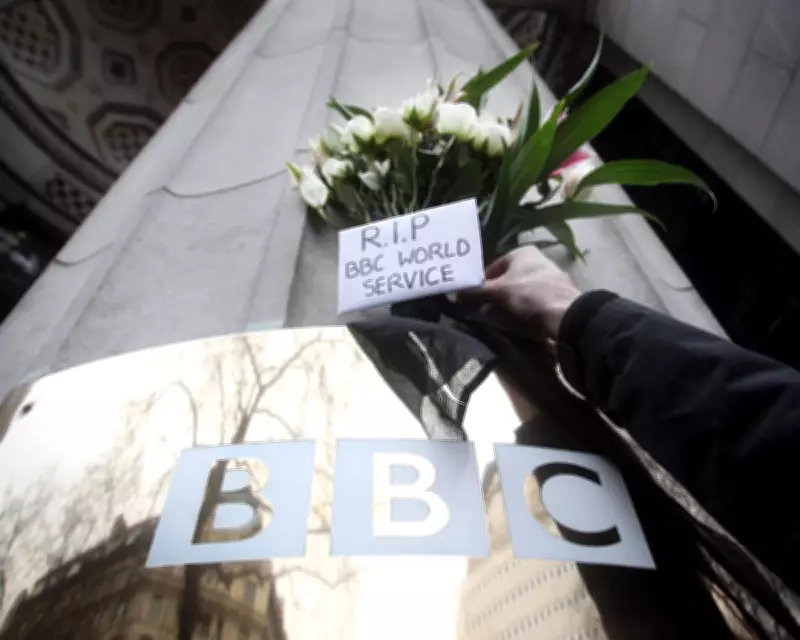
The BBC World Service: A Global Beacon in Peril
With just seven weeks remaining before its funding completely evaporates, the United Kingdom's most trusted international news organization and greatest cultural asset stands at a critical crossroads. The BBC World Service, which reaches an astonishing 313 million people weekly across 43 different languages, represents what former UN Secretary General Kofi Annan once called "perhaps Britain's greatest gift to the world" during the twentieth century. Yet this week, Director General Tim Davie delivered the sobering announcement that this vital service will exhaust its financial resources by the end of March.
Funding Collapse Amid Global Media Shifts
The World Service's current £400 million budget primarily derives from the television licence fee, with the Foreign Office contributing £137 million during the last fiscal year. This crucial funding arrangement with the Foreign Office concludes at March's end, and no concrete plan exists for what follows this deadline. This funding crisis emerges precisely as global competitors intensify their media investments. Russia and China are currently pouring billions into state-controlled media operations, while American news organizations face significant challenges under political pressures.
Last week witnessed the Washington Post eliminating 300 positions, including their Ukraine correspondent, while Voice of America experienced hundreds of job losses last year. These developments highlight a troubling global trend where independent journalism faces mounting threats from multiple directions.

More Than Just Broadcasting: A Lifeline for Millions
While some question why domestic licence fee payers should subsidize services primarily consumed internationally, the World Service maintains substantial domestic appreciation. During late-night hours, it provides British listeners with a window to global events, offering an alternative to social media doomscrolling and countering parochial perspectives. As journalist Jeremy Paxman eloquently described, the service resembles "an ageing uncle who's seen it all" with a distinctive style that transforms understatement into something approaching flamboyance.
Beyond its cultural significance, the World Service serves as a literal lifeline for millions worldwide. During Iran's recent internet blackout, the BBC's Persian service delivered additional radio programming via shortwave and medium wave transmissions. The organization has launched emergency services responding to conflicts in Ukraine, Syria, Gaza, and Sudan, plus earthquake coverage in Myanmar. Remarkably, it remains the sole international news organization still broadcasting within Afghanistan, where it established an educational program for Afghan children in 2024.
Historical Context and Contemporary Challenges
The service traces its origins to December 1932 when then-Director General John Reith launched the Empire Service with modest expectations, stating "the programmes will neither be very interesting nor very good." Nearly a century later, this humble beginning has evolved into a global media powerhouse. However, recent years have brought significant challenges through cuts, closures, and job reductions.
In 2022, radio broadcasts in ten languages including Arabic, Persian, Chinese, and Bengali transitioned to digital-only services, a decision criticized for disproportionately affecting women who rely most heavily on radio access. Wherever the BBC has withdrawn due to financial or political pressures, propaganda outlets have rapidly filled the resulting information vacuum.
The Strategic Imperative for Support
No serious observer questions the World Service's value as an instrument of British soft power, but BBC leadership correctly argues it constitutes an essential component of national security infrastructure. In today's information warfare landscape, accurate journalism represents the most potent weapon against disinformation. The service must not be permitted to stumble into irreversible decline.

During the Second World War, novelist Penelope Fitzgerald described radio as "scattering human voices into the darkness of Europe" based on her BBC experiences. In our contemporary era of artificial intelligence noise and rampant disinformation, the World Service requires urgent support to continue scattering human voices during these increasingly dark times. Director General Davie's call for decisive government backing represents both appropriate and urgently necessary action to preserve this irreplaceable global institution.