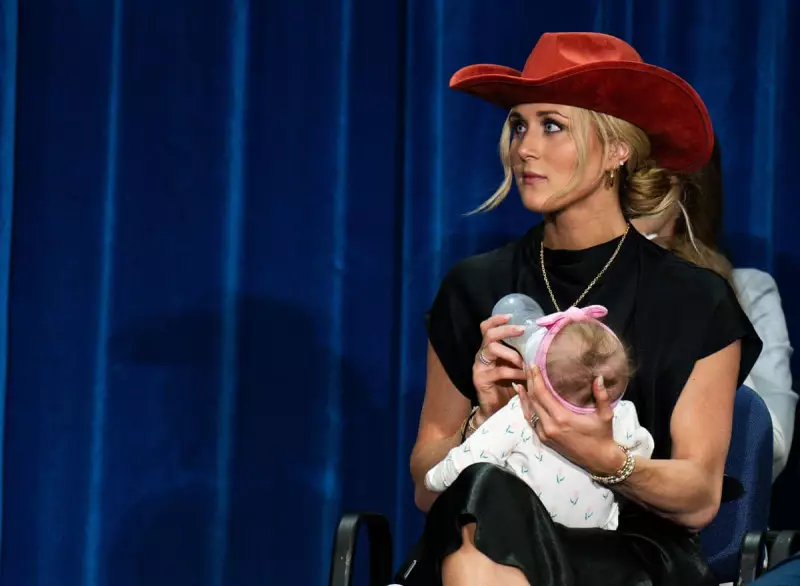
In a striking juxtaposition of personal motherhood and political messaging, former collegiate swimmer turned activist Riley Gaines recently breastfed her infant daughter on stage during a "Policy Celebration" event at the US Department of Health and Human Services headquarters in Washington DC. This intimate maternal display, captured in photographs on 8 January 2026, forms part of Gaines's public brand that heavily emphasises traditional femininity and family values. Yet this image of protective motherhood stands in stark contrast to her vocal stance on recent immigration enforcement actions.
The Womanosphere's Call to Resist Compassion
Gaines represents a leading voice within what has been termed the "womanosphere" – a predominantly white Christian conservative media sphere that promotes anti-feminist, gender-essentialist ideologies. Alongside fellow conservative commentator Allie Beth Stuckey, Gaines has been actively encouraging her substantial following to resist feelings of empathy toward individuals affected by Immigration and Customs Enforcement (ICE) operations. This messaging comes amid growing public outrage over specific incidents, including the detention of five-year-old Liam Ramos in Minneapolis.
Controversial Responses to ICE Actions
During a recent podcast episode, Gaines addressed the case of young Liam Ramos, who was taken by ICE agents from his family's driveway while wearing snowpants and a blue hat with bunny ears. While the images prompted widespread disgust across the United States, Gaines expressed gratitude toward the enforcement agents. "I will say thank you to our ICE agents," she stated. "Thank you for not abandoning that five-year-old boy like his father did. I'm glad and I'm grateful."

This perspective directly contradicts accounts from eyewitnesses and Ramos's school district, which reported that the father had been detained by ICE and that authorities had attempted to use the child "as bait" to draw other family members from their home. Despite these conflicting narratives, Gaines pleaded with her audience to avoid compassionate responses. "Do not let compassion, or what you believe to be compassion, cloud you or suspend you from thinking critically," she advised her listeners.
The Philosophical Foundation of Anti-Empathy
Allie Beth Stuckey, another prominent figure within this conservative women's media sphere, has developed a more formal philosophical framework for this anti-empathy position. In her 2024 book Toxic Empathy: How Progressives Exploit Christian Compassion, Stuckey argues that empathy represents a vulnerability that progressive activists weaponise to advance their agendas. She first developed this thesis following the murder of George Floyd, when she objected to social media expressions of solidarity with victims of institutionalised racist violence.
"I was facing weaponized, toxic empathy," Stuckey wrote of that period. Five years later, she continues to preach that empathy can weaken Christians by allowing reflexive horror over systemic violence to cloud their objectivity. According to her framework, showing compassion toward immigrants, people of colour, the disenfranchised, or anyone defending their rights makes individuals pawns of progressive activists.
Growing Dissent Within Conservative Circles
Despite the womanosphere's concerted efforts to shape narrative and emotional responses, recent ICE activities in Minneapolis have prompted noticeable dissent within conservative and Christian communities. Some followers have begun questioning the absolute support for enforcement actions, particularly when they involve children or result in fatalities like those of Renee Good and Alex Pretti.
April Ajoy, a former evangelical Christian and author of Star-Spangled Jesus: Leaving Christian Nationalism and Finding a True Faith, observes this shift among people she knows personally. "I've seen people on my personal Facebook page or on Threads who say: 'I voted for Trump, I supported ICE, but I can't support what they're doing now, we need justice and investigations,'" Ajoy reported. She notes that some are beginning to "unravel that really dogmatic theory" of absolute ideological alignment.

Polling Reflects Changing Attitudes
This emerging dissent finds support in recent polling data. A survey conducted by the Economist revealed that at the beginning of this year, 15% of Republicans expressed strong or somewhat favourable views toward abolishing ICE. Following Pretti's death, that number increased to 19% – not a dramatic surge, but certainly indicative of growing unease within conservative ranks about current enforcement approaches.
Alternative Messaging Within the Womanosphere
Not all womanosphere responses to recent events have followed the same pattern as Gaines and Stuckey's direct advocacy for ICE. Some influencers have adopted different approaches to encourage disengagement from the political controversy.
Alex Clark, a Turning Point USA podcaster who describes herself as a "cuteservative," detailed her Sunday activities on social media shortly after Pretti's killing, listing pilates, church, lunch at Sweetgreen, a facial, and a "Taylor Swift symphony by candlelight" experience. This presentation of normalcy amidst controversy serves as permission for her audience to ignore unfolding events, according to Michigan State University assistant professor Mariah Wellman, who studies Maga influencers.
"To the white, Christian women in her audience, that's further permission to disengage with politics," Wellman explained. "It's confirmation that they don't have to protest or post something on social media. She's framing it as taking care of yourself and staying out of the government's way."
Domesticity as Political Statement
Haley Williams, a Christian mother with over 50,000 Instagram followers who hosts the Kindled podcast, took a different approach by posting what she presented as humorous "Simple ways I lower my risk of being shot by ICE." Her suggestions centered on 1950s-style domestic activities, including "drinking coffee and cuddling my baby" and "hanging out with my husband" – activities she claimed research showed reduced likelihood of confrontation with law enforcement.
This messaging, while presented humorously, reinforces the womanosphere's core directive to conservative women: maintain traditional domestic roles and avoid political engagement that might challenge established power structures. The underlying message remains consistent across these varied approaches – women should distrust their emotional responses to controversial events and instead adhere to prescribed ideological positions.
The Challenge of Maintaining Unity
Despite these concerted efforts at message control, the womanosphere faces significant challenges in maintaining unity among followers as ICE enforcement actions continue to generate controversy. The emotional impact of images like those of five-year-old Liam Ramos or the memorials for Renee Good and Alex Pretti creates cognitive dissonance for some conservative women who have traditionally supported strong immigration enforcement.
As Ajoy observes from her experience within evangelical communities, "If you are not fully in line with every single position [that womanosphere figures promote], then you can get ostracized from your community." This social pressure helps maintain alignment in ordinary circumstances, but extraordinary events can create cracks in this unified front.
Wellman notes the particular influence of figures like Stuckey, who has "positioned herself as an authority figure to women, to the point where she gives them permission to not look elsewhere for facts or perspective." This authoritative positioning makes dissent psychologically difficult for long-time followers. "It takes a lot to push back on someone you feel like you know and believe in," Wellman explained. "It's not a small thing if you've followed Stuckey for a long time and then start to dissent."
Nevertheless, the continued violence in Minneapolis and other locations presents an ongoing challenge to the womanosphere's anti-empathy messaging. As Stuckey herself acknowledged in a recent statement calling the killings of Good and Pretti "tragic" while still defending ICE's mission, the tension between human emotional responses and ideological commitments creates difficult terrain for conservative media figures navigating these issues.