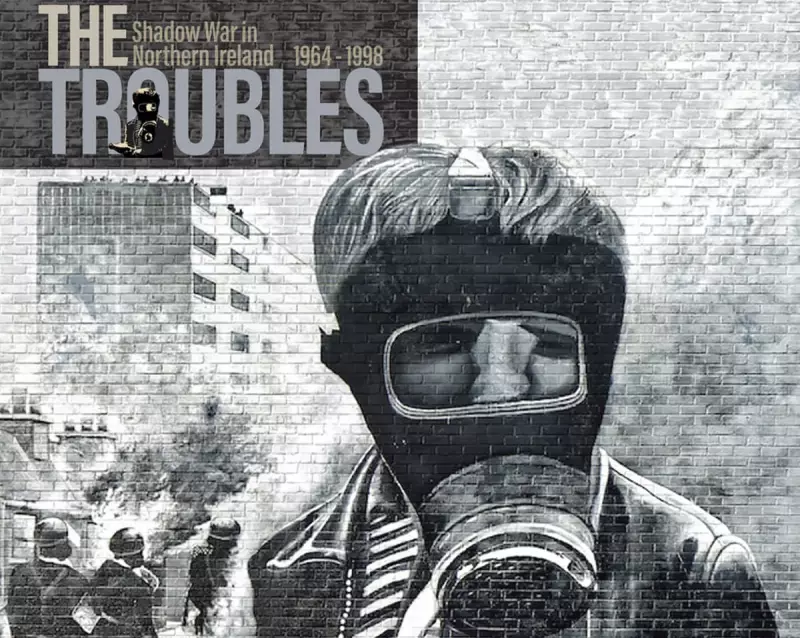
Planned Troubles-Themed Board Game Faces Fierce Criticism in Northern Ireland
A proposed board game that turns the Northern Ireland Troubles into entertainment has been met with widespread condemnation from victims' rights groups, who argue it risks retraumatising survivors and oversimplifies a complex historical conflict.
Game Mechanics and Historical Context
The game, titled The Troubles: Shadow War in Northern Ireland 1964-1998, is being developed by Connecticut-based Compass Games and allows two to six players to adopt different factions involved in the conflict. Players can choose to represent security forces, the IRA, loyalist paramilitaries, or nationalist and unionist politicians, navigating political deals and security operations across eight historical epochs.
According to the game's current iteration, players use dice, tokens, and a deck of 260 cards to simulate the conflict's progression, with the stated aim of concluding within six hours of gameplay. The game includes detailed components such as:

- Blue cubes representing RUC troops
- Black octagons representing IRA active service units
- Tan markers for British military units
- Colour-coded pieces for loyalist paramilitaries (red), unionist politicians (orange), and nationalists (green)
The game's historical epochs span from the "bloody years" of the early 1970s to the "target mainland" campaign of the mid-1980s when the IRA launched attacks in England. Cards feature titles referencing real events and figures, including "nutting squad," "sniper at work," and "Stakeknife" - the codename for an infamous IRA mole.
Victims' Groups Voice Strong Opposition
Kenny Donaldson of the South East Fermanagh Foundation, a victims' rights organisation, has led criticism of the game, stating that it could trigger traumatic memories for survivors and minimise their suffering. "They're oversimplifying what is a very complex issue," Donaldson told reporters. "Many will feel that it has the effect of minimising their suffering."
Donaldson drew a powerful comparison to highlight what he sees as the game's fundamental insensitivity: "What would be the likely response of 9/11 families were these US producers to make a comparable board game about 9/11, with players being the FBI, a terrorist murdering pilot?"
The victims' advocate emphasised that the Troubles remain a living legacy in Northern Ireland society, not a historical event that can be neatly packaged as entertainment. "The core failure of this initiative is the lack of understanding that 'the Northern Ireland Troubles' are not past tense," Donaldson stated.
Developer's Educational Defence
Bill Thomas, founder and president of Compass Games, has defended the project as an educational tool rather than mere entertainment. "This is to protect history, not to make fun of it," Thomas explained, noting that the company produces board games about military history ranging from ancient battles to modern conflicts.
Thomas revealed that the game remains in early development and won't be released for several years, requiring extensive playtesting and refinement. The game's designer, Hugh O'Donnell - a secondary school teacher in Scotland - has created over 200 pages of rules that delve into historical context dating back to Westminster's 1886 home rule bill.
"Kids in their 20s and 30s in America know nothing about history," Thomas argued. "You have to make it interesting." He suggested that without engaging ways to present historical conflicts, important memories risk being forgotten outside their immediate geographical context.
Complex Gameplay and Historical Representation
The game's mechanics allow paramilitary factions to choose between attacking or colluding with security forces, while political factions can select between backing terrorism, contesting elections, and sharing power. Players navigate what the instructions describe as "259 rich narrative cards" divided across key historical periods.

Despite the developer's educational intentions, the game's disclosure has prompted significant concern in Northern Ireland, where many families continue to live with the consequences of the conflict. The Belfast Telegraph first reported that the game was available for preorder on Compass Games' website for $85 (£63.20), though Thomas has since clarified this was premature.
The controversy highlights ongoing tensions between historical education, entertainment, and sensitivity to traumatic events, particularly when developed by those outside the affected communities. As development continues, the debate surrounding the game's appropriateness and potential impact shows no signs of diminishing.